


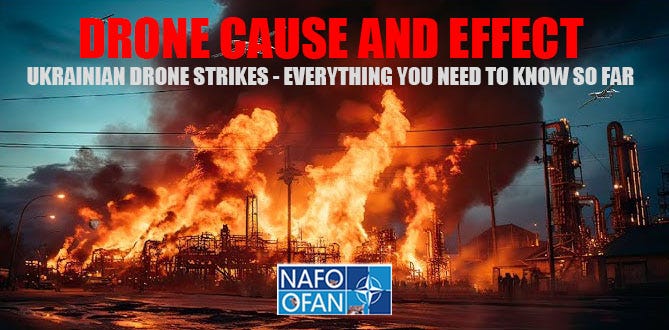
This deep dive is based on publicly available reports and plausible inferences. Owing to the opacity of battlefield damage and Russian accounting, some figures are estimates or drawn from journalistic sources; where possible - flagging uncertainty or caveats.
Intro
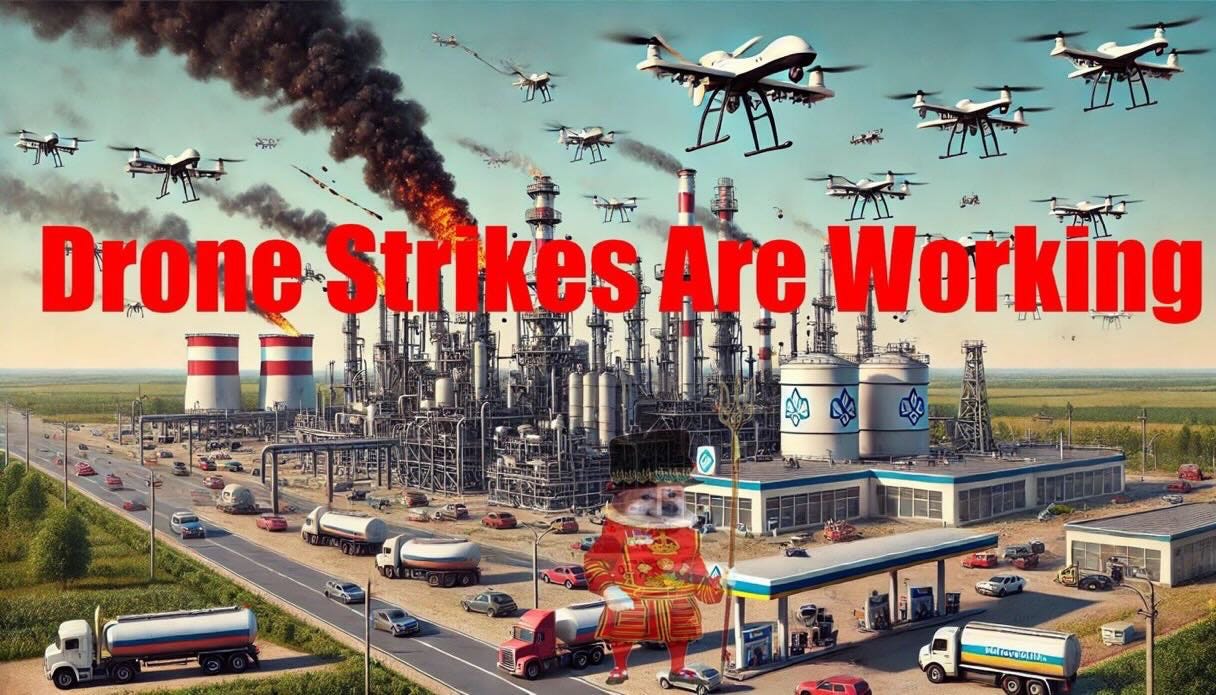
Since mid-2025, Ukraine has escalated its use of drones and loitering munitions to strike Russian oil refineries and related petroleum infrastructure. The strategy appears aimed at “kinetic sanctions” — imposing economic damage on Russia’s oil sector, which is central to state revenues and the war economy.
This thread assembles known data on those drone strikes and their effects on Russian refining capacity; examines Russia’s strategic response, including import plans for refined fuel; and finally offers an estimate of lost revenue and discusses how this may weaken Russian capacity to sustain its territorial ambitions in Ukraine.
Ukrainian Drone Strikes: Scope, Targets, and Mechanism
Targets and Geographic Reach
Ukraine’s drone campaign has struck refineries, petrochemical complexes, pipeline pumping stations, and oil export terminals deep inside Russian territory. For example, on September 24, 2025, drones struck the Salavat petrochemical complex in Bashkortostan, producing specialized fuels and chemical feedstocks.
On September 26, the Afipsky refinery in Krasnodar was hit again, sparking a fire near a processing unit. In mid-September, the Kirishi refinery in Leningrad Oblast had a furnace and part of a key processing unit damaged, knocking offline about 40 % of that refinery’s capacity.
Earlier in 2025, a large drone strike damaged the Ryazan refinery — one of Russia’s major fuel producers — setting fires and damaging storage and treatment units. These strikes show both geographic depth and sophistication in selecting critical infrastructure.
The drones are complemented by loitering munitions like the Ukrainian “Liutyi” system, which reportedly has been tasked against industrial targets including refineries.
The ability to reach into the Russian interior enables Ukraine to disrupt fuel production far from the front.
Mechanisms of Disruption
Damage falls into several categories: direct structural damage (fire, explosions, damage to furnaces or cracking units), secondary losses through forced shutdown due to safety or feedstock disruption, and wear from repeated shock/vibration. Repairs are complicated by security constraints, sanctions on spare parts, and intermittency in access to vulnerable areas.
Some knocked units require weeks to months to restore. For instance, the Kirishi plant expected to need up to one month to repair its damaged furnace and associated units.
Moreover, pipeline and transport interdicts contribute to disruption.
Ukraine has attacked pump stations along the Druzhba pipeline, complicating feedstock delivery to refineries. Authorities report that damage to storage and carrying capacity in the Transneft system has forced constraints on upstream crude flow. Thus, even refineries not physically hit may suffer by lack of feedstock or intermediate product supply.
Cumulative Impact on Refining Capacity
Estimating the aggregate impact is challenging, yet multiple journalistic and industry sources converge on a rough range.
As of late August 2025, Reuters estimated about 17 % of Russia’s refining capacity (some 1.1 million barrels per day) was disrupted — whether via damage or maintenance delays exacerbated by attacks.
That was a record monthly high of 6.4 million tons offline. According to one Reuters analysis, Ukraine’s attacks have on certain days reduced refining throughput by “almost a fifth.”
Subsequent reports attribute nearly 38 % of primary refining capacity offline by late September (~338,000 tons per day), with about 70 % of that dysfunction attributed to drone attacks. That level of idled capacity surpasses earlier wartime peaks (e.g. May 2022) and other historical maintenance downtimes.
Russian media also offer propaganda reporting, crafted under the direct influence of the FSB and Kremlin controlled publication outlets such as Rosstat and RT. They cite (and understate), that in September gasoline and diesel production dropped ~6 % in August and ~18 % in September, as a direct consequence of refinery “downtime”. This is claimed in the face of video graphic evidence of drone strikes and multiple verified individual russian accounts on the ground, often published on Twitter or Telegram.
It is also reported that at least 16 of Russia’s 38 refineries have been struck since August 2025. Within that cohort, key facilities in Ryazan, Volgograd, Samara, Novokuibyshevsk, Syzran, and others have had units disabled or shut entirely.
Some individual plants have lost 40 % or more of internal capacity (Kirishi), or reduced overall capability (Ryazan halved).
One must emphasise the uncertainty: Russian state disclosures are restricted as “state secrets” by Putin’s decree in December 2022 - effectively weaponising reporting and economic data in Russia. The reports ensure the repair progress is opaque, and claim nonsensical reasons such as “some shutdowns may reflect planned maintenance or logistical bottlenecks, not just damage alone”.

Effects on Russia’s Fuel System, Exports, and Domestic Market
Export Adjustments and Crude Reallocation
As refining capacity is curtailed, Russia has diverted more crude oil for export, especially via western ports. In August 2025, Russia raised its export plan by 200,000 barrels per day to account for the freed crude that otherwise would have gone to domestic refining.
Reuters analysts interpret this as a direct market response to refinery disruptions. However, selling crude yields lower export margins than selling high-value refined products, and also pushes Russia further into discounting the “Urals” grade on global markets.
Reuters notes that in August, about 3.1 million tons of capacity (~48 % of offline totals) owed to drone hits, with the remainder due to “maintenance”, probably a euphemism for facilities they can’t repair due to the lack of spares and equipment as a direct result of sanctions on the Russian regime. Russia’s internal balancing has also led to tighter allocation of feedstock and curtailment of some refining units to preserve throughput in priority facilities.
Some analysts regard the attacks as a boon to U.S. refiners, as Russia’s diminished ability to supply refined fuels opens market space for Western producers.
Domestic Shortages, Price Spikes, and Rationing
Within Russia, fuel shortages have begun to manifest in affected regions. Some gasoline stations run out of certain grades; price spikes for A-95 gasoline reportedly exceed 40 % in parts of Russia.
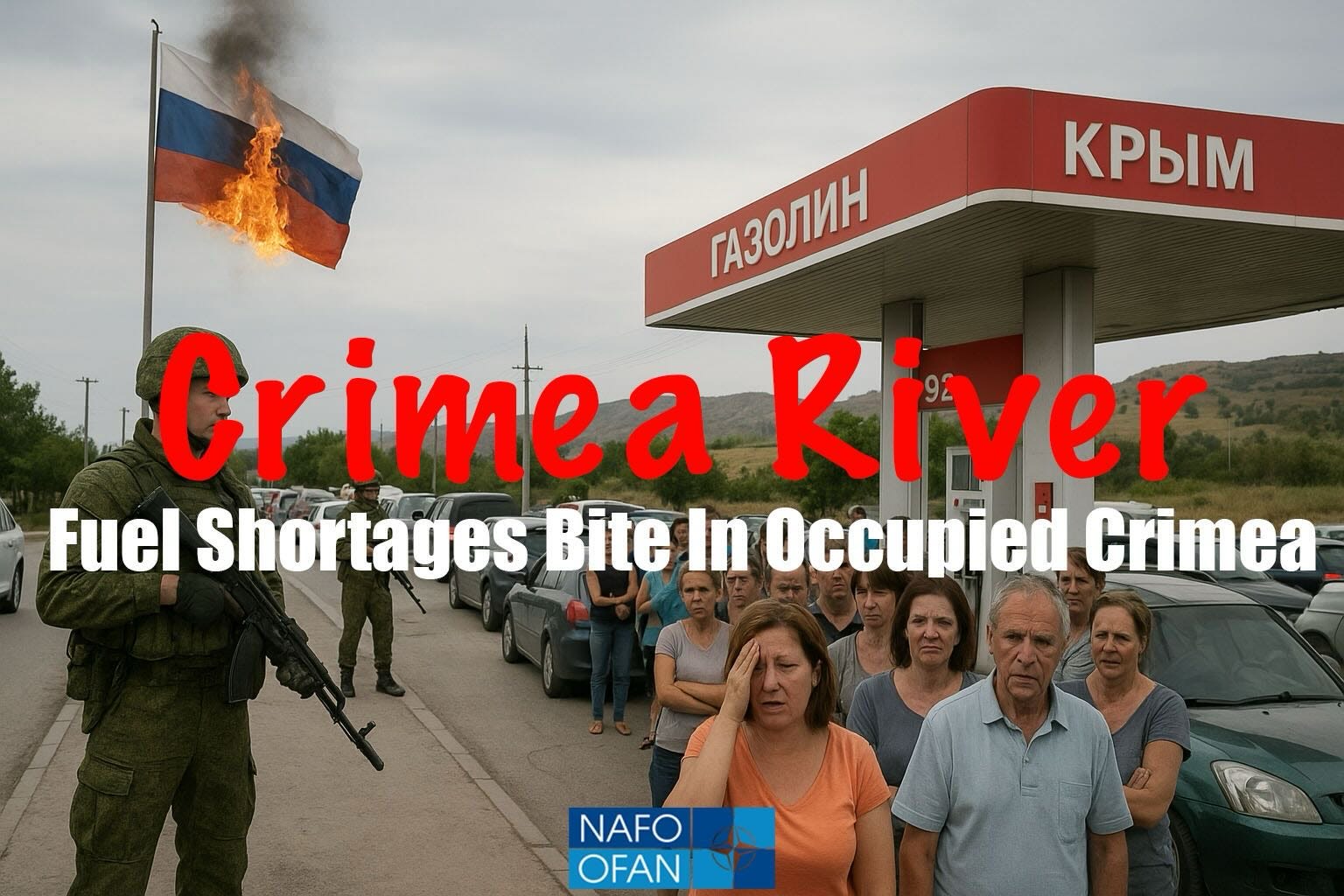
The region of Crimea, under Russian control, has imposed fuel rationing and price freezes, limiting motorists to 30 litres per fill. Deputy Prime Minister Alexander Novak noted “a small deficit” in petroleum products covered through stockpiles, but signalled that domestic balance is fragile, prompting extended export bans. Some Russian regions report that certain grades (e.g. Ai-95) may take up to two weeks to normalise supply. Two months later the supply issues are persisting and growing - leading the implementation of soviet styled fuel vouchers, a flourishing black market and fuel thefts.
To mitigate domestic pressure, Russia has extended and tightened export bans on gasoline and diesel.
On September 30, 2025, Russia declared a partial diesel export ban (for resellers) and extended its gasoline export ban through year-end, citing domestic shortages. The ban on gasoline covers both producers and resellers and excludes only intergovernmental agreements. Analysts, however, expect the domestic supply effect to be modest because Russia already levies a high export tariff on diesel for non-producers.
Decision to Import Refined Fuel
In a striking reversal for a major oil exporter, Russia is now preparing to import gasoline, diesel, marine fuel, and jet fuel to fill domestic shortfalls.
According to press reports, the Eurasian Economic Commission (EEC) — whose members include Russia, Belarus, Kazakhstan, Armenia, and Kyrgyzstan — intends to remove import duties on these fuels until June 30, 2026, to facilitate inflows.
The duty waiver is expected to take effect in about 10 days. Russian sources estimate a domestic deficit of ~400,000 tons of gasoline monthly — about 20 % of consumption — citing that about 1 million tons of gasoline output was lost in September due to refinery outages. Reports also highlight that Russia increased gasoline imports from Belarus in 2025 (e.g. +36 % in July, +168 % in September), but those flows still cover under 2 % of domestic demand.
This import pivot underscores the severity of the internal balance stress: a country that traditionally exported refined products is now forced to become a net importer in order to maintain domestic fuel supply and social stability.
Refining Capacity Reductions and Trends Through September 2025
The pattern of refinery outages in 2025 shows a clear trend of accumulation. As of August, about 6% of Russia’s refining capacity was reportedly nonfunctional (this figure may reflect partial unit shutdowns or reduced throughput). But by early September, average outage rose to ~18 %, and by September 28, nearly 40 % of capacity was “idled”.
These numbers are drawn from Russian media and analytics firms such as Siala, RBC, and quoted in journalistic accounts. While the precise baseline capacity and definition of “outage” differ across sources, the upward trajectory is clear.
The leap from 6 % to 18 % to 40 % over about two months suggests cumulative damage, repair failure, repeated strikes on repaired units, or compounding grid or logistical stress.
It also implies that Russia’s capacity buffer (i.e. unused spare capacity) was relatively low to begin with. Once attacks surpass that buffer, systemic failure accelerates.
In August, Reuters estimated around 17 % of refining capacity was disrupted (1.2 million barrels per day) via a combination of strikes and maintenance. Thus the 6 % outage earlier may represent a midpoint or partial shutdown baseline. It should also be noted that some plants perform extensive scheduled maintenance in summer, so attributing all downtime to attacks risks overstatement.
It is plausible that by late September, with nearly 40 % nominal capacity offline, Russia must prioritise the most efficient or strategically located refineries for feedstock and allocate output to military, aviation, and key transport sectors — further exacerbating civilian fuel shortages elsewhere.
Estimated Value of Lost Revenue and Strategic Consequences
Estimating Lost Revenue
Quantifying lost revenue to the Russian regime from these disruptions is inherently uncertain. Nevertheless, some approximations can be attempted.
Russia’s oil and gas sector remains a backbone of its fiscal regime, often accounting for between one-third and one-half of federal budget receipts. In August 2025, Russian fossil fuel export earnings dropped to ~EUR 564 million per day, declining for the third consecutive month — although that figure includes crude, LNG, gas, and coal, not just refined products.
If Russia’s refined products export earnings are a smaller subset, the impact of reduced capacity is magnified by the higher margins on refined fuels versus crude exports. Some trade analyses suggest that diesel exports are now at their lowest since 2020, and the price premium on diesel relative to Brent has widened by $25–30 per barrel due to scarcity.
If we assume Russia’s average margin per barrel of refined product vs crude is on the order of $10–20, a 1 million bpd (barrels-per-day) shortfall in refining could translate to $10–20 million per day in lost margin, or ~$3–6 billion per year (a rough order). But this is a first approximation and depends heavily on product mix, export pricing, and discounting.
Additionally, domestic disruptions force Russia to forgo export opportunities (e.g. shifting refined volumes to domestic use), further compounding the fiscal hit. If import costs of fuel exceed domestic production displaced, Russia may incur negative net balances on trade in petroleum products.
Overlaying the export bans and domestic price control measures, the state may also suffer from lower tax take (excise, VAT) on fuel sales, further diminishing revenues.
Given the scale and strategic importance of petroleum to Russia’s war economy, even a conservative estimate of $1–3 billion in net revenue loss over several months would materially impair resourcing.
Strategic Implications for the War Effort and Territorial Control
The erosion of Russia’s refining base undermines multiple dimensions of its war and occupation capacity:
Fuel Logistics and Mobility: Russian ground, air, and logistic operations are heavily fuel-intensive. Reduced domestic refining capacity means that more fuel must be allocated or imported under constraint, reducing flexibility. Units in peripheral theatres may face fuel shortages or prioritisation to more critical fronts.
Budget Constraints: A reduction in petroleum revenue tightens the Kremlin’s fiscal room to supply arms, pay salaries, and sustain occupation governance. Fuel-sector revenues have historically subsidised or cross-funded other sectors.
Domestic Stability Risks: Fuel shortages, price spikes, and rationing in Russian regions — particularly in remote areas, borderlands, and annexed territories — may generate public discontent or protest, pressuring the regime politically. The government is already responding with export bans, subsidies, and price controls.
Import Dependence and Vulnerability: As Russia begins importing refined fuels, it becomes reliant on external supply chains, which are vulnerable to diplomatic pressure, sanctions, logistical disruption, or contestation. This adds a strategic vulnerability where none existed before.
Opportunity for Leverage in Negotiations: Ukraine (and its backers) can argue that the refinery campaign is weakening Russia’s ability to sustain its invasion irreversibly. This may shift the negotiation calculus, raising the cost to Russia of continuing occupation.
Temporal Leverage: Because repairing refineries is capital- and time-intensive, and because repeat attacks may forestall restoration, the degradation may produce structural decline. If Russia cannot reverse the losses before winter or spring, it may permanently lose a portion of its refining base — thereby lowering its long-term war-sustaining capacity.
However, some caveats are necessary. Russia may reallocate crude to fewer but better-protected refineries, accelerate repair where possible, or accept a degraded but steady “minimum output” for military logistics. Russian state priorities may channel scarce fuel to military and industrial sectors at the expense of civilian supply. Moreover, global crude markets may adapt by accepting lower margins or absorbing Russian crude exports displaced from refined product channels.
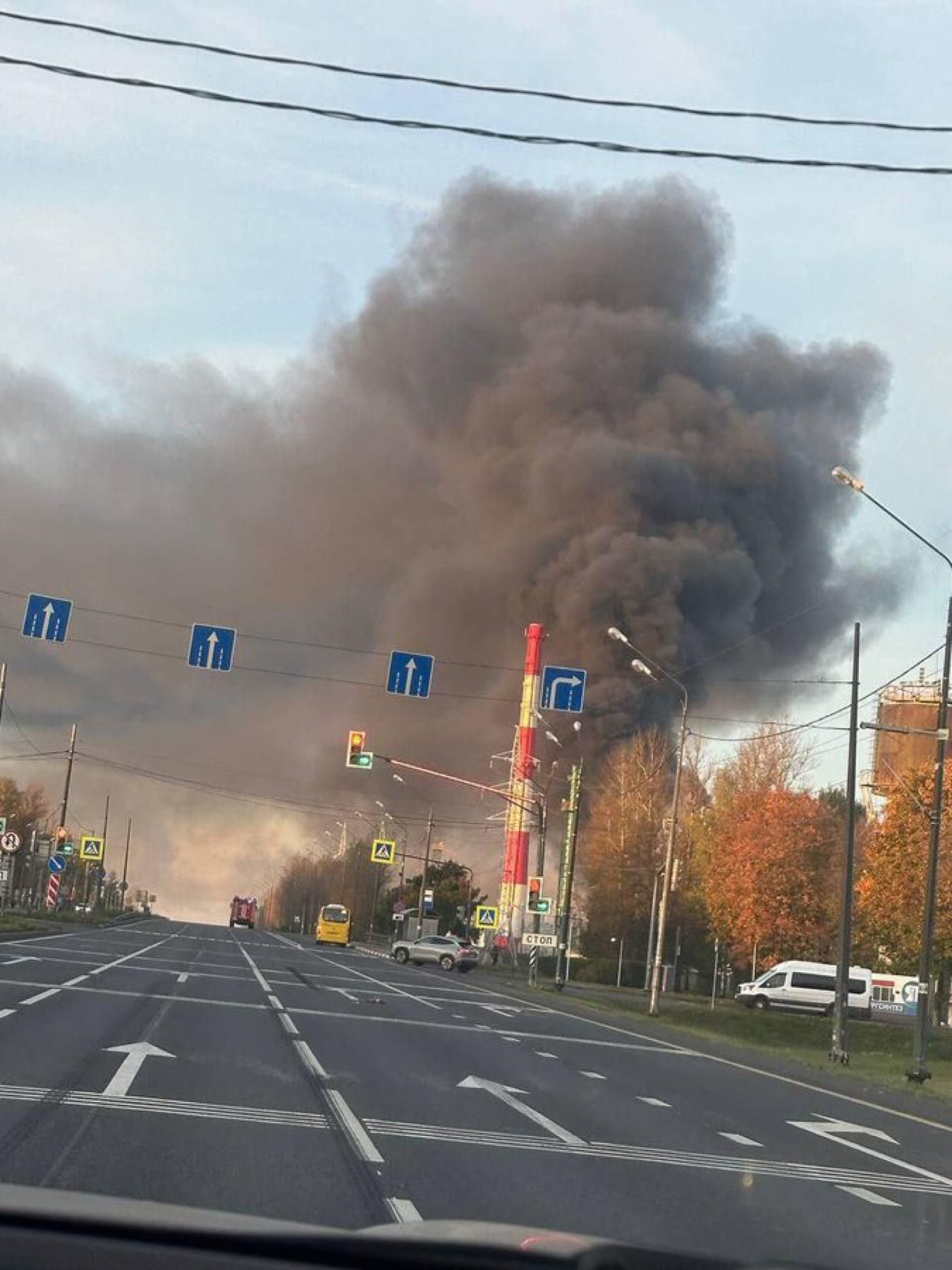
30 September, 2025 - Yaroslavl oil refinery drone strike:
The reported fire at the Yaroslavl oil refinery (Slavneft-YANOS) has significant potential consequences given the size and importance of the facility.
With a designed capacity of 15 million tons per year, YANOS ranks fifth among Russian refineries in terms of primary processing and is the largest refinery in northern Russia. Its products are critical for consumers across central and northwestern regions, supplying industrial enterprises, airports, railway systems, and military-industrial facilities.
On October 1, 2025, Russian authorities confirmed that a fire had broken out at the plant. The regional governor described the blaze as “technological in nature,” rather than linked to external hostile action.
The scale of the damage and whether critical units were affected remains unclear. If the disruption is extensive, the loss of refining capacity could directly impact regional fuel supply, especially given the reliance of airports, the Northern Railway, and major industrial consumers on YANOS output. Even a partial shutdown could increase transport costs, strain distribution logistics, and raise fuel prices in the affected regions.
Slavneft-YANOS (Yaroslavl) has a designed capacity of about 15 million tonnes per year. Russia’s refineries processed roughly 267 million tonnes of crude in 2024 (the lowest annual level since 2012), so 15 ÷ 267 ≈ 0.056, meaning YANOS represents about 5.6% of Russia’s 2024 crude-processing throughput.
If the Yaroslavl plant were knocked fully offline for any length of time, that loss would therefore be equivalent to roughly five to six percent of last year’s national refining throughput. Source for the plant profile: Rosneft’s YANOS page. Source for Russia’s 2024 processing figure: Reuters.
Two further factors magnify that headline percentage. First, a static percentage of national annual throughput understates the short-term shock when the system is already tight. Recent reporting showed record amounts of primary refining capacity being taken offline — Reuters calculated a record monthly high of about 6.4 million tonnes offline in August (and other industry reporting has placed a large share of capacity idle or damaged).
When a portion of the national refinery network is already out of service, losing a single large plant has an outsized effect on regional supply and distribution flexibility because there is less spare capacity to make up the deficit.
The strategic implications extend beyond the regional economy. Russian refineries have already faced stress in 2025 due to Ukrainian drone strikes and domestic policy constraints. In late September, Moscow imposed a partial diesel export ban until the end of the year and extended restrictions on gasoline exports, citing supply concerns. Refinery shutdowns in other regions have already caused shortages, with local officials in Crimea reporting difficulties in maintaining stable supplies. Against this backdrop, any sustained outage at YANOS further reduces Russia’s margin of flexibility in balancing domestic demand and export commitments.
Politically, the framing of the incident as a technical failure is notable. Russian authorities may be keen to avoid public alarm over vulnerabilities to external attack, but regardless of the cause, the event underscores the fragility of refining infrastructure at a time when supply resilience is under pressure.
A prolonged outage could compel greater reliance on other refineries, increase the costs of rerouting supplies, or force Moscow to maintain restrictive export measures to safeguard domestic stability.
In the short term, the impact is likely to manifest in localised supply disruptions and possible price increases. Over the medium term, the consequences will depend on how quickly the facility can be restored to full operation. Should repairs prove lengthy, the refinery’s downtime could become another contributing factor to Russia’s tightening fuel market, already strained by geopolitical conflict, sanctions, and previous refinery losses.
Beefy’s Conclusions
The Ukrainian drone strike campaign against Russian refining infrastructure represents a high-leverage kinetic assault on the backbone of Russia’s war-financing machine. The data to date show a strikingly rapid rise in refinery outages: from modest levels early in 2025, to ~17 % of capacity offline in August, to perhaps 38–40 % by late September, though precise numbers vary by source. Russia’s response — extending export bans, diverting crude, and planning for refined imports — underscores the seriousness of the disruption.
In revenue terms, while precise figures are elusive, the disruption likely inflicts a multibillion-dollar drag on Russia’s margin and tax base. Given the centrality of petroleum to the Russian state budget and war economy, this loss of the refined products value chain reduces Russia’s operational, fiscal, and political resilience.
Strategically, the refinery disruptions erode Russia’s fuel supply security, raise the marginal cost of sustaining occupation, and increase its reliance on external supply lines. In a contest of endurance, Ukraine’s refinery campaign may widen the gap: even if Russia holds territorially in the near term, its ability to project, expand, or sustain its “land grab” ambitions may weaken as the refinery damage compounds.
At present, Ukraine and its allies may view continued targeting of refineries, complemented by sanctions and export controls, as a potent asymmetric tool. Unless Russia can restore or compensate for the lost refining base, the long-term structural damage to its capacity to wage war may play a critical role in shifting the balance.
References and sources:
U.S. Energy Information Administration, “Russia — International Energy Data and Analysis (country profile: Russia).” (EIA) — baseline refinery runs figure. https://www.eia.gov/international/content/analysis/countries_long/russia/ .
Reuters, “Russia’s idle oil refining capacity record high after Ukrainian drone attacks,” 28 August 2025. https://www.reuters.com/business/energy/russias-idle-oil-refining-capacity-record-high-after-ukrainian-drone-attacks-2025-08-28/ .
Reuters, “Russia’s fuel crisis widens after Ukrainian attacks, sources say,” 23 September 2025. https://www.reuters.com/business/energy/russian-fuel-crisis-widens-after-ukrainian-attacks-sources-say-2025-09-23/ .
Reuters, “Russia declares partial diesel export ban until year-end, extends gasoline ban,” 30 September 2025. https://www.reuters.com/business/energy/russia-declares-partial-diesel-export-ban-until-year-end-extends-gasoline-ban-2025-09-30/ .
Reuters, reporting on strikes hitting Kirishi, Afipsky, Ryazan refineries (Sept. 14–26, 2025 reporting series). Examples: “Ukraine attacks major Russian refinery with drone assault,” 14 September 2025; “Russia’s Afipsky refinery douses fire,” 26 September 2025; “Russia’s Ryazan refinery halves refining capacity after drone attacks,” August 2025.
https://www.reuters.com/world/europe/russias-afipsky-refinery-douses-fire-caused-by-drone-debris-2025-09-26/ ; https://www.reuters.com/business/energy/russias-ryazan-oil-refinery-halves-refining-capacity-after-drone-attacks-sources-2025-08-04/
Oxford Institute / Oxford Energy Commentaries on Russian oil & gas fiscal role (February 2025 commentary and background). https://www.oxfordenergy.org/wpcms/wp-content/uploads/2025/02/Comment-Fiscal-Flex.pdf
Financial Times, coverage on gasoline/diesel scarcity, price effects, and Russia’s taxation changes. Example FT reporting and analysis, Sept 2025—see FT coverage of fuel market effects and VAT changes. https://www.ft.com/content/8f8caa82-0792-4d4e-b350-c484e024d725
https://www.ft.com/content/5670b847-02b9-49ae-bf0c-98eb26a52a62
Rosneft, Slavneft-YANOS Refinery Profile – https://www.rosneft.com/press/releases/item/195565
Reuters, Fire breaks out at refinery in Russia’s Yaroslavl region, governor says (Oct 1, 2025) – https://www.reuters.com/world/fire-breaks-out-refinery-russias-yaroslavl-region-governor-says-2025-10-01
Reuters, Russia declares partial diesel export ban until year-end, extends gasoline ban (Sept 30, 2025) – https://www.reuters.com/business/energy/russia-declares-partial-diesel-export-ban-until-year-end-extends-gasoline-ban-2025-09-30
Reuters, Refinery shutdowns hurt fuel supply in several Russian regions, Russian Crimea head says (Sept 25, 2025) – https://www.reuters.com/business/energy/refinery-shutdowns-hurt-fuel-supply-several-russian-regions-russian-crimea-head-says-2025-09-25
Here are the sources corroborating the 38% figure:
Kyiv Post publishes the claim: “As of September 28, 38% of primary refining capacity – equal to 338,000 tons per day – was offline … About 70% of the outages were caused directly by drone strikes.” They cite the “Seala” (which seems to be a variant spelling of Siala) data, as relayed via RBC.
RBC-Ukraine also repeats the figure: “At the end of September, almost 38% of the country’s primary oil refining capacity was idle, which is about 338,000 tons per day … According to Siala’s estimates, approximately 70% of these downtimes were caused by Ukrainian drone attacks …”
United24 Media uses the same numbers: “By late September, nearly 38% of Russia’s oil refining capacity—around 338,000 tons of crude per day—was offline … Ciala estimates that around 70% of the outages stem directly from drone strikes.”
Ukrainska Pravda (English edition) also repeats the figures and states they derive from RBC citing Siala.
Other regional / news aggregators (e.g. Charter97) republish the same numbers, attributing them to Siala via RBC.

Your support will be really appreciated. Please help me keep publishing educational material across channels!
buymeacoffee.com/beefeaterfella
patreon.com/Beefeater_Fella
beefeaterresearch.substack.com
Your meticulously researched report reveals the extent of the damage done to russia's oil industry and the subsequent financial and societal impact. I can only applaud the ingenuity and resourcefulness of the Ukrainian military in achieving such success in degrading russian refining capacity. The fact that these drones can fly deep inside russian territory undetected and inflict so much damage is astounding. Oh, such a delicious irony: an oil rich nation resorting to importing refined product. No wonder #RussianFuelCrisis is trending on twitter!