

Crimea: The Empire’s Cracking Showcase
The growing economic and military burden of defending Putin’s most symbolic conquest

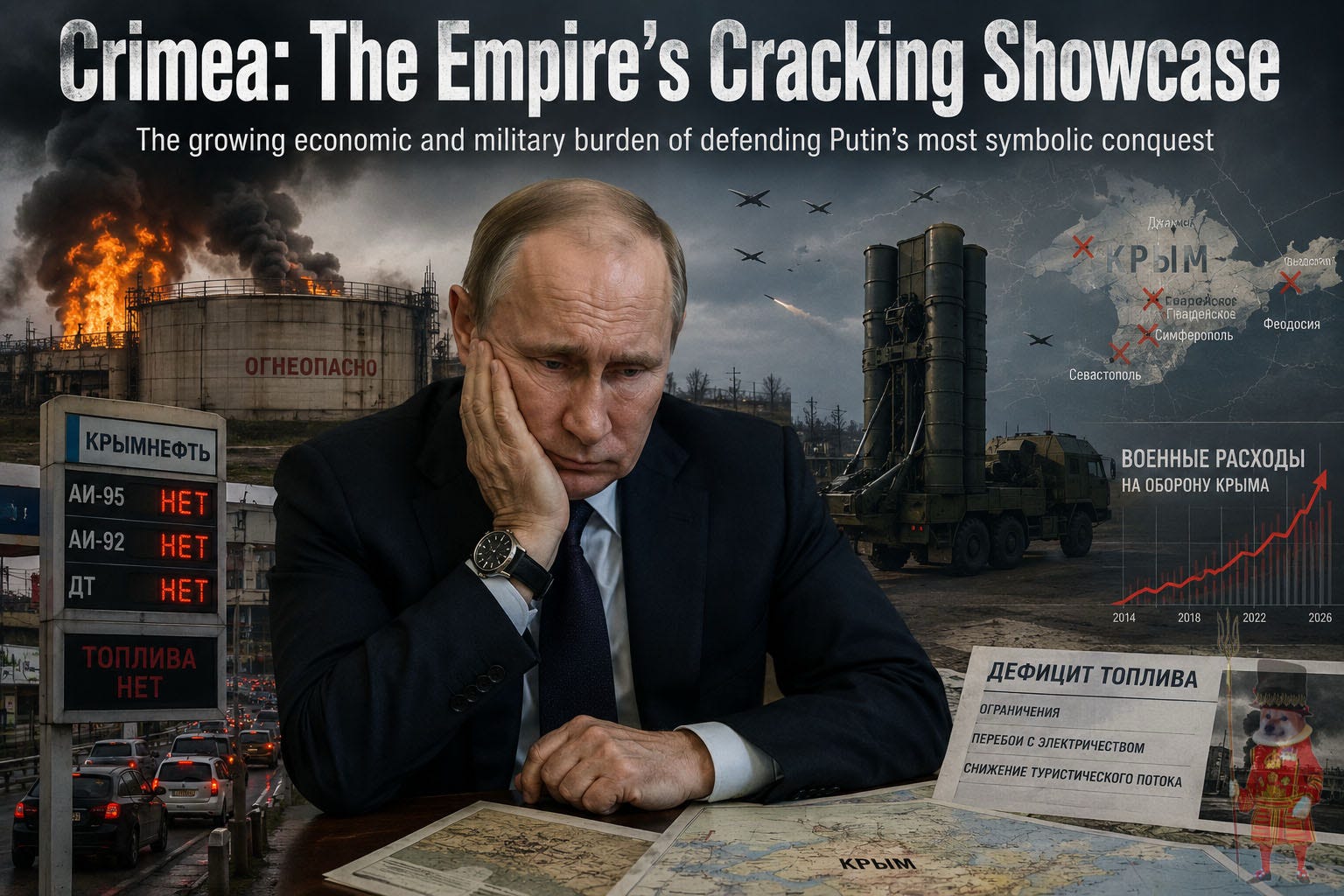
Crimea: The Empire’s Cracking Showcase
Ukraine’s emerging Crimea strategy is not a beach-landing romance. It is uglier, cheaper, and more intelligent: make Crimea too expensive to hold, too brittle to supply, too dangerous to advertise, and too embarrassing to parade.
A full military retaking of Crimea would be a vast drain on Ukrainian forces, requiring amphibious, air, missile, engineering, and urban operations against a fortified peninsula.
So Kyiv is doing something more corrosive: turning Putin’s imperial showroom into a logistics cellar with the lights flickering.
The legal and symbolic backdrop matters. Crimea is occupied Ukrainian territory, and Vladimir Putin is under an ICC arrest warrant for alleged war crimes linked to the unlawful deportation and transfer of Ukrainian children.
The peninsula is not merely land to Moscow. It is the founding relic of Putin’s revived empire myth, the shiny Orthodox-Tsarist-KGB snow globe he has been shaking since 2014. Ukraine’s strikes are aimed at smashing the glass without necessarily marching across every shard.
The Slow Strangulation, or How to Boil an Occupation in Its Own Diesel
The most important development over the past year is the shift from episodic symbolic strikes to systematic interdiction.
Ukraine is no longer merely hitting spectacular targets in Crimea. It is attacking the peninsula’s metabolism: fuel depots, oil terminals, power nodes, gas storage, ferries, rail links, air-defence systems, and military supply vessels.
By late June 2026, this had produced visible administrative panic. Russian-installed authorities suspended civilian gasoline sales in Crimea after intensified Ukrainian strikes against fuel infrastructure, with AP reporting that fuel was being reserved for government use and that the shortages were among the worst since Russia’s 2014 annexation.
Reuters reported temporary household power curbs in Sevastopol after Ukrainian drone attacks strained the energy network, with fuel sales halted to private motorists and reduced hours for public services, transport, shops, cafes, and street lighting.
That is not liberation yet. But it is occupation beginning to cough blood into a handkerchief.
The pattern is unmistakable. Ukraine struck the Hlibivka underground gas storage facility in western Crimea on 19 June 2026, according to Ukraine’s Unmanned Systems Forces reporting cited by the Kyiv Independent. Around the same period, strikes hit oil facilities in Crimea and Krasnodar, including facilities Russia uses to supply its forces, according to Al Jazeera and Reuters-based reporting.
On 23 June, Ukraine said it struck oil facilities near the Crimean Bridge and elsewhere on the peninsula, amid footage of explosions and an already severe gasoline shortage.
The result is a simple strategic equation: no fuel, no manoeuvre; no power, no normality; no normality, no “Russia forever” postcard.
The Air-Defence Onion Is Being Peeled, and Moscow Is Crying
Ukraine’s strikes on Crimea are not just about petrol queues.
They are also about dismantling Russia’s anti-access bubble. S-300 and S-400 systems, radars, command assets, and launchers have been repeatedly targeted. Kyiv Independent reported that Ukrainian drones struck a Russian air-defence system and oil depot in occupied Crimea overnight on 29 April 2026.
Militarnyi reported an 8 June 2026 drone strike on an S-400 position in occupied Crimea.
Kyiv Post reported in April that Ukraine’s “Madyar’s Birds” struck an S-400 radar station in Feodosia, a system capable of tracking up to 100 objects and guiding dozens of missiles.
This matters because every destroyed radar or launcher does two things at once. It removes a defensive asset and forces Russia to protect the remaining ones with still more scarce assets. The shield becomes a burden. The umbrella needs an umbrella. Soon the empire is standing in the rain holding a colander.
UK Defence Intelligence, as reported on 27 June, assessed that Ukraine’s broader targeting is degrading Russian air defences even around priority locations such as the Kerch Strait, and that Kyiv has expanded its options for striking the Crimean Bridge.
That is the strategic hinge. Ukraine is not simply hitting what it can. It is shaping what it may later choose to hit.
The cost of defending illegally occupied Crimea
Ukraine’s campaign against Crimea is becoming an exercise in economic asymmetry. Russia is being forced to spend billions defending an occupied peninsula against weapons that often cost tens of thousands of dollars rather than millions.
Every successful Ukrainian drone that penetrates Crimea’s air-defence network represents an extraordinary imbalance in costs.
A domestically produced long-range drone costing perhaps tens or hundreds of thousands of dollars can force Russia to launch interceptor missiles worth several million dollars each, while simultaneously threatening infrastructure worth hundreds of millions. Even when intercepted, the exchange heavily favours Ukraine economically.
The cumulative costs extend far beyond the missiles fired. Russia has had to reinforce Crimea with additional S-400 batteries, Pantsir systems, radar stations, electronic warfare complexes and fighter aircraft, all of which require constant maintenance, trained personnel and expensive replacement of destroyed equipment.
As Ukrainian strikes have repeatedly degraded these systems, Moscow has been forced to divert scarce air-defence assets from elsewhere in Russia, increasing vulnerability around other strategic locations.
Recent British intelligence assessments indicate that Ukraine’s sustained strikes are weakening even the heavily defended Kerch Strait area, expanding Kyiv’s future strike options.
The economic consequences inside Crimea are now becoming increasingly visible. Fuel shortages have forced Russian occupation authorities to suspend civilian fuel sales, impose emergency measures and reduce electricity consumption, while blackouts and transport disruption have damaged the peninsula’s tourism industry during what should be its most profitable season. Hotel cancellations have surged, businesses face interrupted operations, and local authorities have declared emergency conditions to manage the growing crisis.
Strategically, every destroyed fuel depot, ferry, substation or radar imposes costs that compound rather than simply accumulate.
Infrastructure must be repaired, replacement equipment transported across increasingly threatened supply routes, additional security forces deployed, insurance costs rise, logistics become slower, and civilian confidence deteriorates. What was marketed by the Kremlin as Russia’s glittering Black Sea trophy increasingly resembles an expensive liability requiring continuous subsidy and military protection.
Perhaps the greatest financial burden is opportunity cost.
Every S-400 battery defending Crimea cannot simultaneously defend Russian oil refineries, Moscow or industrial facilities hundreds of kilometres away. Every billion roubles spent repairing damaged infrastructure is a billion unavailable for offensive military operations elsewhere.
Ukraine’s campaign is therefore not simply destroying assets; it is forcing the Kremlin into an ever more expensive defensive posture where maintaining Crimea consumes resources that Russia can ill afford to lose.
In effect, Ukraine is transforming Crimea from Putin’s greatest geopolitical prize into one of his most expensive recurring bills. Rather than serving as a showcase for Russian expansionism, the peninsula is steadily becoming an exercise in diminishing returns, where the political value of holding it is increasingly outweighed by the military and economic costs required simply to keep the lights on and the fuel flowing.
Kerch: The Bridge That Became a Hostage
The Kerch Bridge remains the grand symbol:
Putin’s concrete signature across stolen water. It has already been attacked before, but its survival should not be mistaken for Ukrainian incapacity. The better explanation is sequencing.
Destroying Kerch is militarily attractive but not automatically optimal.
First, the bridge is heavily defended, repaired, monitored, smoked, and politically over-insured. Business Insider reported satellite imagery showing Russian smoke screens over the bridge as Ukrainian drones increasingly target supply lines.
Second, a bridge attack is most valuable when it coincides with wider interdiction of alternatives. If ferries, rail bridges, fuel stores, northern road corridors, depots, and air defences are all degraded first, then Kerch’s destruction becomes a chokehold rather than a headline.
That appears to be exactly the direction of travel. UK-linked reporting says Ukrainian strikes around 20 June hit air defences, fuel storage, and vehicle ferries used to transport supplies across the Kerch Strait.
The Guardian reported that Ukraine has targeted oil depots and transport routes, including the Novorossiya highway and Kerch-linked routes, disrupting fuel and supply chains and forcing cancellations of public events and children’s summer camps.
In other words, Kyiv may be treating Kerch less like a single target and more like the final theatrical prop in a siege already underway.
There is also political utility in leaving it standing, damaged by fear.
A bridge that still exists but cannot be trusted is a psychological weapon.
Every queue, inspection, smoke screen, closure, rumour, and convoy delay tells Russians the same thing: the umbilical cord is visible, fragile, and already being squeezed.
Timelines: Collapse Is Not a Date, It Is a Pressure Curve
Forcing Russia to abandon Crimea is plausible only if “abandon” means a political-military decision under unbearable cost, not a neat calendar appointment.
The most likely near-term outcome, through summer and autumn 2026, is not Russian withdrawal but progressive degradation: fuel rationing, power instability, reduced tourism, disrupted ferries, higher insurance and logistics costs, greater military stockpiling problems, and further relocation of air defence from other Russian regions.
A more dangerous phase could emerge if Ukraine sustains the current tempo for several months while also keeping pressure on the land corridor through occupied southern Ukraine. ISW assessed on 21 June that Ukraine is conducting a strike campaign to deny Russia the ability to sustain logistics and transport fuel across the Kerch Strait, already worsening fuel shortages and supply disruptions in Crimea.
By 27 June, ISW said Ukrainian long-range strikes continued to degrade Russian air defences and fuel storage capabilities in occupied Crimea.
If that trend persists, Crimea becomes less a fortress and more a trapped garrison with beaches.
The fastest plausible coercive timeline would require sustained Ukrainian strike production, continued Western intelligence and weapons support, further attrition of Russian air defence, and a major rupture in either the land bridge or Kerch logistics. Under those conditions, Russia could face a serious Crimea sustainment crisis within months.
Actual abandonment, however, would probably require wider battlefield or political shock: a collapsing southern front, a Kremlin succession crisis, or a negotiated exit forced by military exhaustion. Without that, Moscow may choose misery over retreat, because imperial vanity is cheaper than honesty in the Kremlin accounting system.
The Poster Child Becomes a Missing-Persons Poster
Crimea was supposed to prove Putin’s theory: that Russia could steal territory, militarise it, Russify it, vacation on it, and force the world to sigh itself into acceptance.
Ukraine’s drone campaign attacks that entire proposition. It says occupation is not possession. It says annexation does not make fuel tanks invulnerable.
It says a bridge is not sovereignty, merely concrete waiting for consequences.
The strategy is cynical in the best military sense: avoid the meat grinder, poison the logistics, blind the sentries, frighten the ferries, empty the petrol stations, dim the lights, and let Putin’s imperial showroom become a maintenance liability with flags. Crimea may not fall in one thunderclap.
More likely, it is being made to fail by increments: one radar, one depot, one ferry, one substation, one embarrassed governor at a time.
References and sources:
For the first essay, these are the principal references that underpin the analysis, with direct URLs.
International Law
International Criminal Court
Situation in Ukraine: Arrest warrants for Vladimir Putin and Maria Lvova-Belova
Ukraine’s Campaign Against Crimea
Reuters
Fuel stations run dry after Ukrainian strikes
Reuters
Russian-installed authorities declare economic emergency in Crimea
https://www.reuters.com/world/russian-installed-authorities-declare-emergency-crimea-2026-06-26/
Reuters
Temporary power restrictions in Sevastopol
Reuters
Power outages after Ukrainian strikes
Reuters
Crimea tightens fuel rationing
Ukrainian Military Reporting
Kyiv Independent
Ukrainian drones strike Hlibivka underground gas storage facility
Kyiv Independent
Ukraine confirms strike on Russian air-defence system and oil depot in Crimea
Kyiv Post
Strike against Russian S-400 radar near Feodosia
https://www.kyivpost.com/post/73242
Militarnyi
Drone strike on S-400 position in occupied Crimea
https://militarnyi.com/en/news/drones-s-400-air-defense-occupied-crimea/
British Defence Intelligence
UK Ministry of Defence
Defence Intelligence Updates
https://www.gov.uk/government/collections/uk-defence-in-intelligence-latest-updates
Kyiv Post
British Defence Intelligence Update, 26 June 2026
https://www.kyivpost.com/post/79100
Military Analysis
Institute for the Study of War (ISW)
Russian Offensive Campaign Assessments
https://www.understandingwar.org/
Critical Threats Project (AEI)
Russian Offensive Campaign Assessments
https://www.criticalthreats.org/
Kerch Bridge and Logistics
Business Insider
Satellite imagery of smoke screens protecting the Kerch Bridge
Associated Press
Ukraine strikes railway bridge and infrastructure to isolate Crimea
https://apnews.com/article/d44f4639e670ed6e4f97c1e0ad6dce6e
Le Monde
How Ukraine is orchestrating a logistical squeeze on Russian-occupied Crimea
Wider Strategic Context
The Guardian
Ukraine intensifies strikes to raise the cost of occupying Crimea
https://www.theguardian.com/world/2026/jun/26/ukraine-war-briefing-zelenskyy-40-day-russia-blitz
Radio Free Europe / Radio Liberty
Ukraine strikes oil facilities near the Kerch Bridge
https://www.rferl.org/
Al Jazeera
Ukraine strikes oil facilities in Crimea and Krasnodar
These sources collectively underpin the essay’s assessment of Ukraine’s strategy of degrading Russian logistics, fuel supplies, air defences, and infrastructure in Crimea while increasing the economic and military costs of sustaining the occupation.