

Peleus precedent vs Hideous Hegseth
What the Peleus precedent actually stands for—and what conditions would be required before it could be applied to any modern case, including Hegseth’s alleged order to kill shipwrecked survivors.

What the Peleus precedent actually stands for—and what conditions would be required before it could be applied to any modern case, including Hegseth’s alleged order to kill shipwreck survivors as reported by the Washington Post.
This thread explains the considerations, it does not offer conclusion on the allegations. The purpose of this thread is to create awareness of the legal arguments.
What the Peleus Trial Established (1945–46)
The Peleus war-crimes trial concerned the German submarine U-852, whose captain, Kapitänleutnant Heinz-Wilhelm Eck, ordered the killing of survivors of the steamship Peleus after it had been torpedoed.
The court held:
Key legal principles established by the trial
Killing shipwrecked survivors is a war crime under the laws and customs of war.
Superior orders do not excuse unlawful killings when the order is manifestly illegal.
Command responsibility applies: commanders can be held personally liable for ordering, permitting, or failing to prevent unlawful killings.
Actions occurring in the context of an armed conflict are governed by international humanitarian law (IHL), not domestic military necessity claims.
These principles later influenced post-war jurisprudence and contemporary IHL (Geneva Conventions, Additional Protocols, customary law).
Can this precedent be applied to any modern individual (including Hegseth)?
Only if all of the following strict conditions are met:
(1) Context of an armed conflict
The Peleus precedent specifically concerns conduct during an international armed conflict (IAC) or non-international armed conflict (NIAC).
If an act occurs outside an armed conflict, Peleus does not directly apply, though domestic criminal law would.
The classification of the U.S. pursuit of “drug smugglers” as an armed conflict is a subject of significant legal debate and is generally not recognised as an armed conflict under international law.
The U.S. administration under President Trump has asserted that the U.S. is in a “non-international armed conflict” (NIAC) with drug cartels and has used this justification for using military force, including lethal strikes on vessels in the Caribbean. However, this stance is contested by independent legal experts and international bodies.
Key Points of the Legal Debate
Law Enforcement vs. Armed Conflict: The consensus among international legal experts and the UN Human Rights Chief is that countering illicit drug trafficking is a law enforcement matter, governed by international human rights law, not the law of armed conflict. Law enforcement operations have strict limitations on the use of lethal force, permitting it only as a last resort against an imminent threat to life.
Lack of “Armed Attack”: The right to use military force in self-defense under Article 51 of the UN Charter is predicated on an “armed attack”. Experts argue that drug trafficking, by itself, does not constitute an “armed attack” in the sense required by international law to justify a military response.
Sovereignty and Use of Force: International law prohibits the unilateral use of force in the territory or international waters of another state to fight crime, as this violates that country’s sovereignty. Traditional counter-narcotics operations rely on bilateral agreements with other nations to obtain consent for interdiction.
Domestic Law Concerns: The U.S. Constitution assigns the power to declare war to Congress. The administration’s claim of an armed conflict has sparked a debate domestically, with some lawmakers and legal scholars calling the strikes potentially illegal and extrajudicial killings.
International Condemnation: The UN Human Rights Chief and other international experts have explicitly stated that the U.S. strikes violate international law and find no justification in it. A former International Criminal Court prosecutor suggested such systematic attacks on civilians during peacetime could be considered crimes against humanity.
In essence, while the U.S. administration has attempted to classify its actions as an armed conflict to provide a legal justification for military strikes, this classification is widely rejected by external legal authorities and the international community. The operations are generally considered law enforcement actions that should adhere to human rights law standards.
(2) Verified evidence of ordering unlawful killings
For Peleus to be relevant, there must be established, factual proof—not allegations, not rumours, not media speculation—that a person:
Ordered,
Knowingly permitted, or
Directly participated in
the killing of protected persons, such as:shipwrecked survivors,
detainees,
civilians,
hors de combat combatants.
Without verified evidence, the question remains theoretical.
(3) Protected status of the victims
The precedent applies when victims are:
shipwrecked,
surrendering,
incapacitated, or
civilians.
If the victims are active combatants, Peleus is not the correct precedent.
(4) Jurisdiction
The case must fall under:
International Criminal Court (ICC),
a national military tribunal,
or the doctrine of universal jurisdiction for grave breaches.
Hegseth’s alleged order to kill shipwrecked survivors:
The next image is a screenshot of a Washington Post article published on November 28, 2025, detailing an order by Defense Secretary Pete Hegseth during a military strike on an alleged drug-trafficking boat in the Caribbean.
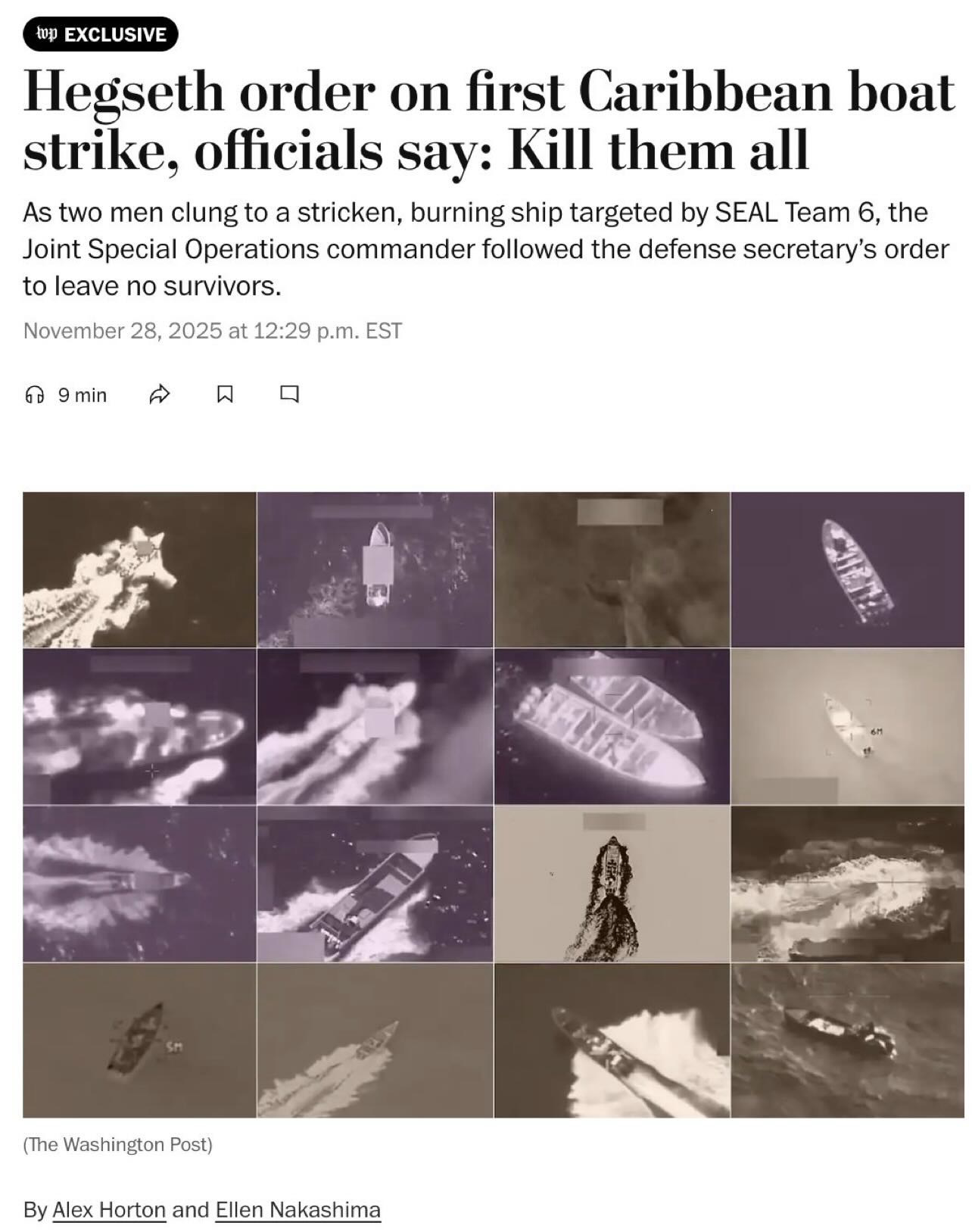
“Two survivors were clinging to the smouldering wreck. The Special Operations commander overseeing the Sept. 2 attack ... ordered a second strike to comply with Hegseth’s instructions.”
The article reports that a Joint Special Operations commander followed an order to leave no survivors, even as two men clung to the burning ship targeted by SEAL Team 6. This incident is part of a series of controversial U.S. strikes on vessels in the Caribbean and Pacific throughout late 2025, which have raised questions about international and maritime law.
Application to Allegations Against Hegseth
Recent news reports, primarily from November 2025, indicate that Defense Secretary Pete Hegseth allegedly gave a verbal order to “leave no survivors” and “kill everybody” in military strikes on alleged drug-smuggling boats near Venezuela. The application of the Peleus findings to these events is a subject of intense legal and political debate:
Extrajudicial Killings: Legal experts and human rights groups have labeled the strikes as potentially unlawful “extrajudicial killings” because the targets were not plausibly threatening imminent harm and were not engaged in traditional armed conflict under a formal declaration of war.
Lawful vs. Unlawful Orders: The core legal conflict revolves around whether the orders issued by Hegseth were lawful. Military lawyers at US Southern Command reportedly raised legal objections, concluding that the attacks may constitute unlawful extrajudicial killings and that they were overruled.
Command Responsibility: The Peleus precedent suggests that if the orders were indeed unlawful, those who issued them (Hegseth) and those who executed them could face criminal liability.
In essence, the Peleus trial provides a historical and legal framework that holds military personnel accountable for atrocities, particularly the killing of non-combatants or survivors, which is the central issue in the allegations against Hegseth.
The ongoing controversy highlights the tension between political directives and established international laws of armed conflict.
What else must be considered?
On the 16th of September, 2025 - UN experts condemned the extrajudicial execution by the United States of 11 people when it sank a civilian vessel in the Caribbean Sea on 2 September 2025, and three people on another vessel on 15 September.

30th October, 2025 - it was reported by the BBC that “International law does not allow governments to simply murder alleged drug traffickers,” the experts said. “Criminal activities should be disrupted, investigated and prosecuted in accordance with the rule of law, including through international cooperation.”
Under law, the intentional use of lethal force “is only permissible as a last resort against individuals who pose an imminent threat to life”, he said.
Secretary of Defence Pete Hegseth has said strikes are being carried out on vessels operated by drug-trafficking groups designated as terrorist organisations by the US, saying this week that “the Western Hemisphere is no longer a safe haven for narco-terrorists bringing drugs to our shores to poison Americans”.
Reported on November 6th, 2025 - the BBC said “A former chief prosecutor at the International Criminal Court (ICC) has told the BBC that US air strikes on alleged drug smuggling boats would be treated under international law as crimes against humanity.”
The administration says it is in a formal armed conflict with South American traffickers who are bringing drugs into the US. But Mr Moreno Ocampo said the military campaign fell into the category of a planned, systematic attack against civilians during peacetime. This, he said, meant that the campaign fell into the category of crimes against humanity.
The White House said in response that President Donald Trump acted in line with the laws of armed conflict to protect the US from cartels “trying to bring poison to our shores... destroying American lives.” It highlighted that the ICC had no jurisdiction over the United States and argued that it was a “biased, unserious entity”.
The United States allows indicted war criminals free travel to the USA, without fear of persecution by the International Criminal Court. However is conducts extrajudicial executions on people they suspect of trying to reach the US by boat, with or without drugs and outside the rule of law norms.
References and sources:
“Trial of Heinz Eck, August Hoffmann, Walter Weisspfennig, Hans Richard Lenz and Wolfgang Schwender (the Peleus trial)” — record at a research-library catalogue.
URL: https://lawcat.berkeley.edu/record/538978
The judgment document of the Peleus trial, “United Kingdom v. Kapitanleutnant Eck et al.” (20 Oct 1945) on worldcourts.com.
URL: https://www.worldcourts.com/imt/eng/decisions/1945.10.20_United_Kingdom_v_Kapitanleutnant_Eck.pdf
A background/history analysis “Historical Origins of International …” on legal-tools.org that references the Peleus case.
URL: http://www.legal-tools.org/doc/1a7083/
Overview of the case from the International Committee of the Red Cross (ICRC) case-book summarizing events and holdings.
URL: https://casebook.icrc.org/
https://www.ohchr.org/en/press-releases/2025/09/us-war-narco-terrorists-violates-right-life-warn-un-experts-after-deadly#:~:text=%E2%80%9CInternational%20law%20does%20not%20permit,law%2C%E2%80%9D%20the%20experts%20said
US strikes on alleged drug boats violate law, UN human rights chief says https://www.bbc.com/news/articles/cx2nx95pgz7o
https://www.washingtonpost.com/national-security/2025/11/28/hegseth-kill-them-all-survivors-boat-strike/
