

Putin’s Parcel Service
The Kremlin outsourced parts of its war effort to commercial logistics and forgot that warehouses have coordinates

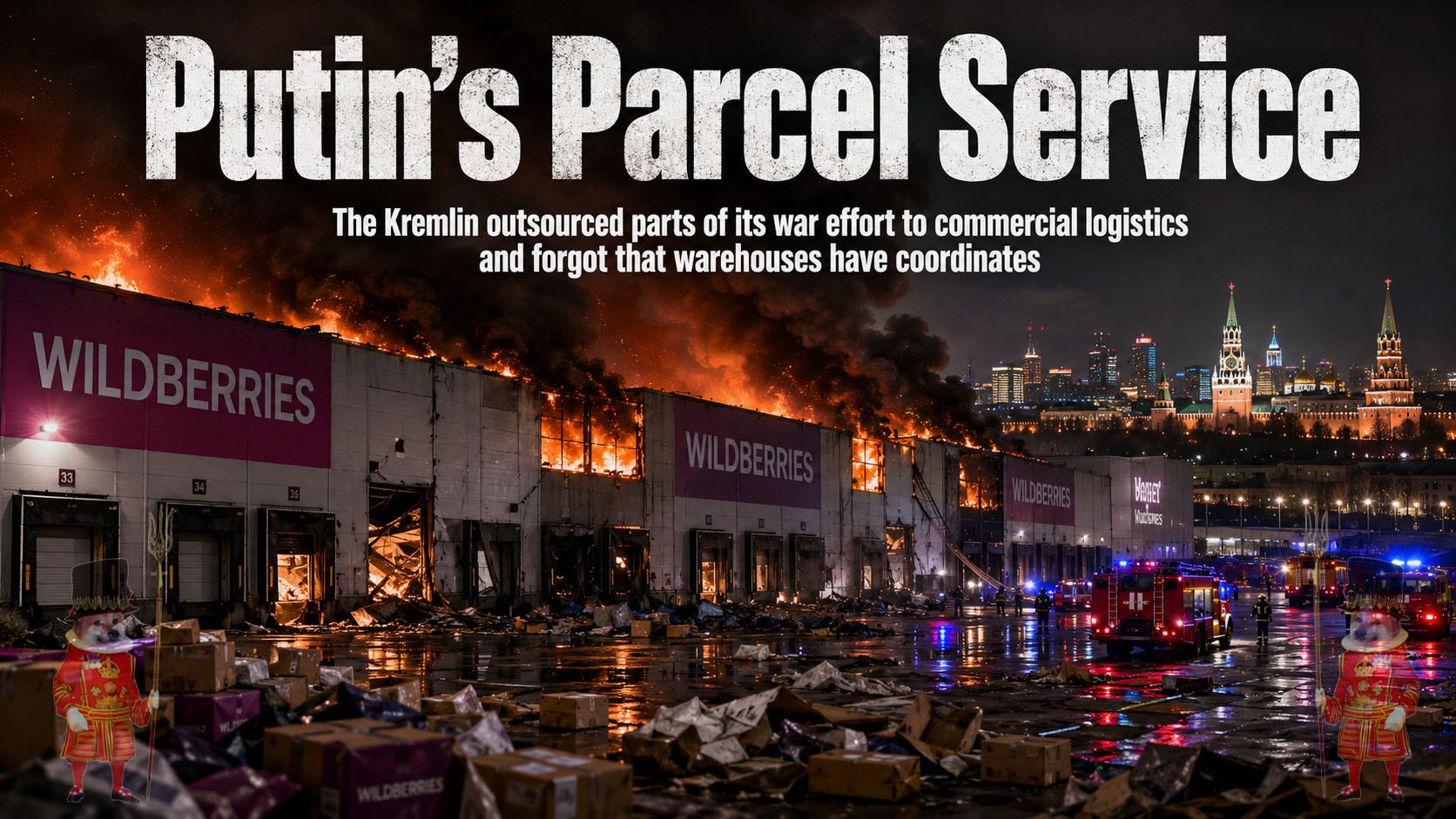
Russia put its consumer economy and military shopping list on the same conveyor belt. Ukraine has started pressing the emergency stop.
For years, the Kremlin has tried to preserve a comfortable fiction. Russia could invade its neighbour, flatten Ukrainian cities, mobilise hundreds of thousands of men, convert factories to military production and still allow ordinary Russians to order trainers, cosmetics, Chinese electronics and tactical body armour from the same app without the war becoming unduly inconvenient.
That arrangement is becoming harder to maintain.
On 18 July 2026, Ukrainian drones struck Wildberries logistics centres in Kotovsk, in Russia’s Tambov region, and Elektrostal, east of Moscow. Russian officials reported that eight workers were killed and dozens injured.
Four days later, further strikes hit Wildberries facilities in Krasnodar and Nevinnomyssk in southern Russia, causing major fires, casualties and additional disruption. Reuters verified footage showing a huge plume of smoke over the Krasnodar site.
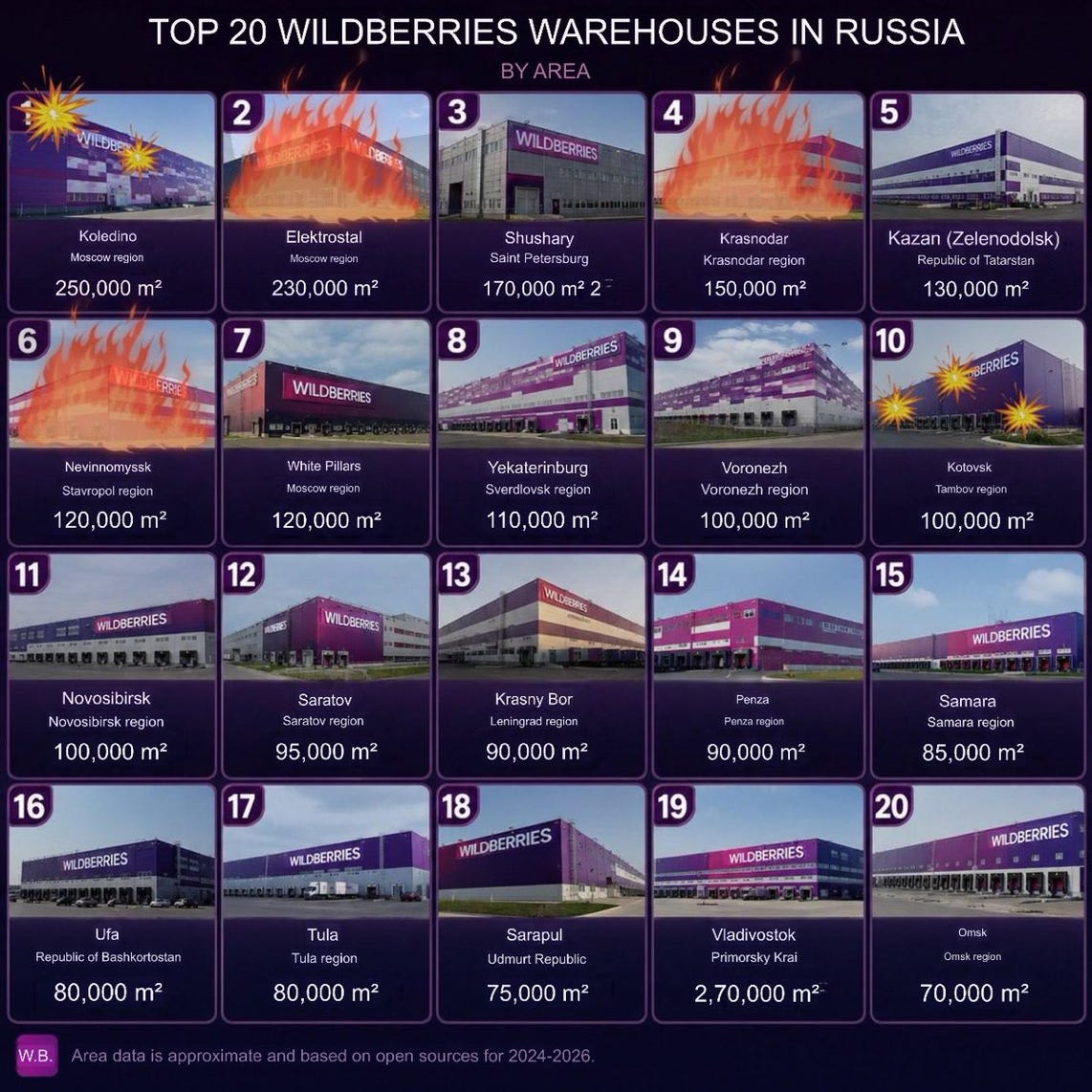
Set out in a Twitter post here:


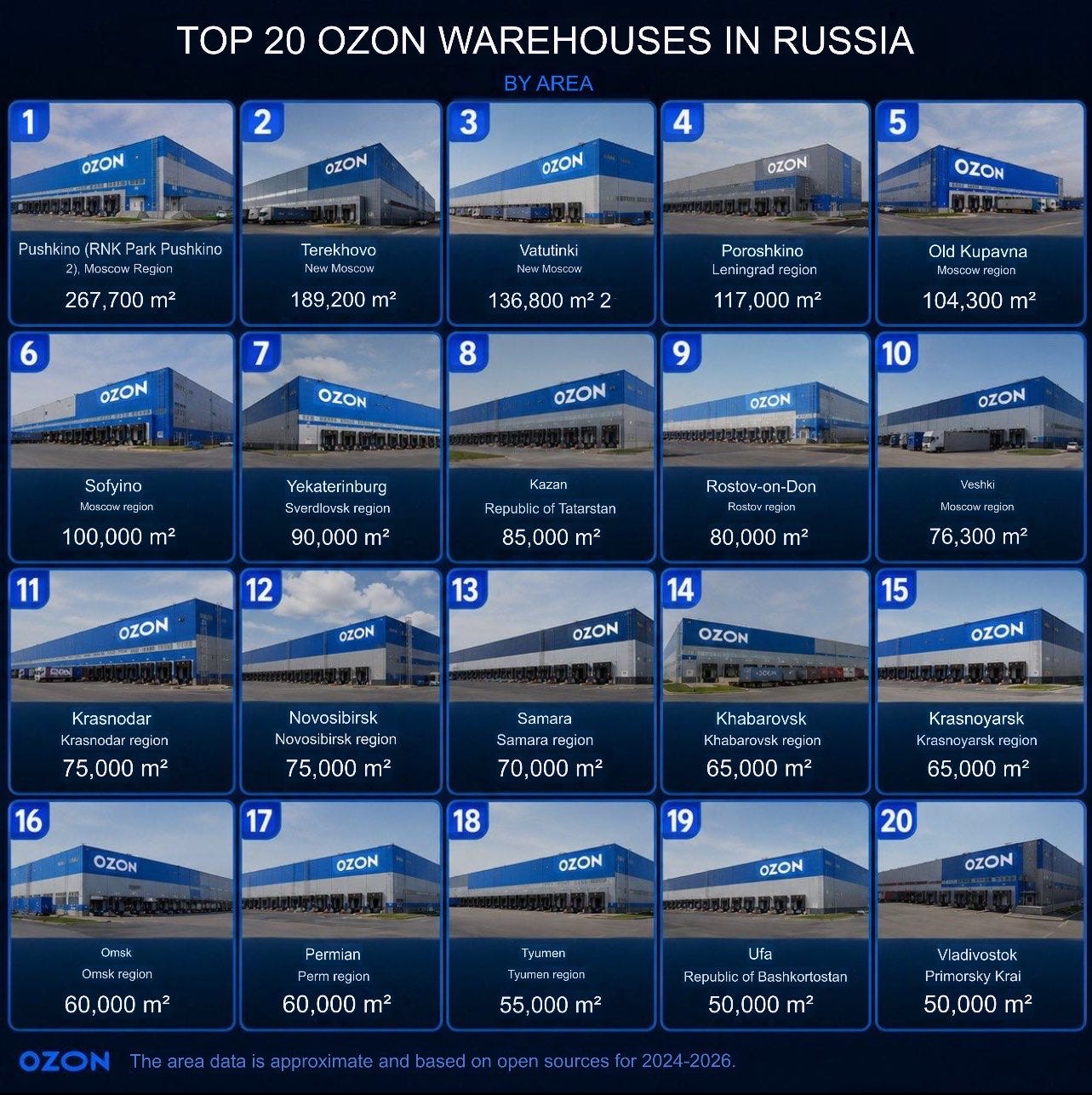


Four warehouses in less than a week is not an unfortunate coincidence involving unusually combustible parcels. It looks like a campaign.
President Volodymyr Zelenskyy described the facilities as logistics hubs involved in supplying Russian forces with drone components and other equipment.
The Kremlin denied that Wildberries had military links and presented the company as an innocent civilian retailer. This is broadly the same Kremlin that describes ammunition depots as tractor factories and military airfields as unexpectedly aeroplane-shaped cultural centres. Nevertheless, the legal and evidential question deserves a more serious answer than either side’s press statement.
Russia’s Amazon, with an aisle for war
Wildberries is not simply a website selling discounted socks. It is one of the load-bearing beams of Russia’s consumer economy.
The company says it handles about 20 million orders per day through warehouses covering roughly three million square metres. It has more than one million sellers. Together, Wildberries, Ozon and smaller online platforms sell goods and services equal in value to approximately 8.5 per cent of Russian GDP, although that figure describes transaction value rather than their direct contribution to national output.
The platforms support around four million jobs, more than five per cent of Russia’s workforce, including sellers, couriers, warehouse staff and operators of the ubiquitous collection points scattered through Russian towns.
Russia’s online retail market grew by 28 per cent in 2025 to 11.5 trillion roubles. It accounted for 18.8 per cent of the country’s retail sales, according to Russia’s Association of Internet Trade Companies.
This matters because the Kremlin has encouraged a “platform economy” in which a shrinking number of giant digital marketplaces connect consumers, manufacturers, importers, banks and transport companies. It is efficient when functioning normally. It is also a splendid way of concentrating risk into several enormous buildings with easily identifiable roofs.
Wildberries’ military relevance is more complicated than the slogan “it sells armour, therefore every warehouse is a barracks.”
Publicly available listings reportedly included body armour, combat helmets, camouflage clothing and fibre-optic cable of the kind used in Russian FPV drones.
Reports also identified drone-related accessories and equipment suitable for military volunteers purchasing supplies for Russian units. However, there is no publicly confirmed evidence that Wildberries as a corporation has a formal supply contract with Russia’s Defence Ministry.
That distinction matters, but it does not make the company irrelevant to the war.
Russia’s invasion increasingly depends on a blurred procurement ecosystem. Military units, regional administrations, volunteer organisations, soldiers’ relatives and nationalist fundraising groups buy commercially available radios, batteries, thermal clothing, electronics, optical cable, drone parts, protective equipment and vehicles.
The product may begin its journey as civilian merchandise, but its destination and use can be entirely military.
Modern drone warfare is especially dependent on ordinary commercial supply chains. An FPV drone does not need every component to arrive in a crate stamped “Property of the Ministry of Defence.” It needs motors, cameras, batteries, controllers, fibre-optic cable and electronics.
These are precisely the categories of goods that large marketplaces are designed to aggregate, store and dispatch at speed.
Wildberries therefore occupies the grey zone where Russia’s civilian economy meets its improvised war economy. It is not a weapons manufacturer in the traditional sense. It may nonetheless function as part of the distribution machinery through which useful military goods reach units, intermediaries and volunteer networks.
Are the warehouses lawful military targets?
The answer is not automatically yes, and it is not automatically no.
Under international humanitarian law, an object becomes a military objective when, because of its nature, location, purpose or use, it makes an effective contribution to military action and when destroying or neutralising it offers a definite military advantage in the circumstances at the time.
Civilian objects must not be attacked merely to punish the population or damage an enemy’s economy. Even where an objective qualifies as military, the attacker must still take feasible precautions and avoid civilian harm that would be excessive compared with the expected military advantage.
The fact that military-style products were sold somewhere on the Wildberries marketplace does not, by itself, prove that every Wildberries facility is a legitimate target.
A website listing body armour is not a magic legal wand that transforms three million square metres of warehouses into one gigantic ammunition dump.
The stronger Ukrainian case would require intelligence showing that the particular facilities were storing, sorting or transporting drone components, navigation systems, military equipment or other supplies for Russian formations.
If such evidence existed, the relevant sections of those logistics centres could qualify as military objectives.
The large civilian workforce, mixed inventory and surrounding population would still make proportionality and precautions critical.
Ukraine may possess intelligence that has not been made public. Open sources currently establish that Wildberries carried dual-use goods and that Ukrainian officials said the targeted hubs supported military supply. They do not independently establish the contents, customers or military role of every building at the moment it was struck.
That does not validate Kremlin claims of complete civilian innocence. It simply means the legal case depends on use and military advantage, not on how irritating or economically painful the target is.
The immediate bill: warehouses, stock and ruined sellers
The first two strikes appear to have damaged facilities representing approximately 6.5 to nine per cent of Wildberries’ warehouse space. Other estimates put the disrupted share of logistics capacity at around seven per cent.
Russian analysts floated direct and indirect loss estimates of up to 100 billion roubles, while a later assessment suggested that sellers’ destroyed inventory might be worth 150 billion to 170 billion roubles. These figures remain provisional and should be treated as estimates, not audited accounts delivered by Moses from the mountain.
The damage is divided between several unfortunate pockets.
Wildberries itself faces the cost of destroyed or damaged buildings, sorting equipment, conveyors, automated systems, vehicles, information technology and site restoration. Sellers face the value of lost inventory. Transport companies face rerouting expenses.
Customers face cancellations and delays. Banks face distressed borrowers. The state faces demands for tax relief, subsidised loans and compensation. Insurers, where insurance exists, face claims or lengthy arguments about exclusions.
Wildberries amended its seller terms shortly before the strikes to include drone attacks among force-majeure events that could exempt it from liability.
Reports subsequently described sellers being offered discounts, loans and support measures rather than immediate full reimbursement for destroyed goods. This is the Russian wartime economy in miniature: the state launches the war, the corporation invokes force majeure, the small business receives a brochure about affordable credit.
For a small merchant, destroyed stock is not an accounting curiosity. It may represent borrowed money, months of manufacturing, customs costs, advertising expenditure and the entire seasonal collection. A business can be profitable on paper and still collapse if its inventory disappears before it can be sold.
The danger therefore extends beyond the value of the goods burned. A seller who loses stock may default on a loan, stop ordering from a factory, dismiss staff, abandon advertising contracts and cease paying tax. The original warehouse loss propagates outward through a chain of smaller losses, each less photogenic than a burning roof but economically more persistent.
Why seven per cent can hurt more than seven per cent
Large distribution networks do not behave like water tanks. Losing seven per cent of warehouse capacity does not necessarily reduce deliveries by exactly seven per cent. The outcome depends on where that capacity sits within the network.
Elektrostal was one of Wildberries’ largest hubs and an important centre serving Moscow and surrounding regions.
Removing a strategically positioned warehouse creates congestion elsewhere. Goods must be redirected to more distant facilities. Lorries travel longer routes. Sorting centres operate closer to their limits. Collection points receive less predictable deliveries. Staff work overtime. Mistakes, damaged parcels and returns increase.
This is known as a network effect. A blocked side road is inconvenient. A blocked motorway junction can produce traffic jams across an entire city.
There is also a difference between spare warehouse space and usable operational capacity. Another building may have empty floor area, but it may lack the staff, automated sorting equipment, loading bays or information systems required to absorb millions of additional items at short notice.
Wildberries has substantial resilience. It operates a large national network, and the Kotovsk site was expected to resume accepting shipments within days. That suggests the company can repair, isolate or reroute around some damage. Claims that four strikes have already produced a Russian economic apocalypse are therefore premature. Russia has not collapsed because someone in Novosibirsk must wait longer for a kettle.
The more important question is whether the attacks continue.
One destroyed hub is an emergency. Repeated strikes on multiple regions turn the emergency into a permanent operating condition.
The arithmetic of disruption
A rough calculation helps explain the scale without pretending that spreadsheet theatre is prophecy.
Wildberries claims to process 20 million orders per day. If seven per cent of effective capacity were unavailable for 30 days, that would represent approximately 42 million order-days of theoretical capacity affected. It would not mean 42 million orders permanently lost, because Wildberries could reroute shipments, postpone deliveries or use spare capacity.
It does indicate the size of the logistical burden transferred to the rest of the network.
If disruption continued for 90 days, the theoretical exposure would rise to 126 million order-days.
A second calculation starts with Russia’s 11.5 trillion-rouble annual online retail market. A disruption equal to one per cent of annual online transaction value would affect roughly 115 billion roubles of sales. A three per cent disruption would represent about 345 billion roubles.
Again, this would not translate directly into an equal fall in GDP. Some purchases would be delayed, moved to Ozon, bought in physical shops or redirected through smaller platforms.
But delayed sales still damage cash flow. Transferred sales still impose new transport and marketing costs. Replaced goods may cost more. Imported stock may remain trapped in the wrong region. The damage is therefore best understood not as one dramatic subtraction from GDP, but as millions of small economic sandbags tied to businesses, consumers and logistics providers.
Inflation by drone
Repeated warehouse attacks could raise prices through several channels.
Retailers must spend more on air defences, fire protection, security, backup storage and insurance. Goods may travel longer distances through less efficient routes. Sellers will demand higher margins to compensate for the risk that their stock could disappear without reimbursement.
Banks will price greater uncertainty into loans. Warehouses may be dispersed into smaller facilities, improving survivability but sacrificing economies of scale.
Those costs eventually arrive at the checkout.
Russia enters this period with limited economic comfort. The Bank of Russia’s Business Climate Index fell from 0.9 in June to minus 3.6 in July 2026, its weakest level since 2022, while companies’ price expectations rose.
Russia’s federal budget deficit reached 5.73 trillion roubles in the first half of 2026, and Reuters reported that the full-year deficit could exceed the government’s plan by more than one trillion roubles because of higher spending.
Every additional security subsidy, reconstruction loan or tax deferral must therefore be financed by a state already paying for the invasion, military procurement, soldiers’ bonuses, veterans’ benefits, regional bailouts and the replacement of damaged energy infrastructure.
The e-commerce lobby has already sought tax deferrals for affected businesses. That may be sensible emergency policy, but it transfers the cost from private companies to the state budget.
The Kremlin’s economic philosophy increasingly resembles a restaurant where the state orders the war, oligarchs eat the meal and taxpayers are presented with the bill.
The military consequences
The immediate military benefit depends on what was actually stored and routed through the four hubs.
If significant quantities of drone components, optical cable, navigation equipment, radios, protective clothing or other military-use goods were destroyed, Russian units and volunteer networks may face temporary shortages.
Even modest delays can matter in fast-moving categories such as FPV drones, where units consume large numbers and constantly require replacement parts.
The larger effect may be organisational. Suppliers will become more cautious about storing military-related goods in giant commercial hubs. Russian authorities may order sensitive items dispersed, disguised, moved at night or carried through separate military channels. That reduces efficiency.
A centralised marketplace can match thousands of buyers and sellers quickly. A dispersed wartime system must use more intermediaries, smaller shipments and less predictable routes. Each extra handover creates another opportunity for delay, theft, corruption, paperwork or Ukrainian intelligence collection.
The strikes may therefore force Russia to choose between efficiency and security. Concentrate supplies in large automated hubs and Ukraine has attractive targets. Disperse them across many smaller sites and Russia loses speed, visibility and economies of scale.
This is the logistical equivalent of making an opponent wear heavy boots. It may not stop him walking, but every mile becomes more expensive.
The psychological front: the war arrives with the parcel
The Kremlin’s domestic bargain has been straightforward. Citizens surrender political freedom and avoid questioning the war. In return, the government tries to keep daily life recognisably normal.
Wildberries helped sustain that normality. Even in towns suffering from poor physical retail provision, consumers could order imported electronics, clothing, medicines, cosmetics and household goods. The marketplace was not merely convenient. It was part of the insulation separating Russia’s population from the consequences of Russia’s invasion.
Striking that system weakens the insulation.
The psychological effect does not require nationwide shortages. It requires unpredictability.
Is the warehouse safe? Will the parcel arrive? Is the seller insured? Will the next drone strike hit a refinery, railway depot, airport, power station or distribution hub? Does a worker accept a night shift in a building that Ukrainian intelligence may regard as part of the war economy?
This is not the same as producing organised opposition to Putin. Authoritarian societies can endure extensive economic suffering without generating effective political resistance.
The Kremlin controls television, policing, elections and public protest. Russians may blame Ukraine, local officials, businesses or Western sanctions rather than the invasion itself.
The more realistic objective is cumulative pressure. Each disrupted delivery, fuel shortage, factory closure and damaged warehouse raises the domestic cost of continuing the war. It forces the state to spend money defensively. It compels businesses to divert capital from expansion to survival. It erodes the claim that Putin’s war can remain distant, orderly and largely free for the Russian population.
Will this become an economic catastrophe?
Four warehouses alone will not wreck Russia’s economy.
is large, profitable and geographically diversified. Consumers can switch to Ozon, physical retailers or other platforms. Kotovsk’s rapid planned reopening demonstrates that some facilities can recover quickly. The word “catastrophe” should therefore be reserved for the cumulative campaign, not awarded prematurely after every spectacular fire.
A contained scenario would see Wildberries restore or replace capacity, reroute goods and absorb much of the cost.
Sellers would suffer heavily, but the national effect would be visible mainly through delays, modest price increases and state-backed support.
A grinding scenario would involve periodic attacks on Wildberries, Ozon, railway terminals, freight depots, refineries and industrial warehouses. Companies would face permanently higher logistics and security costs. Sellers would hold less stock, insurers would withdraw, credit would become more expensive and regional delivery times would deteriorate. The economy would continue functioning, but with more friction, inflation and business failures.
A systemic scenario would emerge if Ukraine repeatedly disabled several categories of infrastructure at once, particularly oil refining, railway logistics, electricity distribution, ports and commercial warehousing. Each network depends on the others.
Warehouses require power and fuel. Railways require signalling and repair materials. Factories require deliveries. Retailers require functioning banks and telecommunications. Simultaneous disruption can create bottlenecks that are much greater than the sum of the individual attacks.
That is where economic damage becomes strategically meaningful. Ukraine does not need to destroy Russia’s entire economy.
It needs to increase the marginal cost of aggression until each additional month of war demands more money, more repression, more mobilisation and a greater sacrifice of civilian living standards.
The Kremlin’s rather flammable contradiction
Russia insists that its civilian economy is separate from its military machine. Yet it recruits workers through civilian companies, finances the war through civilian taxes, sources components through civilian importers, uses civilian railways and commercial vehicles, and relies on online marketplaces through which military-use goods can be purchased.
Moscow wants the benefits of integrating civilian commerce into its war effort while demanding that every integrated civilian facility remain immune from attack. It wants dual use without dual risk.
That argument becomes less convincing as Russia’s war economy swallows more of the supposedly civilian economy. The boundary has not vanished, and Ukraine remains legally obliged to respect it. But the Kremlin itself has spent four years smudging that boundary with military procurement, mobilisation and sanctions evasion.
Wildberries is an unusually powerful symbol of that contradiction. It represents consumer comfort, entrepreneurial aspiration, Chinese imports, algorithmic efficiency, banking, transport and the improvised acquisition of equipment useful at the front. It is Russia’s shopping centre and, potentially, part of Russia’s military supply web.
Ukraine’s message is therefore larger than the warehouses themselves.
A state cannot wage an imperial war indefinitely while expecting its logistics network to retain the ambience of a peaceful home-delivery service. Russia brought devastation to Ukrainian homes, ports, power stations, hospitals, factories and warehouses. Ukraine is now demonstrating that the infrastructure sustaining the aggressor’s war is neither distant nor untouchable.
The Wildberries fires are not yet Russia’s economic catastrophe. They are the warning label attached to it.
Contents may become extremely expensive during prolonged imperial adventures.
References and Sources
The four Wildberries strikes
Reuters, 18 July 2026: Initial attacks on the Kotovsk and Elektrostal warehouses, casualties, fires and Zelenskyy’s statement that the targets were logistics facilities connected to drone and navigation equipment.
Associated Press, 18 July 2026: Independent reporting on the attacks at Kotovsk and Elektrostal, casualties and the wider Ukrainian long-range strike campaign.
https://apnews.com/article/c2d0d713643288b81dbbea714d5db5ac
Reuters, 21 July 2026: Kremlin acknowledgement that Wildberries and small businesses suffered substantial losses, together with information about disrupted operations and the company’s scale.
Reuters, 22 July 2026: Attacks on the Krasnodar and Nevinnomyssk facilities, fires, casualties and the request by an e-commerce lobby group for tax-payment deferrals.
Euronews, 22 July 2026: Additional reporting on the Krasnodar and Nevinnomyssk attacks, evacuations, fires and the reported scale of the Elektrostal site.
https://www.euronews.com/2026/07/22/russia-reports-fresh-drone-strikes-on-wildberries-logistics-hubs
Meduza, 22 July 2026: Reporting based on statements from Wildberries founder Tatyana Kim and the governors of Krasnodar and Stavropol.
Ukraine’s explanation of the targets
Official website of the President of Ukraine, 18 July 2026: Zelenskyy said the targets included warehouses used to distribute navigation systems, drone-production components and other supplies for Russian forces.
The Guardian, 19 July 2026: Summary of the Ukrainian claim that the facilities were involved in handling sanctioned components used for drone and navigation equipment.
Wildberries’ military and dual-use product listings
The Moscow Times, 20 July 2026: Identifies publicly advertised body armour, combat helmets, camouflage clothing and fibre-optic cable used in drones. It also notes that there is no publicly confirmed evidence of a formal Wildberries relationship with Russia’s Defence Ministry.
This is the strongest open-source reference for the dual-use listings, but it does not establish which products were physically present in each warehouse.
Wildberries and the Russian platform economy
Reuters, 22 July 2026: Detailed profile of Wildberries and its economic importance. Reuters reports that Wildberries processes approximately 20 million orders daily and that Russian digital platforms support about four million jobs. It also explains the Kremlin’s reliance on the so-called platform economy.
The widely quoted 8.5% of GDP figure refers to the value of goods and services handled by the wider Russian platform economy, including Wildberries, Ozon and smaller platforms. It is not the direct GDP contribution or profit of Wildberries alone.
AKIT, Russia’s Association of Internet Trade Companies, 19 February 2026: Official industry data showing that Russian e-commerce reached 11.5 trillion roubles in 2025, grew by 28%, and accounted for 18.8% of retail sales.
https://akit.ru/news/11-5-trln-rublej-akit-podvela-itogi-internet-torgovli-za-2025-god
Seller losses, insurance risk and force majeure
Meduza, 1 July 2026: Wildberries amended its seller contract to include drone attacks, missile strikes and related military damage as force-majeure events for which it might not be liable.
The Moscow Times, 1 July 2026: Independent reporting on the same contractual change and the transfer of wartime risk from the platform to sellers.
Meduza, 18 July 2026: Wildberries subsequently said it was developing compensation arrangements despite claiming that it was not contractually obliged to reimburse sellers.
Meduza, 19 July 2026: Details the support offered to sellers, including storage discounts, preferential loans and debt-payment deferrals, rather than immediate full compensation.
Meduza, 22 July 2026: Reports an analyst estimate that inventory stored at the Elektrostal and Kotovsk warehouses could have been worth 150 billion to 235 billion roubles, with a more cautious estimate of 150 billion to 170 billion roubles.
These loss figures are preliminary estimates rather than audited company results.
Operational resilience and reopening
Meduza, 21 July 2026: Wildberries said that the Kotovsk facility would begin accepting shipments again on 23 July, illustrating that some damaged capacity may be restored relatively quickly.
This source supports the report’s warning that four strikes alone do not amount to the collapse of Russia’s e-commerce system. The strategic effect depends on repetition, the importance of individual hubs and simultaneous pressure on fuel, rail, energy and industrial logistics.
Russia’s deteriorating economic position
Bank of Russia, July 2026: The central bank’s official Business Climate Index fell from 0.9 in June to minus 3.6 in July.
https://www.cbr.ru/press/event/?id=32705
Russian-language monitoring page:
https://www.cbr.ru/analytics/dkp/monitoring/0726/
Reuters, 16 July 2026: Reports that Russia’s federal budget deficit reached 5.73 trillion roubles in the first half of 2026 and could exceed the annual government plan by more than one trillion roubles.
Reuters, 16 July 2026: Covers the deterioration in Russia’s business-climate indicator and the Kremlin’s claim that the problems were not yet critical.
Reuters, 12 May 2026: Russia reduced its official 2026 GDP growth forecast from 1.3% to 0.4%, alongside weaker investment, industrial and retail expectations.
Reuters, 19 June 2026: Covers fuel-production disruption, inflation risks and the Bank of Russia’s monetary-policy dilemma following Ukrainian attacks on refining infrastructure.
International humanitarian law and target status
ICRC, Additional Protocol I, Article 52: The central legal definition. A civilian object becomes a military objective only where its nature, location, purpose or use makes an effective contribution to military action and its destruction offers a definite military advantage.
https://ihl-databases.icrc.org/en/ihl-treaties/api-1977/article-52
ICRC rules-of-war guide: Explains distinction, proportionality and the requirement to take feasible precautions to reduce civilian harm.
https://www.icrc.org/en/document/FAQ-rules-of-war-ihl
ICRC Customary IHL Rule 10: Civilian objects remain protected unless, and only for such time as, they qualify as military objectives.
https://ihl-databases.icrc.org/en/customary-ihl/v1/rule10
ICRC Customary IHL Rule 8: Detailed definition and state practice concerning military objectives.
https://ihl-databases.icrc.org/en/customary-ihl/v2/rule8?country=gb