

Reading between the Code Names and Redactions
What initials, nicknames, and legal pseudonyms mean in the Epstein files

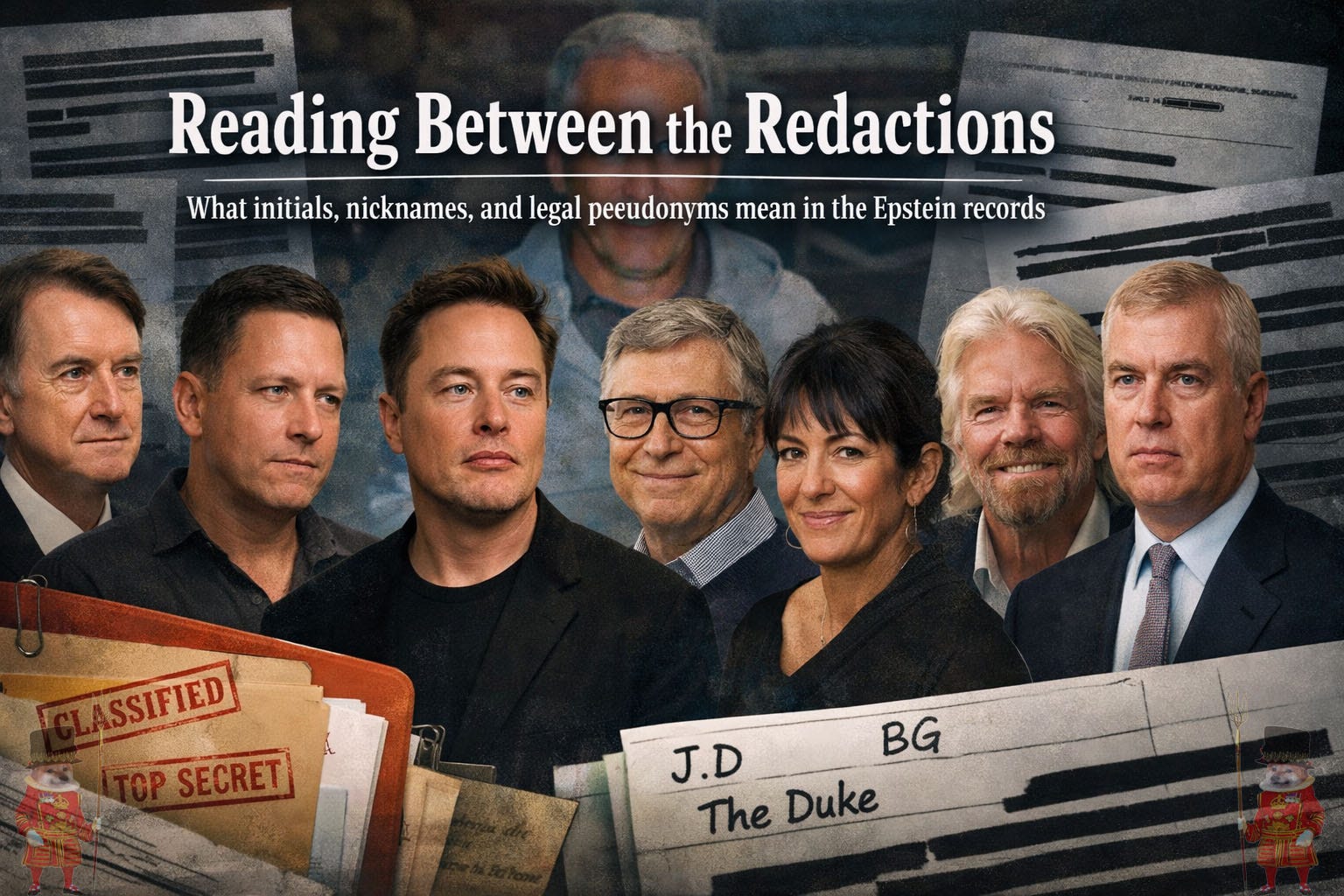
The Jeffrey Epstein files, particularly the released court documents and emails, contain numerous pseudonyms and nicknames to protect identities, notably hundreds of “John Does” and “Jane Does”. Key identifiers include “Doe 107” (often identified as a high-profile figure) and “Doe 36”.
Key Identified Pseudonyms & Potential Associations:
Doe 107: This pseudonym has been strongly linked to Bill Clinton, who appeared frequently in the records but was not accused of wrongdoing.
Doe 36: Frequently mentioned in relation to the case, and identified as (now ex) Prince Andrew.
Doe 112: Identified as Leslie Wexner.
Doe 15: Identified as Alan Dershowitz.
“Doe” Numbers: Hundreds of others are listed simply by number (e.g., Doe 1-250+) to protect the anonymity of victims, witnesses, and associates.
Contextual Nicknames & Terms:
“Little St. James”: Referred to as “the island,” Epstein’s private island in the US Virgin Islands, a focal point of the investigation.
“The Client List”: A colloquial term for the numerous, often high-profile, individuals who visited the island or used his private planes.
Many individuals in the documents are listed simply by their real names, but the “Doe” system was utilised in court filings to prevent immediate public identification of many individuals involved, whether as witnesses, associates, or victims.
Here’s a clearer look at *some of the actual terms people have flagged or discussed as possible “code words” in the Epstein files and related investigations — plus what’s known about them. It’s important to separate reported investigative context from unverified speculation on the internet:
Terms (actually discussed in reporting or filings)
1. Massage
Investigators and accusers have specifically said that in Epstein’s context, the word “massage” was used euphemistically to refer to sexual acts with young women and girls he and his network trafficked, because girls were often referred to as “massage therapists.”
Terms (often mentioned in the files and debated for meaning)
These words have popped up in email bodies and other documents released — sometimes hundreds of times. But authoritative sources do not confirm them as official trafficking code words; instead, these definitions come primarily from internet commentary and non-expert analysis:
2. “Pizza” & “cheese”
These have appeared very frequently in the documents, and some observers speculate they might be informal shorthand in some email threads. Online safety communities have flagged “cheese” and “pizza” previously (outside these particular files) as slang for child pornography — in part because the initials C.P. match that phrase — but that doesn’t come from prosecutors’ definitions in the Epstein case itself.
3. “Grape soda,” “Chinese cookie,” “bobby”
These are reported examples of unusual combinations or food terms people have found in emails from the Epstein files. Some commenters suggest these might be codes used between insiders, but again, there’s no official explanation from authorities about their meanings.
“Candy”
Based on the released Jeffrey Epstein documents and emails, the term “candy” and references to the name “Candy” appear in several contexts, ranging from direct references to individuals to potentially coded language regarding his trafficking operations.
Here are some potential meanings based on the released files:
Nick Candy (Property Tycoon): Several mentions of “Candy” appear to refer to the British billionaire property tycoon Nick Candy, whose name is present in some files related to potential business matters.
Young girls and victims
Literal Candy/Gifts: In some contexts, the term may refer to actual candy or, less commonly, gifts, as suggested by communications that also involve luxury items and other goods.
The released documents contain a variety of terms, and understanding their precise meaning often depends on the specific context of each communication.
Famous Names in code and plain language
Here’s a grounded overview of how some people appear in the newly released Epstein files — particularly the forms or variants of their names, email handles, initials, nicknames, or shorthand that have been noted in reporting and document leaks.
It’s key to stress that seeing a name or variant in the files (including abbreviations or shorthand) does not mean wrongdoing; the files include a mix of correspondence, schedules, metadata, references and unverified tips.
1. Bill Gates
Appears repeatedly under his full name in emails and schedules.
In some internal text indexes and metadata, his name is reportedly shortened to “bg.” This looks like an informal reference or email tag rather than a codename.
2. Peter Thiel
Mostly listed as full name in document mentions.
Thiel’s name often pops up in tables of file hits and email exchanges; there’s no widely reported code or alternative handle in the mainstream media analyses of the files so far.
3. Elon Musk
Typically shown under full name in formal references in the files.
There are no widely reported alternate email addresses or nicknames published by major news outlets regarding Musk’s entries in the documented releases as of early 2026.
4. Ghislaine Maxwell
Appears in her full name in many items, including her 2020 arrest mugshot release and correspondence released in the batch.
Some email threads (as described by journalists) show short forms like “G.” or “G. Max” in addresses or signatures where the remainder was redacted for privacy.
In at least one early tranche of Maxwell-Epstein email exchanges released previously, Christophers like “A” (implied to be Prince Andrew) were used in the header, but that’s a contextual snippet rather than a consistent alias for Maxwell himself.
5. Richard Branson
Most references to Branson appear under his full name in the released documents.
There have been no widely reported codename variants or email handles for him appearing in these releases.
6. Peter Mandelson
Largely appears in the files under his full name.
A business-bank transfer in one set of documents showed “Peter Mandelson” labeled as “BEN” on a payment record — likely shorthand for beneficiary rather than a code name.
7. Political Leaders & Royals
Many political figures appear, and the variants range from formal titles to nicknames or initials:
Prince Andrew
Often referred to by his formal name Andrew Mountbatten-Windsor in public documents.
In some email dispatches previously detailed by reporters (from earlier releases), single-letter or descriptive headers (e.g., “A” from Balmoral) appeared in Maxwell–Epstein communications, implying shorthand for Andrew’s messages — but these are contextual email headers and not published DOJ codenames.
Donald Trump
Largely appears by full name in searchable references and metadata. He appears more than 5300 times in the files released so far - with only half of the files released so far.
Bill Clinton
Appears by full name in flight logs, photos, and email references.
Other leaders in the documents
Figures like Larry Summers, Ehud Barak, Robert F. Kennedy Jr., and George Mitchell show up under their full names in the released files.
Important Context on Name Variants in the Epstein Files
✔️ Names appear in full, official forms when public figures are referenced in emails, schedules, or logs.
✔️ Abbreviations like “bg” for Bill Gates are likely email handle shorthand or tagging used within the files’ metadata — not secret codenames in a conspiratorial sense.
✔️ Some single-letter headers or redactions (like “G.” or “A”) happen because email addresses and headers were redacted for privacy or security reasons; they’re not published as official aliases.
✔️ No authoritative DOJ glossary has been released defining a systematic covert naming code for public figures in the Epstein files. The variants noted in media analyses are mostly shorthand, initialisms, or redacted headers.
The Big Picture
The Epstein files are a massive trove of emails, attachments, schedules, and scanned documents overseen by the DOJ in response to transparency laws. Mentions of individuals — and occasional trimmed email handles or initials — tend to reflect:
how an email was addressed or stored in the dataset;
how a journalist’s search index returned names; or
how redactions were applied for privacy protections.
None of these name forms — whether “bg,” initials, or simple redactions — have been confirmed by authorities as an official coded alias system the way investigators sometimes define code words in other investigations.
Searching the files
Legal software can quickly scan vast amounts of documents for subjects that fall outside specific keywords, providing insights into the Epstein files. In Epstein’s court case, some of the phrases, like “joint* w/3 defend*,” could potentially reveal emails discussing a “joint defense privilege” between Maxwell and Epstein.
Other terms with the “w/3” qualifier, such as “high* w/3 school*,” “school* w/3 girl*,” and “sex w/3 toy*,” were also sought after by Giuffre’s lawyers, along with references to law enforcement agencies like the FBI and state and federal prosecutors.
Giuffre’s legal team focused on several key names in Maxwell’s circle, including British Prince Andrew, and terms such as “nipple,” “schoolgirl,” “servitude,” and other sexual phrases. The term “massage,” which was reportedly used by Epstein as a code word for sex with young women and girls employed as massage therapists.
Speculative or Unverified Terms from Public Discussion
These show up in hobbyist investigations or Reddit threads but are not confirmed by prosecutors or official investigators:
“Chicken parm,” “chicken soup” — internet speculation linking chicken phrases to CP (child pornography) themes.
“Patsy’s,” “amore,” “white tuna,” “ice cream,” “cream cheese” — example keywords flagged by document-readers hunting for context, not proven codes.
Random food and terms with weird spellings/symbols — often due to PDF formatting issues and not intentional codes.
What’s really known from official reporting
Investigators and victim testimonies informed prosecutors that the term “massage” was used euphemistically for sex trafficking activities involving girls trained as “massage therapists.”
The DOJ’s releases contain millions of pages, but there is no released DOJ document that publicly defines “pizza” or other food terms as trafficking codes in the Epstein case. Independent media reporting on frequency of words does not equate to confirmation that they are secret codes.
Here’s a reliable overview of how identities are masked or appear as initials/nicknames in the actual released documents:
1. Legal Redactions for Privacy (Court-ordered)
In many official court materials and document releases tied to the Epstein case, names and identifiers for victims (especially minors) are redacted or replaced with pseudonyms to protect privacy. This is standard legal procedure in federal cases involving minors and sexual abuse victims — judges will allow witnesses to be referred to by initials or pseudonyms in filings to avoid public exposure.
These pseudonyms often take forms like:
“Jane Doe 1”, “Jane Doe 3” — classic legal placeholders used in filings.
Initials only (e.g., J.D., M.H.) — sometimes seen where documents have been redacted to conceal full names.
First names only — used when combined with other protections to lessen identification risk.
These aren’t secret operational code words — they’re legal tools to comply with privacy law.
2. Informal Nicknames or Abbreviations in Emails
In everyday communications (like emails within the files), some people appear under shorthand references, initials, or friendly nicknames, but there is no DOJ-published glossary confirming these were intended as systematic codes to conceal identity from investigators:
Examples from reporting and document context
“TheDuke” — used in a contact list entry believed to refer to Prince Andrew.
Affectionate nicknames — e.g., “sweat pea” used in correspondence with someone believed to be Prince Andrew in personal emails (not an official DOJ codename).
Affiliation initials — in tech email threads, Microsoft founder Bill Gates is reported in one analysis as sometimes appearing with shorthand like “bg” in drafts or address book entries.
These types of abbreviated references are common in personal emails and don’t mean they were necessarily being hidden from investigators — often they reflect casual shorthand or personal address book labels.
3. Why There Isn’t a Definitive “Codename List”
Across the files (millions of pages of emails, legal filings, contact lists and court material), investigative journalists and fact-checkers have noted that:
There’s no complete, authoritative DOJ codename glossary published in these releases. What’s public are excerpts, redactions, and searchable text — not a DOJ explanation that a given label means X or Y.
Many “nicknames” are just email login fragments or personal shorthand (e.g., short handles like gmax found in some files in the context of Ghislaine Maxwell’s email addresses). Insights like this come from document readers and are not DOJ-official labels.
In Practical Terms
Here’s how identities are generally treated in the released material:
Legal and safety redactions
Victims (especially minors) identified by pseudonyms, initials, or omitted entirely.
Informal shorthand in email metadata
Shorthands like initials (“bg”) or personal nicknames (“TheDuke,” “sweat pea”) can appear, but they’re contextual and not defined as part of a secret code system.
Standard names without disguise
Many documents simply use full names where permissible under redaction rules; prosecutors and the DOJ have stated they did not systematically redact non-victim names in releases other than privacy-based redactions.
What This Isn’t
Contrary to some internet speculation, the files don’t include a publicly released set of systematic hidden code words used to conceal identities in the way criminal enterprises sometimes do. What does appear are:
Search engine and forensic keyword flags (terms used in litigation for searching text, like “massage”).
Standard legal redaction pseudonyms protecting minors.
Personal communication shorthand used by the individuals themselves.
Beefy’s Bottom line
In the released Epstein files:
✔️ More than 5,300 files with references to Donald Trump and related terms. They include unverified and hidden claims, as well as documents that had already been made public. This excludes the vast number of files not released to the public, which it is fair to assume contain both DOnald Trump and his chosen Republican Party and business “friends”, who he is trying to protect.
✔️ Victims and certain individuals are protected with initials or legal pseudonyms.
✔️ Some personal shorthand, nicknames, and abbreviations appear in email threads.
✖️ There’s no DOJ-published evidence that Epstein used a structured system of covert code names exclusively designed to hide identities from investigators.
This thread is based on the current understandings developed, both through official court filings and investigative journalism. This will improve and expand over the coming weeks and months. (As of February 2026)
Some words (like massage) have documented meaning in the context of Epstein’s sex trafficking network. Others (like pizza, cheese, grape soda) are being pointed out because they recur in the released documents, and people online are theorizing about them — but no official prosecutor statement released so far confirms those as established code words. The frequent appearance of everyday words in a massive trove of emails doesn’t automatically make them coded references.
When people dig into the massive Epstein files released by the U.S. Justice Department, it’s important to separate actual documented redactions and pseudonyms used for legal privacy from online speculation about “hidden codes.”