

Scorched Supply Chains
How refinery strikes are rippling through Russia’s farms, food markets and fragile wartime finances.

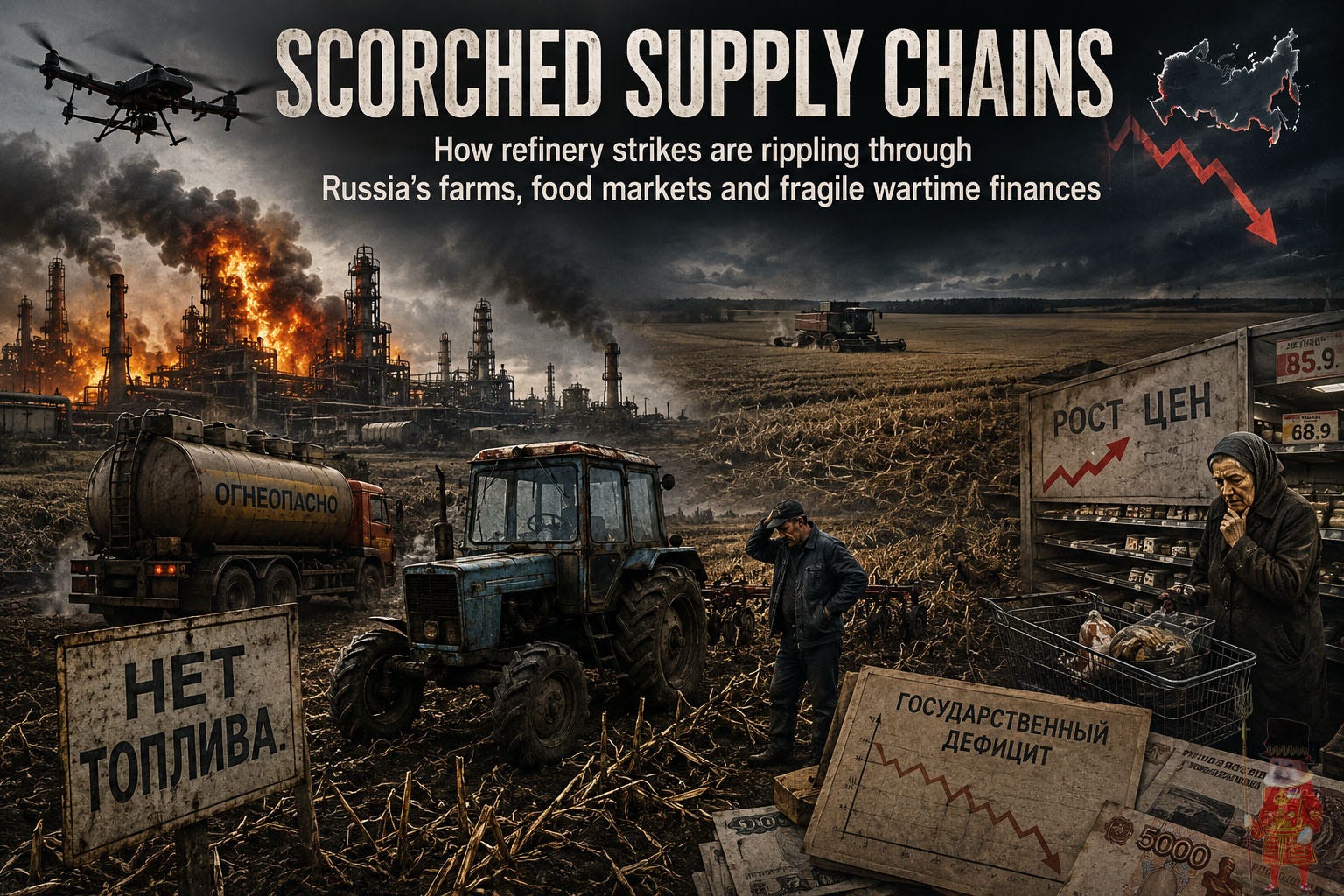
Russia’s Agriculture Under Persistent Fuel Disruption
Background:
Russia’s agricultural outlook has worsened materially because Ukrainian strikes are no longer a nuisance to refining and fuel logistics but a nationwide supply shock.
By late June and early July 2026, Russian authorities had acknowledged fuel shortages, imposed sales restrictions in most regions, prepared or approved tax and regulatory changes to facilitate imports and lower-quality blending, and on 8 July imposed a full diesel export ban until 31 July while also announcing fuel imports.
At the same time, major refining assets have been damaged or shut: the Moscow refinery is unlikely to resume this year, and the Omsk refinery—Russia’s largest and top petrol producer—halted operations after a July strike. These are not marginal events. The International Energy Agency said Russian crude output fell to 8.7 million barrels per day in May, 10% below target, and Energy Intelligence estimated nearly one-third of refining capacity offline in early June, with refining runs below 4 million barrels per day.
The critical judgement is that Russia is unlikely to face a near-term, nationwide calorie shortage, but it does face a credible risk of regionally acute agricultural disruption, higher food inflation, sharper fiscal strain, and repeated local shortages of perishables and transport-dependent goods.
In the short term, the state can still cushion agriculture by diverting exports, drawing reserves, importing finished fuel, and prioritising agro-industrial users. In the medium term, however, that stabilisation becomes more expensive and less effective if strikes persist through the 2026 harvest, autumn winter-sowing campaign, and the 2027 spring sowing and harvest cycle.
The result is likely to be a more volatile, more state-directed, and more regionally unequal agricultural system rather than an outright collapse.
My central estimate is that, if disruption remains at roughly current intensity, Russia can avoid a national food availability crisis in the next 6 months, but it is likely to suffer a modest national crop-output loss in the low single digits for the 2026/27 cycle, concentrated in timing-sensitive harvesting and hauling operations, with larger local losses in Crimea and parts of southern Russia and Siberia.
If the current disruption persists into the next full production cycle, the more serious risk is to 2027 output, livestock margins, and food prices, not because Russia lacks land or grain, but because repeated fuel, power, fertiliser, and logistics disruptions erode timeliness, input use, and cold-chain reliability.
This estimate is an inference from the observed scale of refinery outages, regional rationing, the state’s emergency measures, the timing of the crop calendar, and the fact that USDA still had Russia’s 2026 wheat crop near 89.5–90.3 million tonnes before the latest July refinery strikes fully played through.
Food inflation and fiscal pressure are the most plausible macro transmission channels.
The Bank of Russia had already warned that pro-inflationary risks had risen because of a “temporary decline in motor fuel production”, while annual inflation stood at 5.6% in mid-June and fiscal policy was judged more accommodative than previously expected.
Federal and regional budgets were already under strain before the fuel shock: Russia’s federal deficit had reached 2.6% of GDP in the first five months of 2026 versus a full-year target of 1.6%, while the Finance Ministry warned regional deficits would rise to 1.9 trillion roubles in 2026.
Additional fuel-import subsidies, forgone fuel-export revenue, emergency support to farming and transport, and higher social compensation would all push in the same direction.
Will Russia’s only option for mitigation of the risks be:
👉 A strict priority-allocation regime for harvest, winter sowing, irrigation, milk collection and animal-feed transport;
👉 Temporary, transparent diesel subsidies targeted to farms rather than to all motorists;
👉 Emergency fuel imports through ports and from Belarus/Kazakhstan; rapid repair and redundancy in rail and road fuel distribution;
👉 Emergency support for refrigerated storage and standby power in Crimea and other exposed regions;
👉 ..and a willingness to curb grain exports if domestic food inflation accelerates sharply?
These measures would not remove the shock, but they would reduce the chance that a fuel crisis becomes a food-and-fiscal crisis.
Analytical frame and evidence base
Beefy’s report assesses Russia and occupied Crimea over 0–6 months, 6–18 months, and 18–36 months, focusing on fuel supply, agricultural operations, logistics, food prices, fiscal effects, policy responses, and trade. It prioritises primary and quasi-primary sources where available: USDA/FAS, IEA data reported by Reuters, Bank of Russia publications, IMF, Russian government or ministry statements, and Reuters’ own reporting from regional fuel markets.
Russian state sources are used cautiously because wartime reporting incentives create a clear risk of understatement or selective disclosure, particularly for politically sensitive shortages, damage, and regional unrest.
Note: There are important data gaps.
Russia no longer publishes some oil-production detail, farm-level fuel stock data are not public, and recent Russia-specific crop-level diesel-intensity data are sparse.
For that reason, some comparative fuel-intensity figures below use peer-reviewed European and agronomy studies as proxies, not contemporary Russian farm-book accounts. Where I present estimates rather than directly reported figures, I label them as assumptions or analytical inferences.
A key methodological point is that the problem is not only national fuel volume.
Russia can still redirect substantial export volumes domestically: seaborne diesel and gas / oil exports were already down 39% month on month to around 1.8 million tonnes in June, and the July diesel export ban further increases the amount theoretically available for domestic use.
But theory and practice diverge because shortages are being driven by regional refinery outages, damaged logistics nodes, freight and distribution mismatches, panic buying, rationing, and regional prioritisation, all of which matter more to farmers than headline national output.
Crimea is the strongest example: supply-line attacks, power outages, halted retail sales, and transport curbs mean that even if Russia has fuel nationally, the peninsula can still face functional shortages.
Fuel constraints and operational effects on Russian farming
The immediate fuel picture is severe. Reuters reported that motorists in nearly all of Russia faced purchase limits by late June, with especially heavy restrictions in southern Russia, Siberia, occupied Ukrainian territories, and Crimea. Regional authorities in central Russia limited sales to 30–60 litres per vehicle, restricted jerry-can sales, or announced two-to-three-week stock cover for only some grades.
In the south and west, stations in Rostov and Makhachkala were rationing heavily; in Siberia, Irkutsk moved to manual allocation prioritising emergency services, public transport, municipal utilities, and agriculture.
That last prioritisation is revealing: the state recognises agriculture as a fuel-priority sector precisely because the market is no longer self-clearing.
The refinery side is equally concerning.
Moscow’s refinery—processing 11.6 million tonnes in 2024 and producing 2.9 million tonnes of petrol and 3.2 million tonnes of diesel—was assessed by Reuters as likely offline for at least six months after June strikes.
Omsk processed 22 million tonnes in 2024 and produced 5 million tonnes of petrol and 8 million tonnes of diesel; after the July attack, it halted operations and two major crude distillation units accounting for roughly three-quarters of capacity were affected or halted.
Reuters also catalogued damage to Yaroslavl, Ufa, TANECO, Kuibyshev, Syzran, Tuapse, Ust-Luga, Vysotsk, and other energy sites. This is enough to show that Russia’s refined-fuel problem is systemic, not local.
A useful way to think about agriculture is to distinguish between direct diesel use and indirect energy dependence.
Peer-reviewed reviews of open-field agriculture find that fertiliser production is the largest energy-consuming activity in the system, around half of total energy inputs, while on-farm diesel is roughly 31%, and other energy uses—especially irrigation, storage and drying—add around 8%.
That means diesel shortages hurt farms immediately through machinery and haulage, while repeated energy disruptions also feed in through fertiliser, cold storage, pumping, and processing.
FAO likewise stresses that refrigeration and reliable energy are prerequisites for preserving perishables, and that inadequate refrigeration causes very large food losses.
Short-term agricultural exposure is highest in operations where timing matters more than total annual input availability.
Harvesting, grain hauling, grain drying, milk collection, feed delivery, irrigation pumping, and refrigerated transport are all vulnerable to intermittent fuel shortages. A combine that stands idle during a narrow harvest window cannot “make up” the lost field conditions later in the same way a factory can make up one missed shift.
Putin’s own intervention—telling officials that seasonal fuel schedules for agro-industrial enterprises must be maintained because “the harvest depends on it”—implicitly acknowledges that risk.
Russia does still have some buffers.
The state said gasoline reserves stood at 1.7 million tonnes in late June; Belarus almost tripled gasoline rail deliveries to Russia in the first half of June; Kazakhstan agreed to 50,000 tonnes of gasoline in July and August; and Russia began seaborne gasoline imports from India.
Parliament also approved subsidies for fuel imports pegged to Indian delivery costs and allowed lower-quality blending, while the government considered temporarily permitting lower-specification fuel.
These measures reduce the risk of a catastrophic immediate breakdown, but they do not fully solve diesel scarcity at the farm gate, especially outside the main pipeline and rail corridors.
The chart below summarises the observable squeeze between production and available balancing mechanisms.
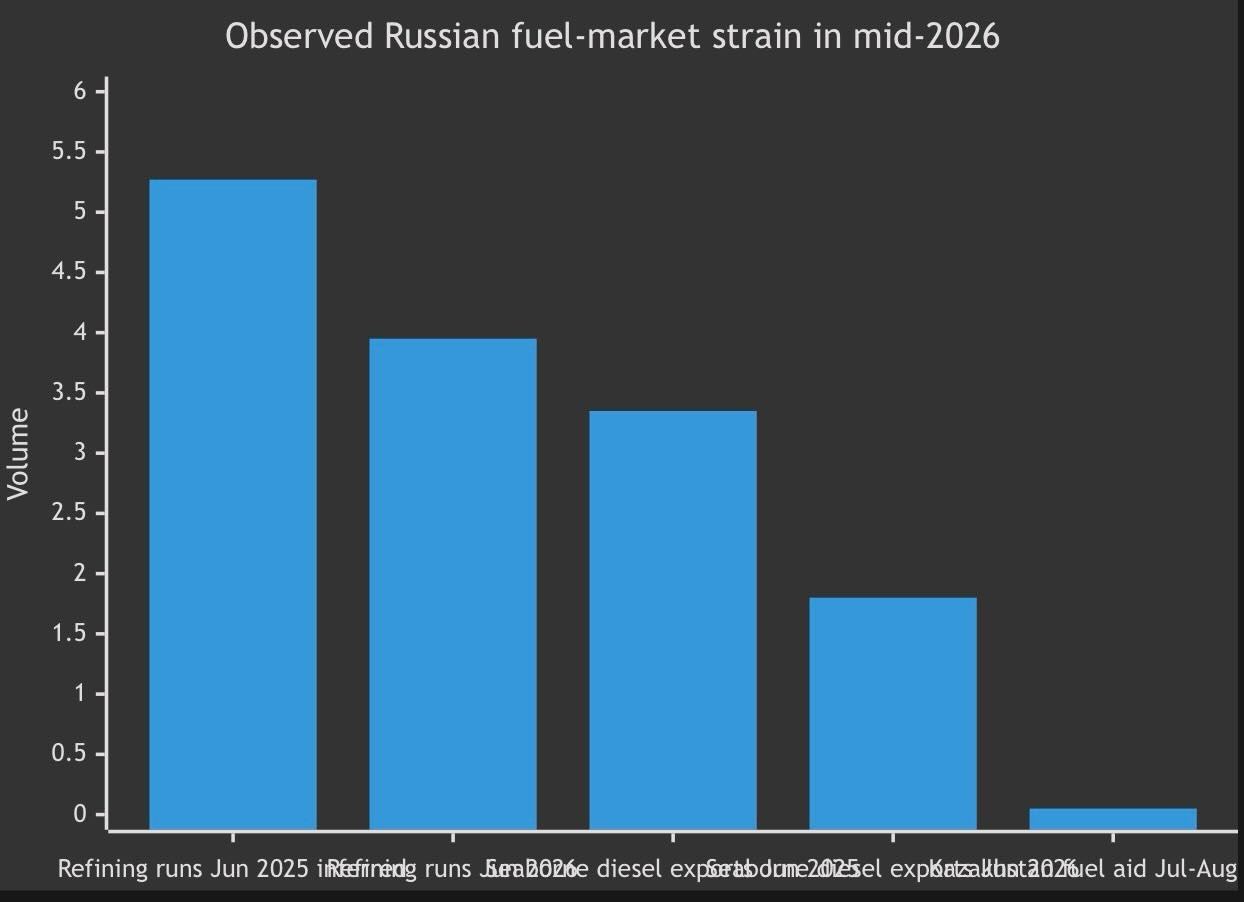
The first bar is inferred from Reuters’ statement that June 2026 refining runs of 3.95 million barrels per day were 25% below a year earlier. Diesel exports fell from 3.35 million tonnes in June 2025 to 1.8 million tonnes in June 2026, while Kazakhstan’s agreed supply of 50,000 tonnes is small relative to both the lost export volume and Russia’s national fuel system.
Regional and sectoral vulnerability
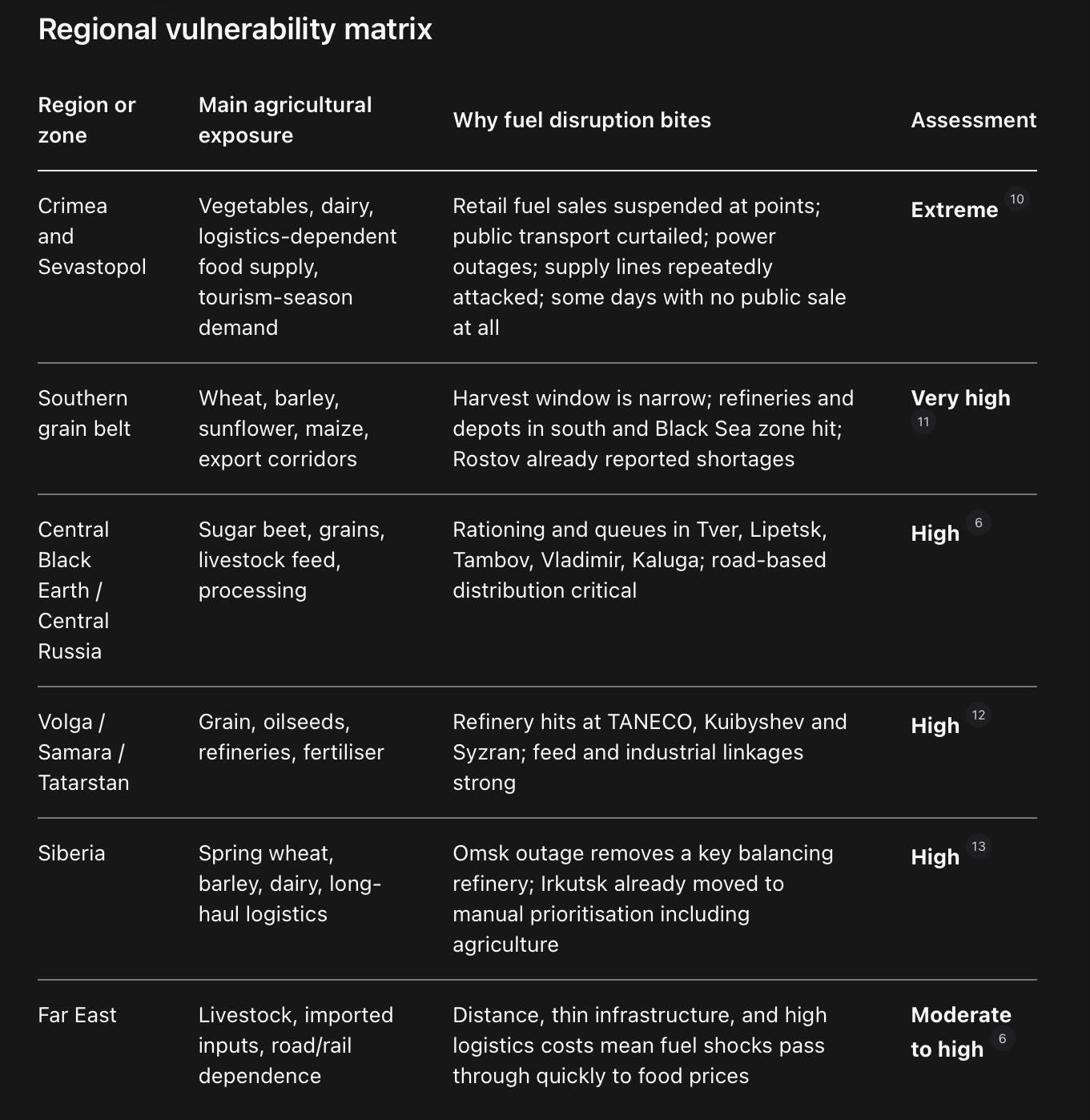
Regional variation is decisive. Russia’s agricultural geography is broad, but the risk profile is not uniform.
The southern grain belt, the Black Earth region, Volga areas, western Siberia, and Crimea do not face the same mix of refinery dependence, transport redundancy, crop mix, and security exposure.
Wheat and sunflower areas in the south face direct harvest and hauling risk; Siberia faces added vulnerability after the Omsk strike; and Crimea faces a compounded fuel-and-power problem because it is both geographically exposed and logistically dependent on contested routes.
USDA and Rosstat-linked sources still imply a large wheat crop in 2026, but that national aggregate can coexist with severe local disruption.
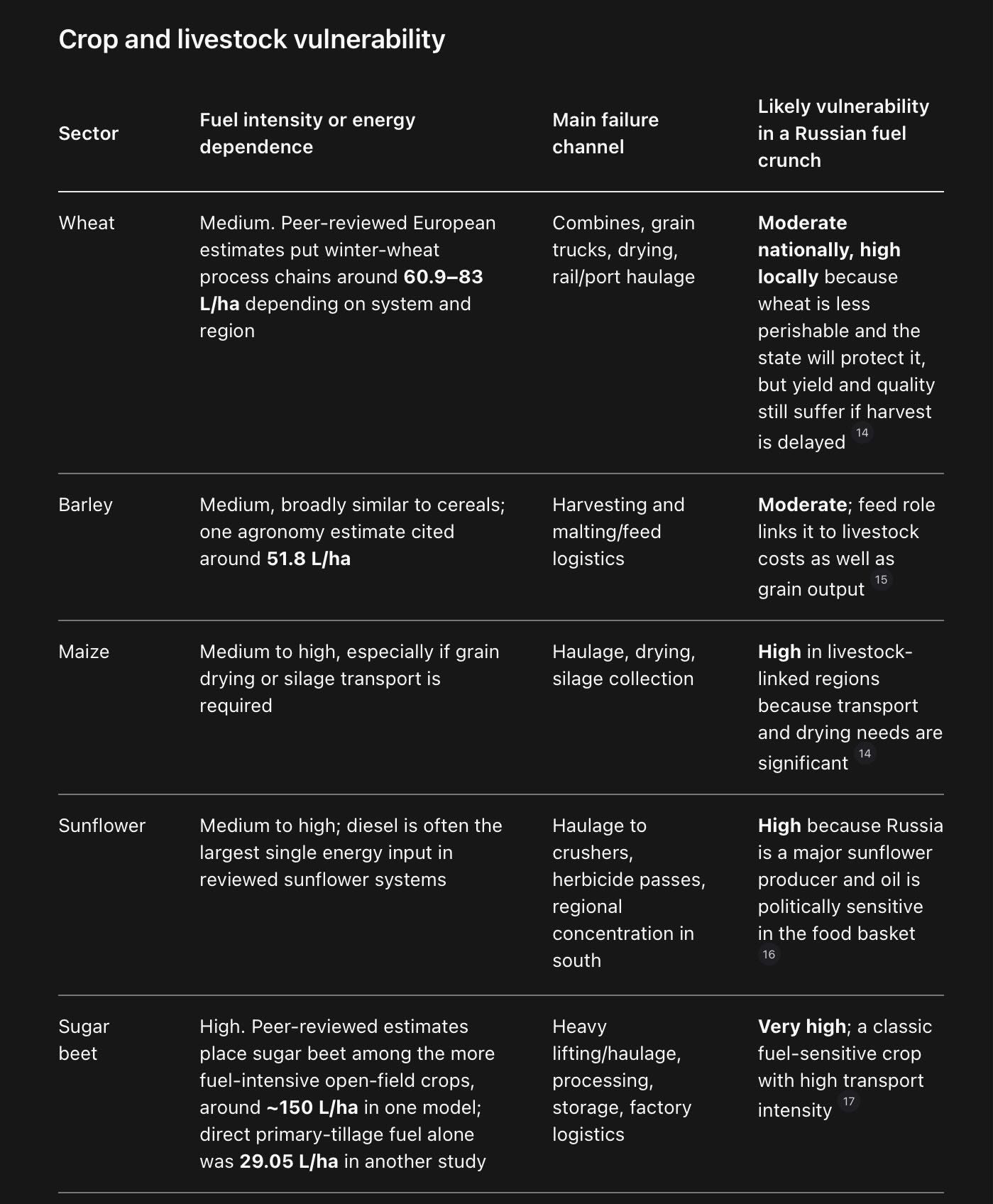
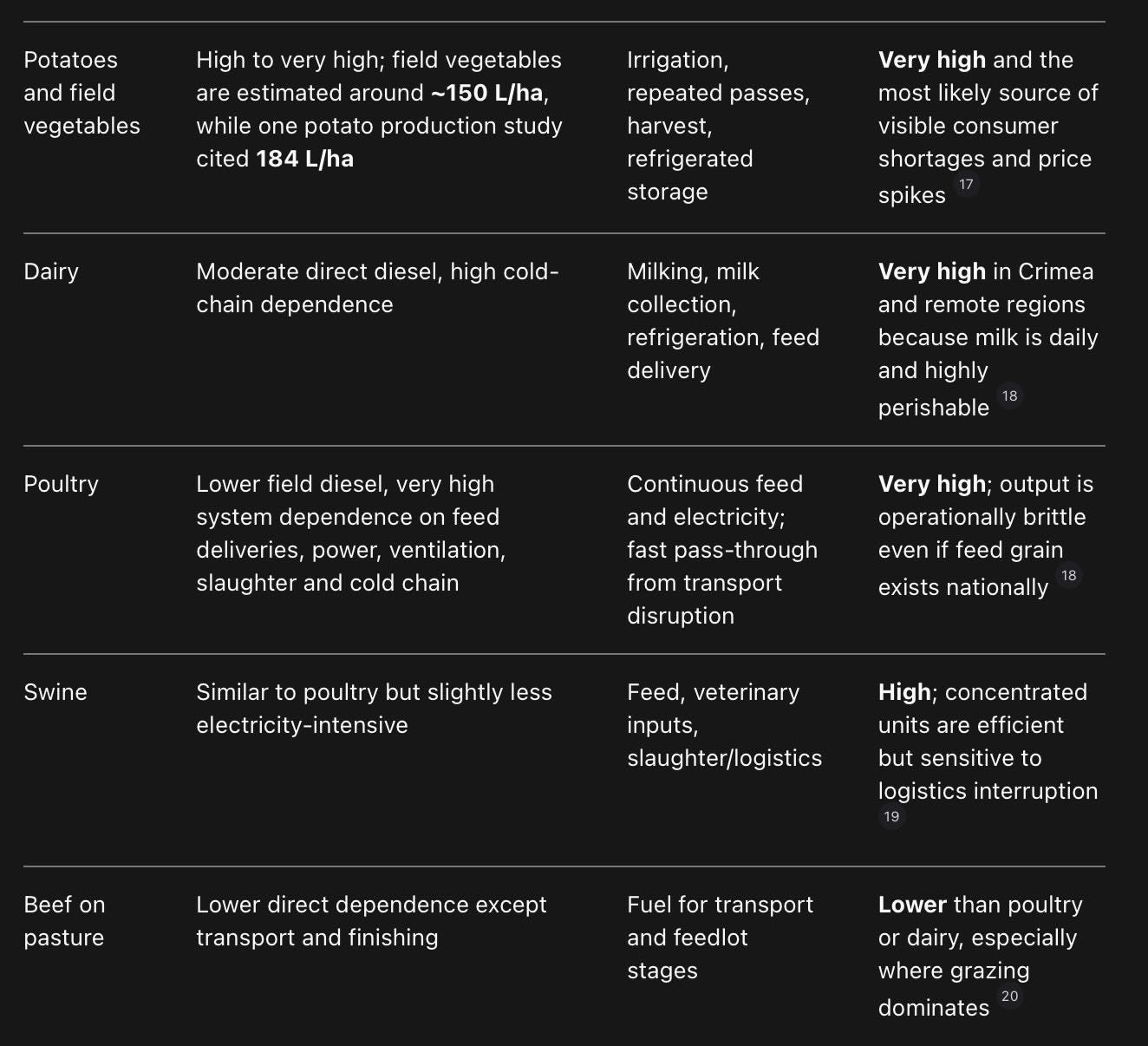
Interpretation. Russia’s largest short-term food-security vulnerability is not bread. It is the perishable basket: potatoes, vegetables, dairy, poultry, eggs, and chilled meat.
Grain gives the state a calorie buffer; perishables expose failures in diesel allocation, power reliability, and refrigerated transport much more quickly.
Food prices, fiscal stress and likely policy response
The domestic price signal is already flashing red. Reuters reported the Russian average gasoline price at 72.38 roubles per litre in late June, but crisis-hit stations were charging far more: around 80 roubles at some private Moscow stations, 120–140 roubles at independent stations in the worst-affected areas, and 189 roubles in Sevastopol when some limited sales resumed.
These are not ordinary price fluctuations; they imply a fragmented market with strong rationing and panic dynamics.
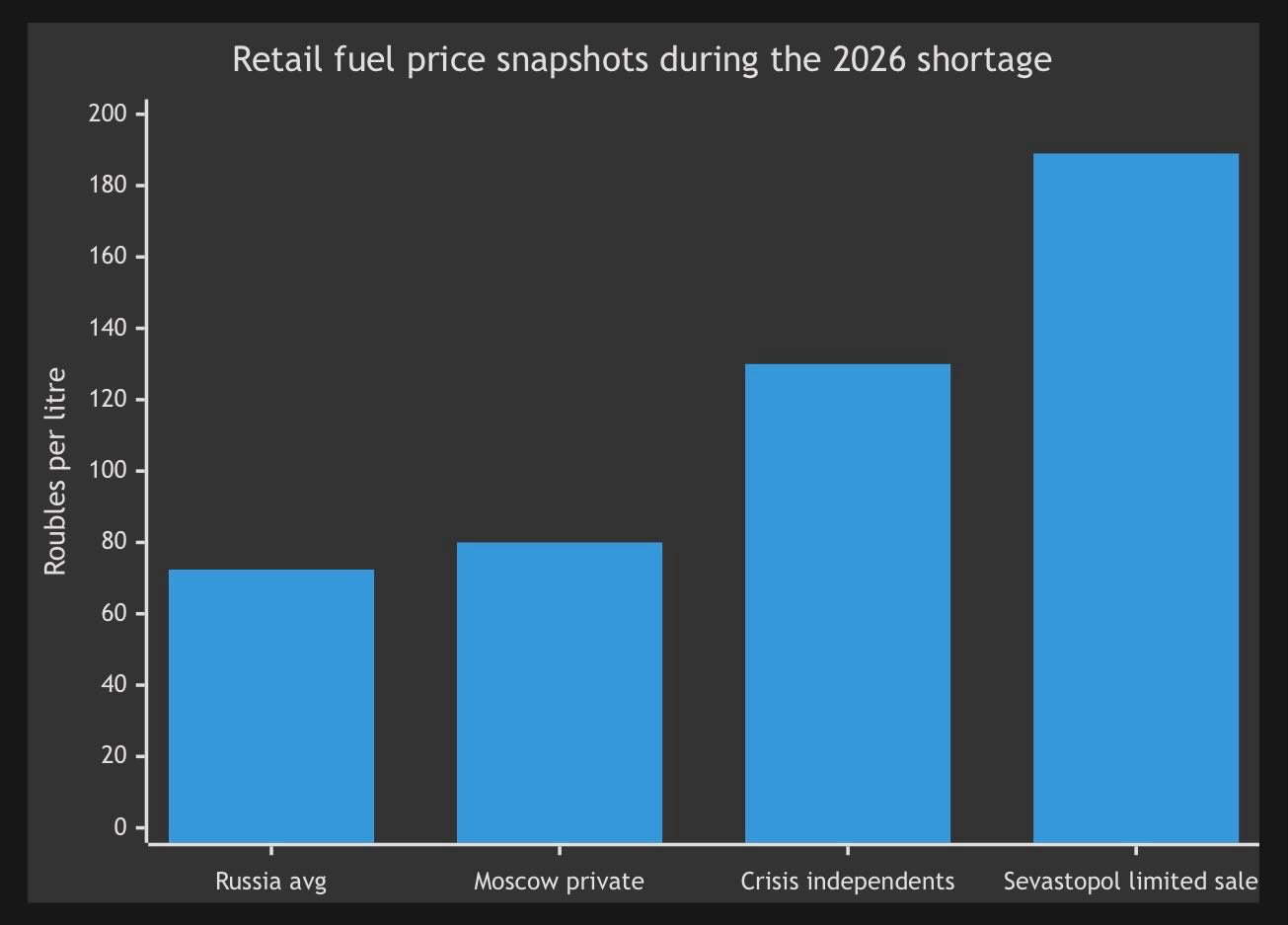
For food prices, the first-round effect is on freight, refrigeration, milk collection, poultry feed transport, and diesel-intensive produce.
The second-round effect comes through tighter 2027 sowing and reduced fertiliser or field-operation intensity if the shock persists.
The Bank of Russia’s own material shows food prices remain a major CPI driver and warns that fuel-production shortfalls are pro-inflationary. My estimate is that, relative to a no-shock baseline, the fuel crisis could add roughly 1–2 percentage points to food inflation over the next 6–12 months in a managed scenario and 3–5 percentage points if refinery damage and regional rationing persist through another sowing-harvest cycle. This is an analytical estimate, not an official forecast.
On food shortages, three scenarios are most plausible:
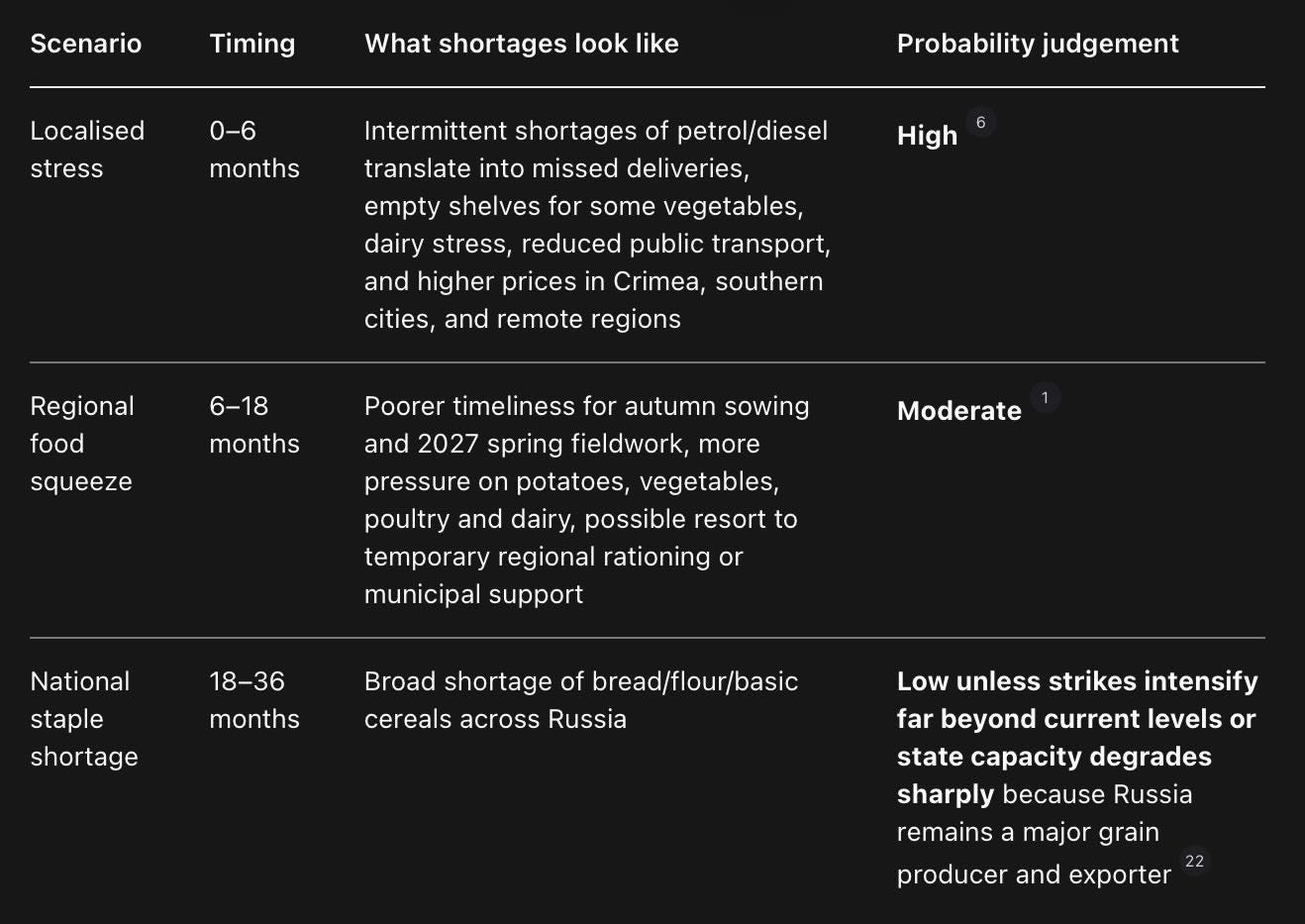
The fiscal implications are negative but manageable in the next few quarters; they become more serious if the shock persists. Russia’s federal deficit had already reached 2.6% of GDP in January–May 2026, above the full-year target of 1.6%, while the Bank of Russia warned that structural primary deficits are likely to persist to 2029.
Regional budgets are also deteriorating: Siluanov projected combined regional deficits of 1.9 trillion roubles in 2026.
Against that backdrop, the fuel crisis means more import subsidies, more support to transport and agricultural users, emergency transfers to exposed regions, and lost or deferred revenue from refined-product exports.
A rough fiscal-order-of-magnitude helps. Russia’s seaborne diesel and gasoil exports were around 1.8 million tonnes in June and only 214,000 bpd in the first eight days of July, already far below the 793,000 bpd of July 2025. If export restrictions and weak production persist for six months, gross lost refined-product export turnover could easily reach several billion US dollars even before counting budget costs of import subsidies and domestic support.
That is not by itself a sovereign-budget catastrophe, but it compounds an already expansionary wartime budget and raises the political cost of maintaining domestic food-price stability.
The most likely policy responses are already visible. They include export bans or curbs, fuel imports, import subsidies, lower-quality blending, manual allocation, rationing by region and buyer type, prioritisation of agriculture and essential services, and possibly broader intervention in food exports if consumer inflation jumps. Russia has used fertiliser export controls before to favour domestic supply, and in March 2026 it suspended ammonium nitrate exports for a month to ensure spring-planting availability. The same logic could readily be extended to food.
Social and political risks should not be overstated, but they are real.
Reuters documented fights at filling stations, large increases in searches for “how to siphon fuel”, and cutbacks to bus routes, waste collection, public transport, café hours, and even children’s camps.
Fuel frustration can turn into food frustration quickly because households understand that “all deliveries are done by road”.
Russia’s own leadership appears worried about this channel: Putin explicitly framed the fuel issue as one that could cause public concern and demanded systemic measures.
Beefy’s Outlook and timeline
My core judgement is that the short-term agricultural future is stressed but not catastrophic, while the medium-term future is materially weaker than current Russian official rhetoric suggests.
USDA data still show a potentially large wheat crop for 2026, which means the country enters this crisis with strong underlying grain-producing capacity.
However, that does not invalidate the fuel risk; it simply means the immediate effect is more likely to be felt in harvest logistics, perishables, regional food prices, and 2027 sowing quality than in a sudden 2026 nationwide grain failure.
In practice, agriculture will probably become more concentrated in the hands of large agroholdings that can self-store fuel, self-insure logistics, and negotiate directly with the state.
Small and medium-sized farms, contract hauliers, independent filling stations, and peripheral regions will carry a disproportionate share of the pain.
That implies a medium-term structural shift: less market allocation, more administrative allocation, more explicit cross-subsidy from consumers and exporters to priority users, and lower average efficiency even if headline output does not collapse.
Timeline of expected impacts
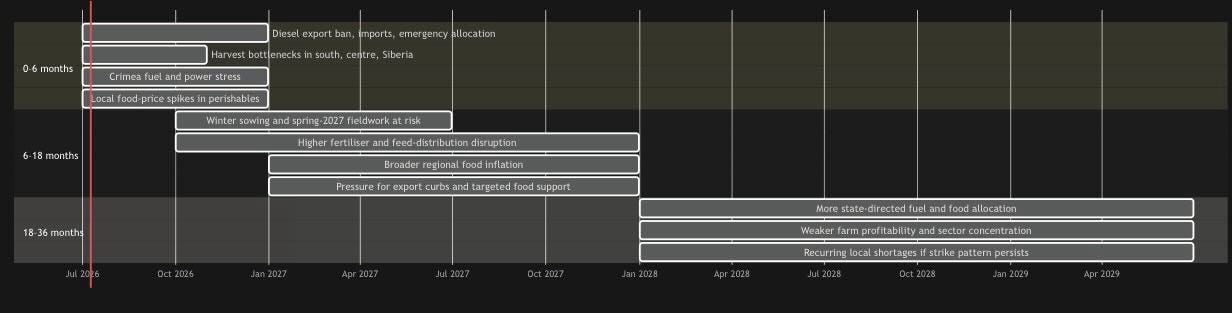
International trade implications are mixed. In the short run, Russia will try to preserve grain exports while cutting fuel exports, because grain remains a strategic foreign-exchange and geopolitical tool and because the 2026 wheat crop still looks large by international standards.
Over 18–36 months, though, persistent fuel and logistics strain raises the chance that Russia curbs grain or vegetable-oil exports more aggressively to defend domestic prices.
The Black Sea route remains central, but it is high-risk!
Black Sea and Baltic oil terminals have also been hit, Crimea’s energy system is strained, and alternative corridors such as the Caspian can help only partially because of vessel-size and water-level constraints.
The planned Tartous logistics hub may create a supplementary outlet, but it is too small to offset major dislocation in the Azov-Black Sea basin.
Open questions remain.
The largest are the actual farm-gate diesel stocks held by major agroholdings, the share of damaged refining capacity that can be restored before the 2026 harvest ends, the reliability of Russian official crop and stock data under wartime conditions, and the degree to which the state would sacrifice export earnings to suppress domestic food inflation.
Those uncertainties are why the report’s scenario ranges are wider in the 6–36 month horizon than in the next 6 months.
References and Sources
Ukrainian Strikes on Russian Refineries and Fuel Infrastructure
Reuters - Ukraine increases attacks on Russian oil industry
https://www.reuters.com/world/europe/
Reuters - Coverage of Russian refinery outages and fuel market disruptions
https://www.reuters.com/business/energy/
Financial Times - Ukraine’s campaign against Russian oil refining infrastructure
https://www.ft.com
BBC News - Russian oil refinery and fuel depot strike coverage
https://www.bbc.com/news/world-europe
Institute for the Study of War (ISW) - Russian Offensive Campaign Assessments and analysis of refinery strikes
https://www.understandingwar.org
Center for Strategic and International Studies (CSIS) - Analysis of Ukrainian long-range strike campaigns
https://www.csis.org
Royal United Services Institute (RUSI) - Analysis of Ukrainian deep-strike strategy
https://www.rusi.org
Russian Fuel Shortages and Logistics - Radio Free Europe / Radio Liberty (RFE/RL)
Reporting on fuel shortages across Russian regions
https://www.rferl.org
The Moscow Times - Independent reporting on fuel supply disruptions and regional shortages
https://www.themoscowtimes.com
Atlantic Council - Russian logistics vulnerabilities and wartime supply chains
https://www.atlanticcouncil.org
UK Ministry of Defence Intelligence Updates - Regular intelligence assessments on Russian logistics
https://www.gov.uk/government/publications/ukraine-intelligence-update
Jamestown Foundation - Russian transportation and logistics analysis
https://jamestown.org
Agriculture and Food Production - United States Department of Agriculture (USDA Foreign Agricultural Service)
Russia Grain and Feed Annual Reports
https://www.fas.usda.gov
USDA GAIN Reports
https://gain.fas.usda.gov
Food and Agriculture Organization (FAO) - Global food and agricultural statistics
https://www.fao.org
International Grains Council (IGC) - Russian grain market analysis
https://www.igc.int
Organisation for Economic Co-operation and Development (OECD) - Agricultural policy monitoring
https://www.oecd.org/agriculture
World Bank - Agriculture and food security datasets
https://www.worldbank.org
Crimea Logistics and Supply Chains - Centre for Eastern Studies (OSW)
Analysis of Crimea logistics and Russian occupation infrastructure
Black Sea Institute of Strategic Studies - Crimea transport and logistics assessments
https://geostrategy.org.ua
European Council on Foreign Relations (ECFR) - Crimea and Russian logistics networks
https://ecfr.eu
Inflation, Food Prices and Consumer Impact
Trading Economics - Russia inflation data
https://tradingeconomics.com/russia/inflation-cpi
World Bank Commodity Markets Outlook
https://www.worldbank.org/en/research/commodity-markets
FAO Food Price Index
https://www.fao.org/worldfoodsituation/foodpricesindex
International Monetary Fund (IMF) - Russia economic outlook
https://www.imf.org/en/Countries/RUS
The Economist - Coverage of inflation and wartime economic pressures
https://www.economist.com
The Moscow Times - Food inflation reporting
https://www.themoscowtimes.com
Russian State Budget, Deficit and War Spending
International Monetary Fund (IMF) - Russian Federation country reports
https://www.imf.org/en/Countries/RUS
World Bank Russia Overview
https://www.worldbank.org/en/country/russia
Institute for the Study of War (ISW) - Russian economic and fiscal assessments
https://www.understandingwar.org
Stockholm Institute of Transition Economics (SITE) - Russian sanctions and fiscal impact research
https://www.hhs.se/en/about-us/centers/site
Bruegel - European economic research on Russia
https://www.bruegel.org
Bloomberg - Russian budget deficit and oil revenue reporting
https://www.bloomberg.com
Reuters - Russian budget, oil revenues and economic developments
https://www.reuters.com/business/energy/
Russian Official Sources (Use With Significant Caution) - Russian Ministry of Finance
https://minfin.gov.ru
Rosstat (Russian Federal State Statistics Service)
https://rosstat.gov.ru
Russian Ministry of Agriculture
https://mcx.gov.ru
Russian Central Bank
https://www.cbr.ru
Particularly Useful Sources
USDA Foreign Agricultural Service
https://www.fas.usda.gov
FAO - https://www.fao.org
IMF Russia Reports
https://www.imf.org/en/Countries/RUS
Reuters Energy Coverage
https://www.reuters.com/business/energy/
ISW Russian Campaign Assessments
https://www.understandingwar.org
UK Ministry of Defence Intelligence Updates
https://www.gov.uk/government/publications/ukraine-intelligence-update
International Grains Council
https://www.igc.int
The Moscow Times
https://www.themoscowtimes.com
Annotated source explanations
Reuters on Russia’s diesel export ban and imports. The clearest single source on the July 2026 emergency response: diesel export ban until 31 July, fuel imports from July, and the collapse in diesel exports. Essential for the short-term fuel balance.
Reuters on Moscow and Omsk refinery outages. These reports establish that the crisis is structurally important because large, named refineries serving major regions are offline or severely damaged. They are central to any medium-term assessment.
Reuters regional shortage reporting. The best evidence that shortages are nationwide but uneven, with particularly strong effects in Crimea, southern Russia and Siberia, and with agriculture explicitly prioritised in official allocation.
Bank of Russia. The most authoritative source used here for inflation and macro-policy risk. Important because it directly links temporary fuel-production decline to inflation risk and notes continuing fiscal concern.
USDA/FAS and IMF. These are the best anchors for judging whether Russia enters the crisis with enough aggregate agricultural capacity to avoid immediate national staple shortages. USDA’s wheat numbers and IMF’s Russia macro projections help prevent overstating collapse risk.
Peer-reviewed energy-use literature and FAO. These sources are not Russia-specific, but they are useful for understanding which farm activities are most exposed to diesel and electricity shocks: field operations, fertiliser, irrigation, storage and cooling.

If you enjoy my threads, please consider supporting my work on Patreon or BuymeACoffee!
Thank You! to those who have supported me on Patreon or buymeacoffee, you are simply awesome.
buymeacoffee.com/beefeaterfella
patreon.com/Beefeater_Fella
beefeaterresearch.substack.com