

Severing Moscow’s Nuclear Tentacles
Killing the Billion-Euro Nuclear Deal, binding Hungary to the Kremlin

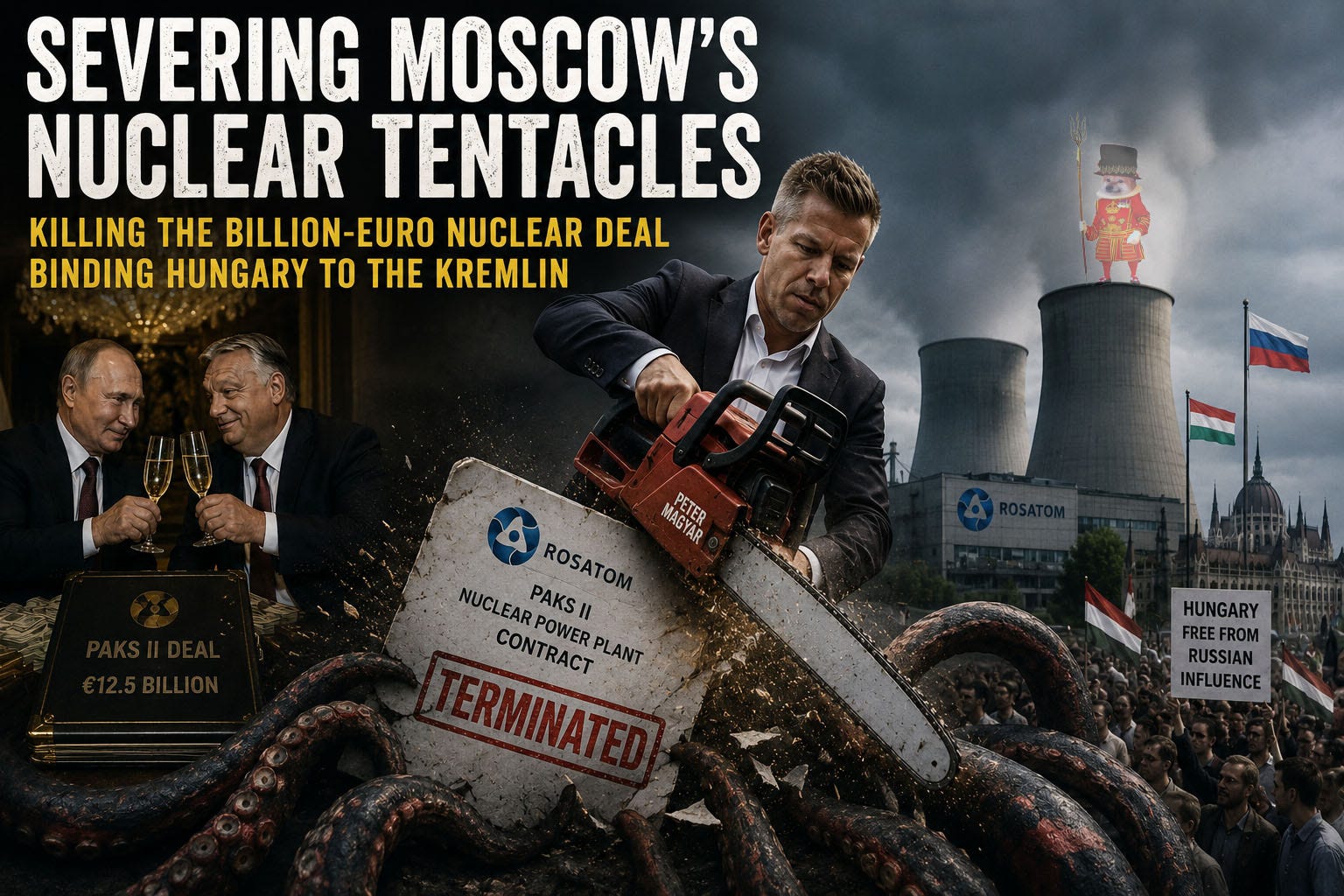
11 May, 2026 - Reuters reports that Hungary’s incoming government intends to review the financing and conditions of the long-delayed €12.5bn Paks II nuclear expansion, awarded in 2014 without tender to Russia’s state nuclear giant Rosatom.
Russias Long Shadow Over Budapest
Paks II is not just a nuclear-energy project. It is one of the deepest Russian strategic anchors inside the European Union: a concrete-and-uranium umbilical cord tying Hungary’s grid, debt profile, technology base, political class and foreign policy room for manoeuvre to Moscow.
The structure was crafted under Viktor Orbán’s long alignment with Vladimir Putin.
In 2014, Hungary awarded Rosatom the project without an open public tender. Russia agreed to finance most of it through a €10bn state loan, covering roughly 80% of the estimated €12.5bn cost, with Hungary covering the rest. The deal was then wrapped in secrecy: Hungary classified key contract details for 30 years, a move critics said shielded corruption risks and prevented proper public scrutiny.
That secrecy matters.
A nuclear plant is not a normal construction contract. It creates decades of dependency: fuel supply, maintenance, safety systems, engineering standards, spare parts, technical upgrades, liability structures, waste management, training and political communication.
Rosatom does not merely build reactors; it builds dependency architecture.
In Paks II, Moscow gained a long-term instrument of influence in the middle of the EU, disguised as energy security.
The legal case against the project is now stronger than ever. In September 2025, the EU Court of Justice annulled the Commission’s earlier approval of Hungary’s state aid because the Commission had not properly examined whether the direct award to the Russian contractor complied with EU procurement rules.
In plain English: the project’s legal foundations are no longer clean marble; they are cracked concrete.
Orbán sold Paks II as sovereignty.
In reality, it looks like a Kremlin-shaped sovereignty trap. Hungary already had heavy Russian energy exposure, and Paks II extended that dependency from gas pipelines into nuclear infrastructure.
The project helped Orbán present himself domestically as the guardian of cheap energy while giving Moscow a propaganda trophy: proof that even after Crimea, and later after Russia’s full-scale invasion of Ukraine, a NATO and EU member still trusted Russia with strategic infrastructure.
The propaganda value is enormous.
Every stage of Paks II lets Moscow say: Europe condemns us, but still needs us. Europe sanctions us, but still builds with us. Europe says Russia is a threat, but one of its own members gives Rosatom a generational foothold.
That is why this is not just about megawatts. It is about Moscow planting a flag inside Europe’s energy nervous system.
Why the contract should be cut
The case for immediate termination is not emotional; it is strategic.
First, Hungary should not bind its future electricity security to a Russian state corporation while Russia wages a war of aggression against Ukraine and uses energy as an instrument of coercion.
Second, the project’s procurement history is compromised by the absence of tendering, excessive secrecy and a major adverse EU court ruling.
Third, the financing model leaves Hungary exposed to Russian leverage through debt and delivery conditions.
Fourth, every year of delay makes the project less credible as a clean energy-security solution and more credible as a political relic from Orbán’s Putinist bargain.
Cutting Paks II would send a powerful signal: Europe’s strategic infrastructure is no longer for sale to authoritarian influence operations. Hungary can still pursue nuclear energy, but through transparent, competitive, EU-compliant procurement involving trusted democratic suppliers, diversified financing and full parliamentary scrutiny.
Paks II is a reactor project, yes. But it is also a Kremlin listening post made of contracts, debt and political theatre. Severing it would not merely cancel a bad deal. It would tell Moscow that its long tentacles into Europe are being cut, one suction-cup at a time.
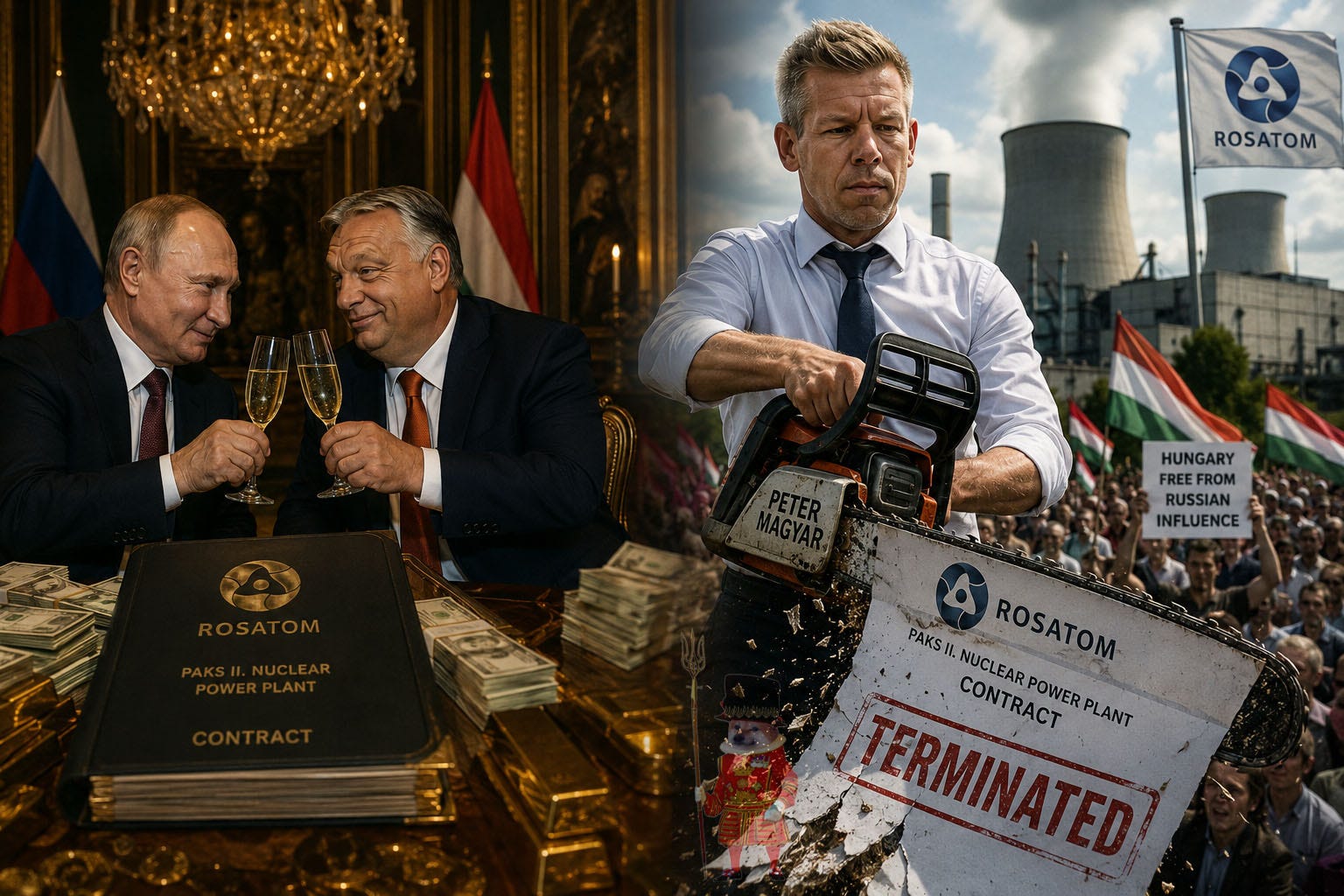
Orbán’s Great Betrayal
How Hungary Became Entangled in Russia and China’s Influence Empire
Under Viktor Orbán, Hungary increasingly positioned itself not merely as an EU member pursuing pragmatic economic diversification, but as a gateway for authoritarian influence deep inside Europe.
What began as Orbán’s so-called “Eastern Opening” policy evolved into a web of strategic dependencies linking Budapest to both Moscow and Beijing through opaque infrastructure, energy and finance agreements.
The Rosatom-led Paks II nuclear expansion became the clearest symbol of this transformation: a multi-billion-euro project financed largely through a Russian state loan, negotiated without transparent competition, wrapped in secrecy and designed to bind Hungary’s energy infrastructure to Russia for generations.
At the same time, Orbán cultivated China as a parallel patron, welcoming large Belt and Road Initiative projects that many Western analysts viewed less as economic miracles than as geopolitical leverage mechanisms dressed in steel, concrete and debt.
Orbán Also sold Hungary off to China
China’s footprint in Hungary expanded rapidly through projects such as the controversial Budapest–Belgrade railway, financed heavily through Chinese loans and constructed largely by Chinese firms.
Critics argued that the line made little commercial sense relative to its immense cost, with Hungarian taxpayers likely carrying repayment burdens long after the political spectacle faded.
The railway became emblematic of Beijing’s strategy across parts of Eurasia and the developing world: offering headline-grabbing infrastructure projects that create long-term financial and political dependence while extending Chinese logistical and diplomatic influence.
Hungary simultaneously opened its doors to Chinese battery manufacturers, telecommunications infrastructure and academic projects, including the once-planned Fudan University campus in Budapest, which triggered mass protests over fears of surveillance influence, corruption risks and the erosion of European democratic norms.
Orbán‘s Scam
Orbán presented these relationships as proof of Hungarian sovereignty and strategic independence from Brussels. In reality, critics increasingly saw the opposite: Hungary becoming financially and politically entangled with authoritarian powers whose interests frequently conflicted with those of the European Union and NATO.
Budapest repeatedly diluted or obstructed EU consensus on Russia and China related policies, including sanctions, Ukraine support measures and human-rights statements, reinforcing perceptions that Hungary had evolved into a veto outpost for external powers inside European institutions.
The reputational damage has been profound. Hungary, once viewed as one of post-Cold War Europe’s democratic success stories, increasingly became associated with corruption allegations, opaque procurement, democratic backsliding and foreign influence operations that weakened collective European unity during a period of mounting geopolitical instability.
The enduring risks - post Orbán
The long-term economic risks may ultimately outlive Orbán himself. Massive state-backed infrastructure projects financed externally often create hidden liabilities through debt servicing, maintenance obligations, technological lock-in and reduced policy flexibility.
Paks II could leave Hungary dependent on Russian nuclear fuel cycles, engineering systems and contractual obligations for decades, while Chinese-backed infrastructure projects may produce limited economic returns relative to their financing costs.
These burdens arrive alongside softer but equally important losses: investor distrust, reduced confidence among European partners and growing concern that Hungary’s institutions became vulnerable to elite capture through foreign-linked patronage networks. In geopolitical terms, Hungary risked trading diversified European integration for concentrated dependency on two authoritarian powers pursuing influence through economic statecraft.
The strategic tragedy is that Hungary possessed every opportunity to modernise within the European mainstream while preserving national sovereignty.
Instead, Orbán often framed Brussels as the threat while portraying Moscow and Beijing as pragmatic partners, despite the latter pursuing openly transactional and influence-driven foreign policies.
The result is a country increasingly isolated inside the EU, viewed with suspicion by allies and burdened with projects that critics argue were designed as much to extend Russian and Chinese leverage into Europe as to deliver meaningful long-term prosperity for the Hungarian people.
Hungary may now spend decades not only repaying financial debts, but also rebuilding institutional trust and repairing its damaged reputation at the centre of Europe.
References and sources:
https://curia.europa.eu/jcms/upload/docs/application/pdf/2025-09/cp250116en.pdf
https://www.businessinsider.com/hungarys-nuclear-deal-with-russia-is-now-a-30-year-secret-2015-3
https://ec.europa.eu/commission/presscorner/detail/en/IP_17_464
https://www.rosatom.ru/en/investors/projects/paks-2/
https://www.bbc.com/news/world-europe-34728964
https://transparency.hu/en/news/paks-ii-the-most-important-questions/
https://www.europarl.europa.eu/thinktank/en/document/EPRS_BRI(2022)729331
https://www.iea.org/countries/hungary
The cost of Orban’s corruption for Hungary
https://curia.europa.eu/jcms/upload/docs/application/pdf/2025-09/cp250116en.pdf
https://ec.europa.eu/commission/presscorner/detail/en/IP_17_464
https://transparency.hu/en/news/paks-ii-the-most-important-questions/
https://www.europarl.europa.eu/thinktank/en/document/EPRS_BRI(2022)729331
https://www.iea.org/countries/hungary
https://www.bbc.com/news/world-europe-34728964
https://www.dw.com/en/hungary-and-china-a-growing-relationship/a-68987815
https://www.politico.eu/article/hungary-viktor-orban-china-europe-xi-jinping/
https://www.csis.org/analysis/chinas-belt-and-road-reaching-europe-hungary-case-study
https://carnegieendowment.org/research/2024/05/chinas-growing-footprint-in-hungary
https://www.transparency.org/en/news/hungary-corruption-rule-of-law-eu-funds-orban
https://freedomhouse.org/country/hungary/nations-transit/2025
https://www.brookings.edu/articles/hungarys-orban-and-the-authoritarian-axis/
Your support will be really appreciated. Please help me keep publishing educational material across channels!
buymeacoffee.com/beefeaterfella
patreon.com/Beefeater_Fella
beefeaterresearch.substack.com