

Shadow Fleet, Shadow Finance, Shadow Promises
Why Britain Still Struggles to Confront Russian Power Beyond the Battlefield

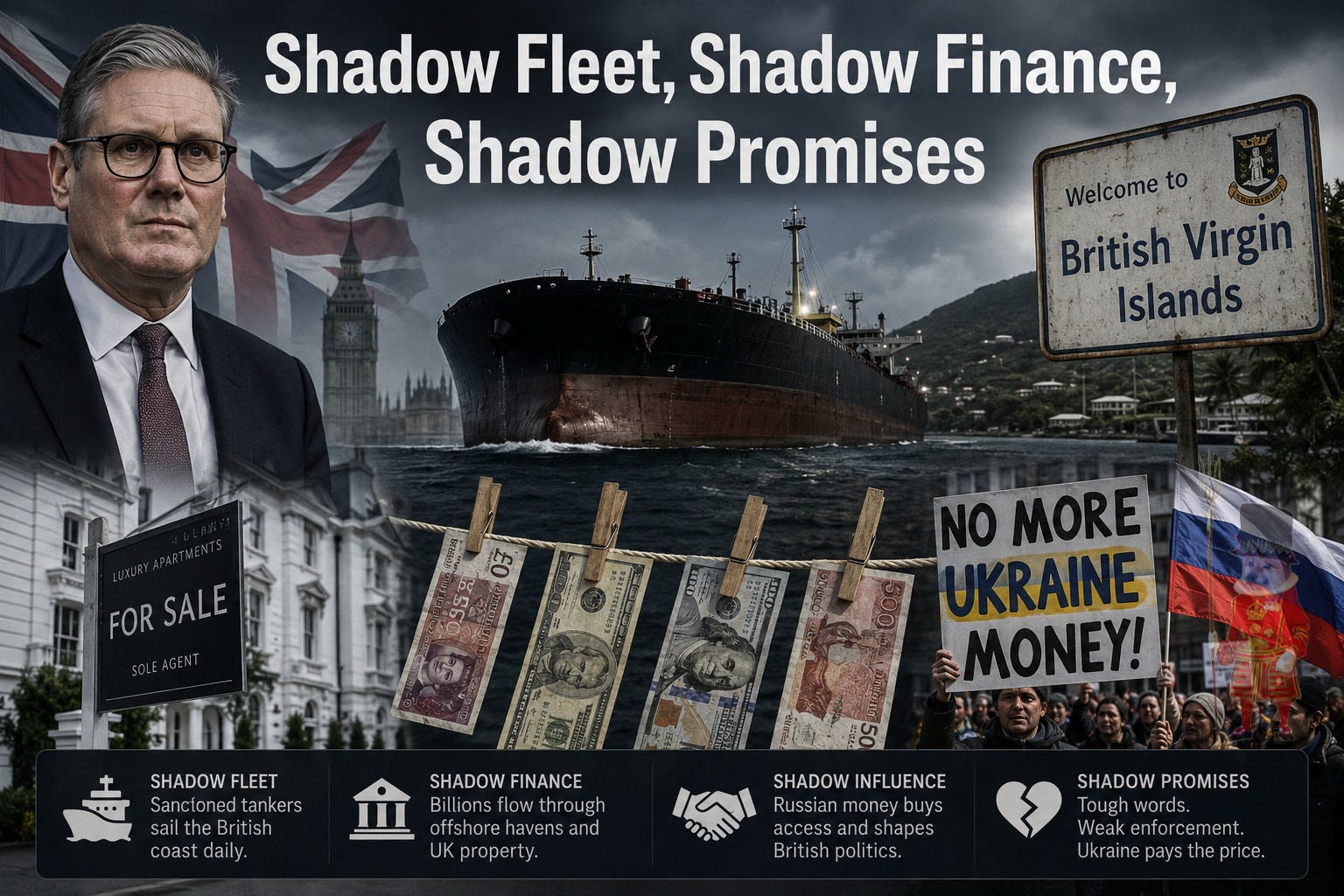
Recognising the immense support
The headline aid numbers are serious: the UK says it has committed up to £21.8bn for Ukraine, including £13bn military support, £5.3bn non-military support, and a £3.5bn export finance cover limit.
It has also pledged £3bn a year in military aid until 2030-31, trained over 62,000 Ukrainian personnel, and says two-thirds of its £2.26bn ERA loan has been disbursed.
The United Kingdom’s contribution - is not trivial support.
Labour and Keir Starmer have been rhetorically strong on Ukraine, but operationally uneven.
The central weakness is that Labour has inherited and largely preserved Britain’s old contradiction: it helps Ukraine with one hand while allowing London, offshore secrecy, legal services, fuel loopholes and maritime hesitation to keep giving Russian interests breathing space.
The result is a policy that looks muscular on podiums but oddly porous in the plumbing.
Sanctions and Oligarchs
On sanctions and oligarch wealth, the picture is damning.
OFSI reports £28.7bn in Russia-related assets frozen, and £37bn total assets reported frozen across sanctions regimes in 2024-25. Yet frozen does not mean seized, transferred, or strategically repurposed. Worse, Transparency International-linked findings indicate that major UK property assets tied to sanctioned Russian oligarchs remain outside frozen-asset registers, with reports identifying 33 properties worth about £700m not frozen.
The deeper failure is property opacity. Transparency International found that offshore vehicles registered in UK Overseas Territories have been used in more than 273 major corruption and money-laundering cases, involving about $327bn, with the British Virgin Islands appearing in 92% of cases. It also found that almost £6bn was used to buy UK property through shell companies registered in British offshore centres.
That is not a loophole; it is a velvet-lined tunnel.
Tax havens
On tax havens, Labour has not yet forced the necessary rupture.
Transparency International reported in February 2026 that 29,000 trade transactions worth $8bn/£5.9bn with Russia were facilitated by companies registered in UK Overseas Territories since the full-scale invasion. It identified 145 opaque offshore companies shielding activity, with the BVI and Bermuda still important intermediaries.
The conclusion is brutal: Britain’s own offshore network remains a sanctions backdoor.
On Ukrainian Refugees
On refugees, the UK did give sanctuary at scale: Commons Library says around 234,000 people arrived under Homes for Ukraine or the Ukraine Family Scheme.
But support has thinned. The Ukraine Permission Extension gives Ukrainians only 18 months, with a further 24-month extension possible, rather than a secure route to permanence. Host “thank you” payments have also been reduced to £350 per month, and only for limited periods under extension rules.
The housing record is particularly weak. Government data continues to track homelessness duties owed to Ukrainians, while reporting has found over £300m in council Ukraine housing funds left unspent despite homelessness pressures. That suggests not just compassion fatigue, but administrative drift.
On Russian visas
There is still no general UK travel ban on Russian citizens.
The Home Office still publishes Russian visa grants through its entry-clearance datasets, and a parliamentary answer in March 2026 confirmed data exist up to December 2025. Separate reporting and FOI-derived figures show Russian visit visa grants remain significant, with one year-to-March-2025 figure showing 40,236 Russian visit visas granted. The old Tier 1 “golden visa” scandal also remains unresolved because the full review has still not been published.
On UK-Russian trade
On trade, the UK has cut direct trade sharply and says over £20bn of UK-Russia trade is now sanctioned. But the government itself admits Russia continues procuring Western goods through third countries. The new sanctions end-use controls are an admission that the previous regime leaked.
The fuel loophole is one of the ugliest failures.
The UK bans Russian oil, but petroleum refined in third countries can still enter under rules of origin.
Global Witness estimated the loophole was worth £123m to the Kremlin in tax revenue in 2023, and CREA has argued UK imports from refineries using Russian crude generated £510m in Russian tax revenue. In plain English: Russian oil can take a bath in India or Turkey and reappear cleaner at a British forecourt.
Shadow Fleet
On the shadow fleet, Labour’s performance is performative rather than coercive. The UK has sanctioned dozens of vessels, including 40 in February 2025 and further ships in May 2025, but sanctioning is not the same as stopping.
Recent reporting says Russian-linked or sanctioned vessels have continued moving through UK-adjacent waters and the Dover Strait, sometimes escorted by Russian warships, while other European states have been more willing to detain suspect vessels.
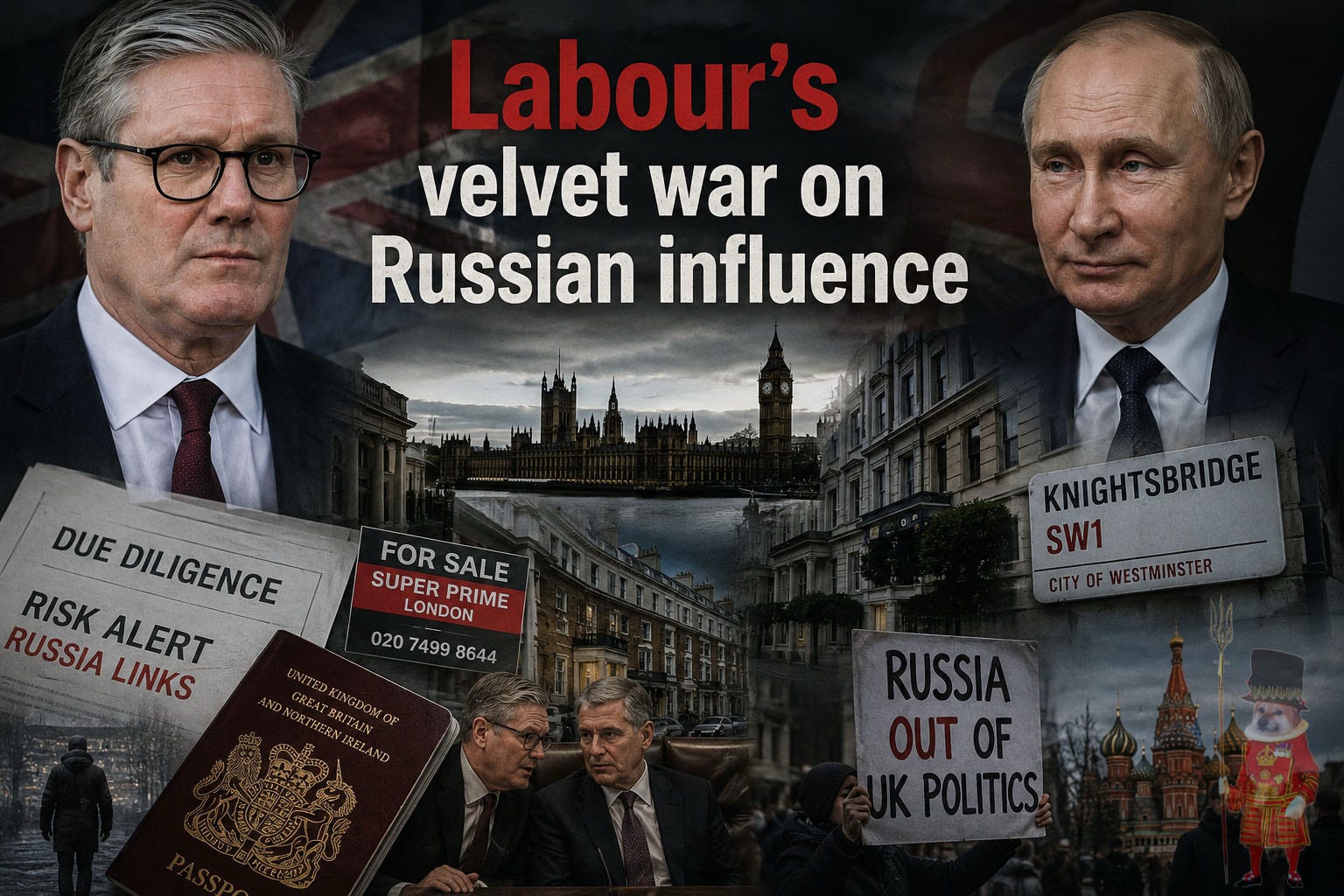
How Russian Influence Exploited Britain’s Divisions and Why Labour Failed to Respond
Labour’s domestic failure on Russian influence
Labour’s weakness is not that it is pro-Russian. It is that it has treated Russian influence as a foreign-policy problem, when much of it is a domestic-governance problem: money, access, property, lobbying, party finance, offshore secrecy, legal intimidation and political destabilisation.
The Mandelson appointment is the clearest symbol.
Peter Mandelson’s long-recorded proximity to Oleg Deripaska, including the 2008 yacht controversy, was already part of Britain’s post-Soviet influence archive.
Recent reporting and parliamentary exchanges have also raised concerns about due-diligence warnings over Mandelson’s links to Russian and Chinese business interests before Starmer appointed him as ambassador to Washington.
Even if no illegality is proven, the judgement failure is glaring: a government claiming to confront Moscow should not elevate figures whose networks create obvious counter-intelligence and reputational vulnerabilities.
The deeper problem is that Labour has not truly broken with “Londongrad”. The 2020 Intelligence and Security Committee Russia Report warned that Russian influence in the UK had become “the new normal”, with Putin-linked wealth embedded in business, society and elite circles. That report also criticised the failure to investigate Russian interference around Brexit properly. Starmer has had years to make this a constitutional-security priority, yet the response remains slow, legalistic and oddly bloodless.
Brexit remains the open wound.
The issue is not whether Russia “caused” Brexit, which has never been proven.
The issue is that the UK state never properly investigated whether Kremlin influence, dark money, bot networks, propaganda ecosystems or elite Russian-linked financing contaminated the referendum environment.
That failure benefits Moscow because ambiguity itself is useful: doubt corrodes trust, conspiracy fills the gaps, and democratic legitimacy becomes easier to poison.
Reform UK and the wider far-right ecosystem sharpen this danger.
The Nathan Gill case is not merely an embarrassing historical footnote. A former Reform UK figure and ex-MEP admitted taking bribes to make pro-Russian statements in the European Parliament, linked to Oleg Voloshyn, a pro-Kremlin Ukrainian politician later named by the US as part of a Russian influence operation.
This does not prove Reform UK as a party is Russian-funded, but it does prove that Kremlin-linked money reached a senior figure in Farage’s political orbit.
That should have triggered a far more aggressive review of party finance, donor networks, foreign-adjacent funding and political messaging alignment.
The political strategy Russia favours is not always direct control. It is fragmentation. Moscow benefits when Western states are paralysed by culture war, anti-institutional rage, distrust of courts, hostility to human rights law, attacks on journalists, suspicion of NATO, and admiration for “strongman” politics. Far-right and hard-populist parties can therefore serve Russian interests even without formal Kremlin command: they weaken the immune system of liberal democracy.
They create precisely the noisy, rule-bending environment in which dirty money, oligarchic influence and authoritarian narratives breathe more easily.
Business is the second failure.
UK sanctions have expanded, but the government has not fully confronted the service economy that enabled Russian wealth: lawyers, consultants, reputation managers, property agents, offshore administrators and financial intermediaries. Transparency International has shown how companies in UK Overseas Territories facilitated almost £6bn in Russia-related trade despite sanctions, with the British Virgin Islands repeatedly appearing as a secrecy hub.
This is not peripheral to Russian influence; it is infrastructure.
Labour’s failure is not a single betrayal but a pattern of caution.
It has supported Ukraine militarily while leaving too many Russian-influence channels intact at home. It has sanctioned tankers but not fully dismantled offshore secrecy. It has condemned Putin while failing to cleanse Westminster’s political-finance vulnerabilities.
It has spoken of defending democracy while leaving the Brexit-Russia question unresolved. It has appointed figures whose networks undermine the moral clarity of its own position.
The conclusions are severe
Starmer’s Labour has been strong enough to oppose Russian aggression abroad, but not brave enough to uproot Russian influence at home.
That half-war suits Moscow. Putin does not need Britain to become pro-Russian; he only needs it to remain permeable, distracted, divided and legally hesitant. Labour has not yet closed that door.
Labour has not failed Ukraine on aid. It has failed to match aid with economic warfare.
Starmer’s government has kept the guns flowing, but not shut the vaults, shell companies, refinery loopholes, visa channels, legal laundries and maritime escape routes that allow Russian wealth and logistics to survive contact with British policy.
The verdict is therefore mixed but severe: Labour has been a credible donor to Ukraine, but a poor dismantler of Russian influence inside the British system. Starmer has continued Britain’s long habit of fighting Moscow abroad while tiptoeing around the structures that served Moscow at home.
References and sources:
https://www.transparency.org.uk/publications/opening-offshore-secrecy
https://commonslibrary.parliament.uk/research-briefings/cbp-9473/
https://www.parallelparliament.co.uk/question/115954/visas-russia
https://energyandcleanair.org/publication/eu-imports-of-refined-products-made-from-russian-crude/
https://www.globalwitness.org/en/campaigns/fossil-gas/the-west-is-still-buying-russian-oil/
https://www.reuters.com/world/europe/uk-announces-new-package-sanctions-against-russia-2025-02-24/

Your support will be really appreciated. Please help me keep publishing educational material across channels!
buymeacoffee.com/beefeaterfella
patreon.com/Beefeater_Fella
beefeaterresearch.substack.com