

The Caspian Mask
How Russian Energy May Be Quietly Reaching Europe Through Azerbaijan’s Expanding Export Empire
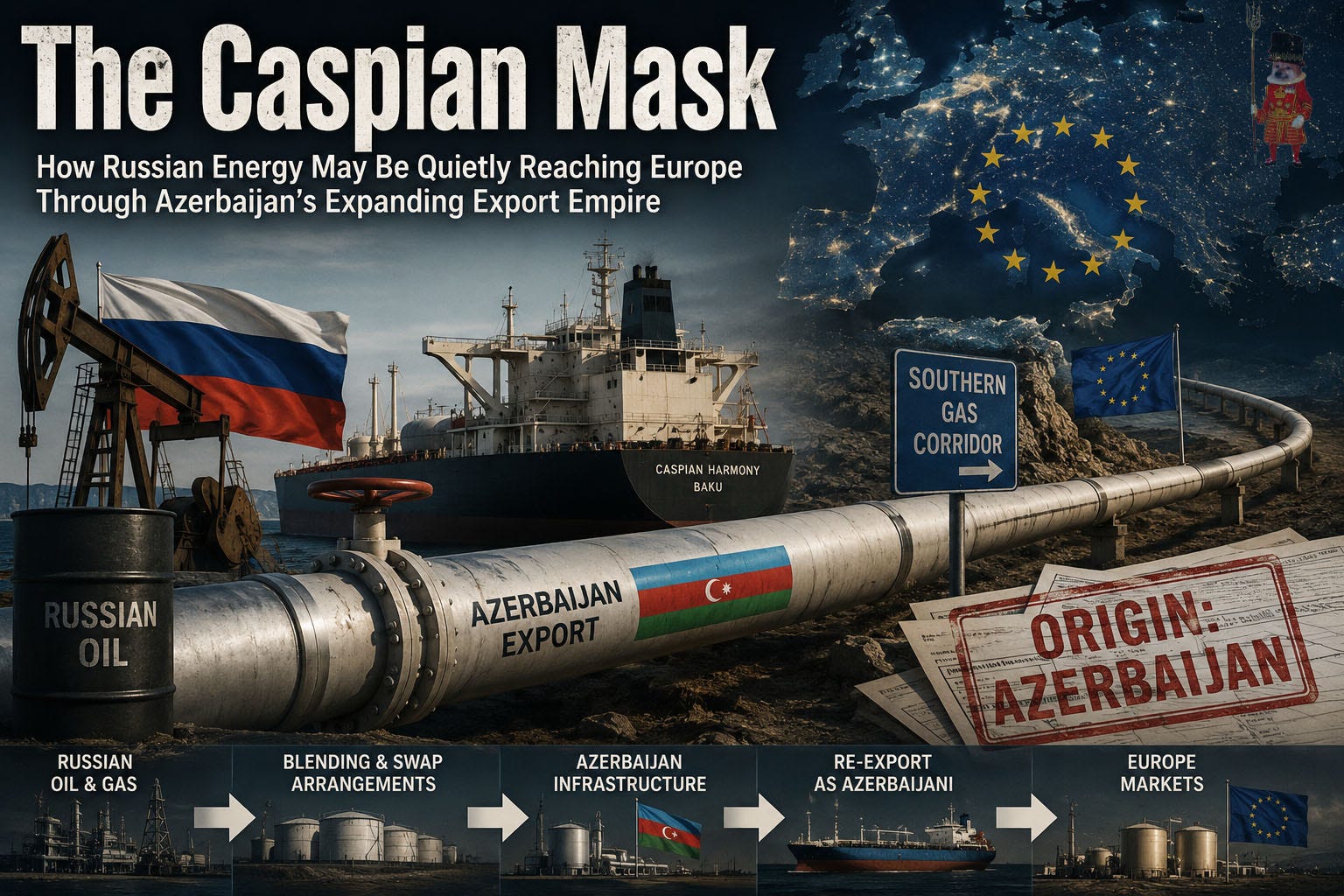
There is credible evidence that Slovakia is actively pursuing a diversification strategy away from heavy dependence on Russian gas, including negotiations for long term gas imports from Azerbaijan. However, the reality is more complicated than a clean geopolitical “break” with Russia. Slovakia is simultaneously still importing substantial Russian gas through alternative routes such as TurkStream via Hungary.
The clearest recent confirmation came from Slovak Deputy Prime Minister Tomáš Taraba in May 2026, who publicly stated that Slovakia is negotiating a gas supply agreement with Azerbaijan for “at least 10 years” in order to diversify supplies.
Beefy’s explores this so-called “pivot” to understand this is not the clean break from Russia as it is being claimed.
Let’s look beneath the hood of Azerbaijan and Russia
Azerbaijan-Russia trade has grown materially since 2022, and part of that growth almost certainly reflects Russia’s post-sanctions “parallel import” economy, although the evidence is stronger for consumer goods, machinery, vehicles, electronics and logistics than for proving state-directed sanctions evasion.
Estimated trade value
Official bilateral trade was about $4.36bn in 2023, then rose to about $4.80bn in 2024. In 2024, Azerbaijan exported about $1.18bn to Russia and imported about $3.62bn from Russia.
In 2025, available customs-based reporting points to roughly $4.5bn-$4.9bn, with Russia still running a large surplus.
Interfax reported a $2.55bn Azerbaijani trade deficit with Russia in 2025, while other trade databases put Azerbaijan’s 2025 imports from Russia at around $3.74bn and exports at around $1.18bn.
The broad direction is clear: compared with pre-invasion patterns, trade has not collapsed under sanctions pressure.
It has become warmer commercially even when politics has cooled. Russia remains a major supplier to Azerbaijan, while Russia is also one of Azerbaijan’s key markets for non-oil exports, especially food and agricultural goods.
Direct imports: what Azerbaijan buys from Russia
Azerbaijan’s imports from Russia are mostly conventional, and not automatically suspicious: wheat, foodstuffs, metals, timber, chemicals, fertilisers, machinery, and industrial inputs.
The import side matters because it gives Moscow hard-currency trade, preserves Russian commercial networks in the South Caucasus, and keeps Azerbaijani business exposed to Russian supply chains.
The trade imbalance is striking. Azerbaijan is not merely selling to Russia; it is buying much more from Russia than it sells.
In 2024, imports from Russia were about three times Azerbaijani exports to Russia.
Exports and re-exports: where the shadow begins
Azerbaijan’s official exports to Russia are dominated by non-oil goods: fruit, vegetables, juices, hazelnuts, potatoes, tomatoes, apples, cherries and similar products. That is the clean, visible layer.
The darker layer is re-export and parallel import trade. Since 2022, Russia has used nearby economies to replace direct imports from the EU, UK, US, Japan and South Korea. The EBRD called this the “Eurasian roundabout”, finding that exports from Western economies to Russia fell sharply while exports to parts of the Caucasus and Central Asia rose, with evidence suggesting some goods were being re-routed into Russia.
Azerbaijan is not the biggest re-export hub compared with Armenia, Kazakhstan, Kyrgyzstan, Turkey or the UAE, but it appears in the network.
Reporting on Turkey’s tightening of military-linked exports to Russia noted that some flows had shifted through intermediaries including Kazakhstan and Azerbaijan.
Estimated value of parallel imports
A cautious estimate would be:
Direct official Azerbaijan-Russia trade: roughly $4.5bn-$4.9bn annually in 2024-2025.
Likely parallel/re-export component: probably hundreds of millions of dollars per year, not proven at multi-billion scale from public data alone. The strongest candidates are vehicles, spare parts, electronics, machinery, branded consumer goods, and some dual-use-adjacent equipment.
The key caveat: customs data can show suspicious growth, but it rarely proves final destination. The trade fog is created by small firms, free-zone logistics, relabelling, mixed consignments, and “private import” channels. It is less a pipeline than a bazaar with false walls.
How it changed after 2022
The pattern after Russia’s full-scale invasion is not simply “Azerbaijan helped Russia dodge sanctions.” It is more precise to say:
👉 Azerbaijan benefited from Russia’s need for alternative trade routes.
👉 Russian demand for Western goods moved into neighbouring markets.
👉 Azerbaijani traders, logistics firms and intermediaries appear to have participated in some rerouting.
👉 The state tolerated the growth because it served commercial and geopolitical leverage.
👉 Baku avoided becoming as exposed as Armenia or Kyrgyzstan, but it did not seal the door either.
Cultural and political ties
The two countries have deep Soviet-era institutional memory, Russian-language education, migration links, business networks, and a large Azerbaijani diaspora in Russia.
Russian media, culture, universities and commercial habits still have influence, although Baku has steadily reduced Moscow’s monopoly by leaning toward Turkey, Israel, the EU energy market, and the Turkic world.
Friction
The relationship has become much rougher since 2024-2025. The biggest flashpoints include the Azerbaijan Airlines crash in December 2024, which Azerbaijan linked to Russian actions, and the deaths of Azerbaijanis during Russian police operations in Yekaterinburg in 2025.
Azerbaijan responded by cancelling Russian cultural events and raiding Sputnik Azerbaijan, while Moscow condemned Baku’s reaction.
The Russian signature on European Energy
Has Europe Truly Diversified, or Simply Changed the Label on Russian Energy Dependence?
There is credible evidence that Russian hydrocarbons can become intermixed with Azerbaijani export systems in certain circumstances, but the picture is nuanced and differs sharply between oil and gas.
For oil, Azerbaijan is primarily an exporter of its own crude, especially Azeri Light from the Azeri-Chirag-Gunashli fields exported through the BTC pipeline to Ceyhan in Turkey.
However, the Caspian and Black Sea trading system has become increasingly opaque since sanctions on Russia intensified after 2022.
Traders, refiners, and shipping analysts have repeatedly warned about blending, relabelling, and transshipment practices across the wider region, including the Caucasus and Türkiye.
One important distinction is that Azerbaijan does not generally need Russian oil to meet export demand.
Azerbaijani Oil Exports are Distinct
But Russian-origin oil can still physically enter Azerbaijani-linked logistics chains through swaps, storage blending, or pipeline balancing arrangements.
The historic Baku–Novorossiysk pipeline directly connects Azerbaijan and Russia, although today volumes are relatively small. More importantly, Caspian tanker routes and Black Sea terminals create opportunities for commingling. Kazakhstan’s exports via Azerbaijan and BTC also complicate traceability because Kazakh crude itself is often exported through Russian systems under brands such as KEBCO.
There have also been investigations across Europe into schemes where Russian oil was allegedly disguised as non-Russian origin through documentation fraud, blending, or ship-to-ship transfers involving intermediaries operating in Azerbaijan, Türkiye, Turkmenistan, and elsewhere.
That does not mean Azerbaijan’s state directly re-exports Russian oil as policy, but it does indicate that the broader regional trading ecosystem provides avenues through which Russian-origin barrels may become obscured.
The Gas Scam
Gas is more politically sensitive. Azerbaijan exports gas to Europe via the Southern Gas Corridor and positions itself as an alternative to Russian supply. However, after the Ukraine invasion, Azerbaijan also increased gas cooperation with Moscow.
In 2022 and later, Azerbaijan imported some Russian gas from Gazprom to help balance domestic demand and contractual obligations.
Critics argued this potentially allowed Azerbaijan to preserve more of its own gas for export to Europe, indirectly recycling Russian supply into the regional system. Baku denied that exported gas to Europe was simply Russian gas relabelled as Azerbaijani.
Technically, once gas enters interconnected pipeline systems and underground storage, molecular traceability becomes nearly impossible. Therefore, the debate is less about literal “Russian molecules” being relabelled, and more about system substitution. In other words:
Russian gas enters Azerbaijan domestically
Azerbaijan exports more of its own production westward
Europe still reduces dependence on direct Gazprom contracts
But Russia may still indirectly support regional supply balances
This “swap effect” is very real in global energy markets. Similar mechanisms occur with LNG, electricity, and refined fuels worldwide.
Politically, European governments have mostly tolerated this ambiguity because they urgently needed non-Gazprom supply routes after 2022. Azerbaijan became strategically valuable as part of the Southern Gas Corridor architecture, despite ongoing concerns over governance, transparency, and sanctions circumvention risks.
Beefy’s conclusions
Slovakia’s reported pivot away from Russian gas to Azerbaijan, should be treated with healthy scepticism, as Russia’s ghost signature appears to have been over-looked.
Azerbaijan is not Russia’s largest sanctions laundromat, but it is part of the grey commercial geography that has helped Russia absorb sanctions.
Official trade is now around $5bn a year, heavily in Russia’s favour.
Parallel imports are harder to quantify, but the realistic public-data estimate is several hundred million dollars annually, with the main risk areas being vehicles, electronics, machinery, spare parts and branded goods rather than bulk oil and gas.
Don’t be fooled by the headlines: Slovakia and Other States Are Pivoting Away From Russia Without Necessarily Escaping Russian Energy - which fuels the illegal war in Ukraine
References and sources:
https://united24media.com/world/slovakia-pursues-10-year-gas-contract-with-azerbaijan-reducing-reliance-on-russia-18928
https://energy.ec.europa.eu/topics/infrastructure/high-level-groups/southern-gas-corridor_en
https://www.reuters.com/world/europe/eu-signs-deal-double-azerbaijan-gas-imports-2022-07-18/
https://en.wikipedia.org/wiki/Baku%E2%80%93Novorossiysk_pipeline
https://energyandcleanair.org/publication/russian-fossil-exports/
https://www.ft.com/content/be8f3264-ac16-4fd9-b1ba-4e5e6fba466b
https://oec.world/en/profile/bilateral-country/aze/partner/rus
https://www.reuters.com/world/europe/eu-signs-deal-double-azerbaijan-gas-imports-2022-07-18/
https://jamestown.org/program/russia-azerbaijan-relations-after-karabakh/
https://energyandcleanair.org/publication/russian-fossil-exports/
https://www.rferl.org/a/azerbaijan-russia-relations-tensions/33390241.html

If you enjoy my threads, please consider supporting my work on Patreon or BuymeACoffee!
Thank You! to those who have supported me on Patreon or buymeacoffee, you are simply awesome.
buymeacoffee.com/beefeaterfella
patreon.com/Beefeater_Fella
beefeaterresearch.substack.com