

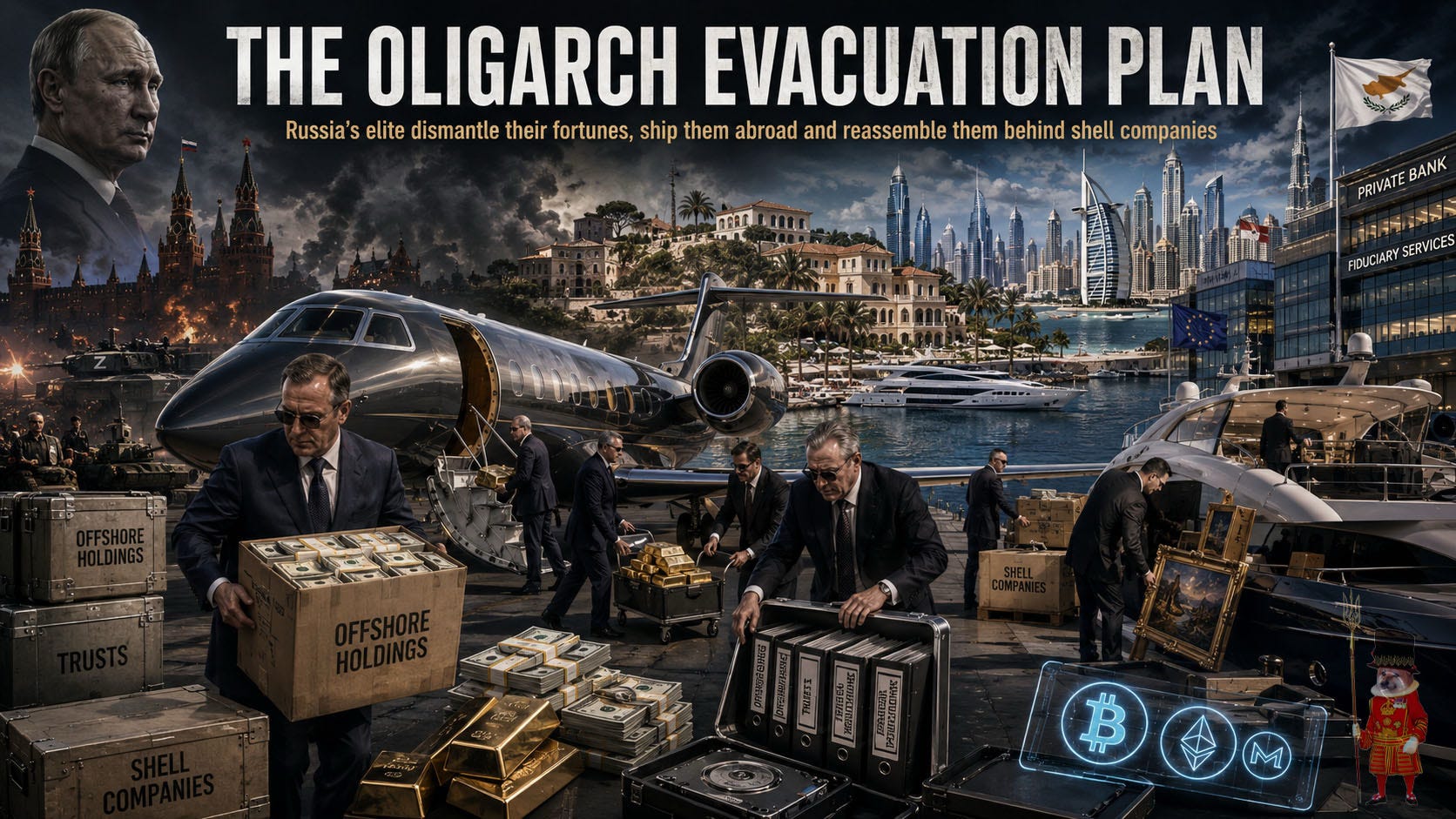
The Oligarch Evacuation Plan
Russia’s elite dismantle their fortunes, ship them abroad and reassemble them behind shell companies

Bloomberg reported July 16, 2026 that Russian billionaires are actively moving money abroad, according to Bloomberg.
The agency reports that over the past year, they have transferred billions of dollars overseas due to concerns about the state of the economy and the risk of asset seizure. It is noted that this trend has only intensified in recent months: the wealthiest Russians are increasingly investing in cryptocurrencies, foreign real estate, and private investment funds.
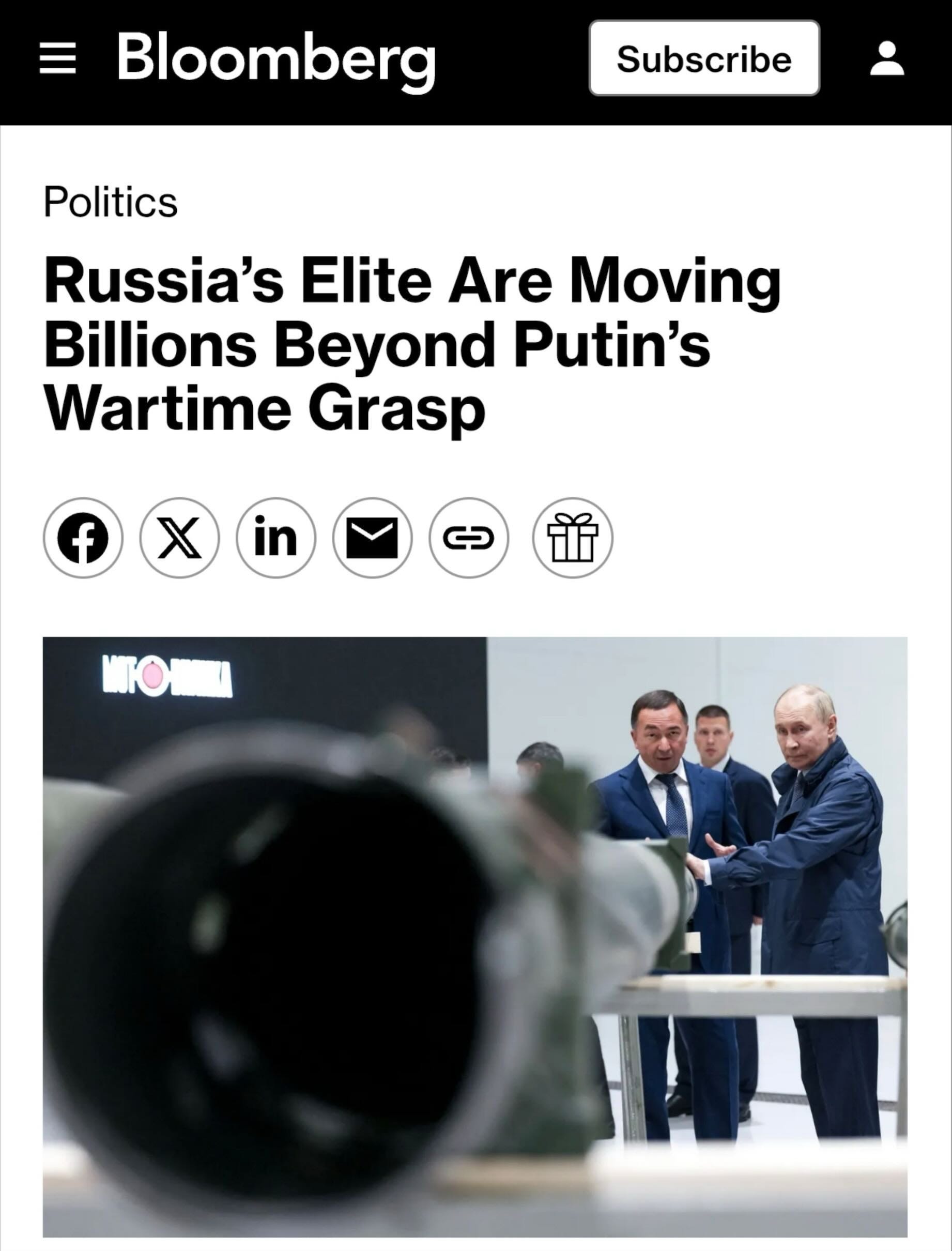
While Bloomberg’s headline is directionally convincing, social-media commentary is a little too simplistic. Beefy explains the story behind the headline:
Dirty Money, Clean Villas
Russian wealth is not simply travelling in one orderly convoy from Moscow to Western Europe.
It is splitting into several streams: some money is being repatriated because Western sanctions have made foreign ownership hazardous; some is moving into politically accommodating jurisdictions such as the United Arab Emirates, Turkey, Central Asia and parts of the Balkans; and some is being repackaged through trusts, relatives, cryptocurrencies, investment vehicles and corporate structures designed to make yesterday’s oligarch resemble tomorrow’s respectable international investor.
The central conclusion nevertheless stands.
Russia’s wealthiest people have compelling reasons to reduce their exposure to the Kremlin. Since 2022, the Russian state has confiscated, nationalised or placed under temporary administration tens of billions of dollars in domestic and foreign-owned businesses.
By 2025, Moscow was preparing to sell portions of an estimated $50 billion in assets seized since the full-scale invasion. Putin’s economic model increasingly resembles a hotel where checkout is forbidden and management reserves the right to steal the luggage.
At the same time, sanctions have made traditional Western holdings vulnerable.
Russian companies and individuals have lost access to bank accounts, property, securities, yachts and corporate stakes. Reuters reported in March 2026 that Russian private assets frozen in the EU were estimated at approximately $33 billion, while two decades of Russian overseas expansion had once produced cumulative capital outflows of roughly $800 billion between 2000 and 2021.
The result is not the disappearance of Russian capital but its migration into darker water.
The Cyprus laundromat with sea views
No EU jurisdiction illustrates the machinery better than Cyprus. The Cyprus Confidential investigation, based on 3.6 million leaked records, found that 67 of the 104 Russians appearing on Forbes’ 2023 billionaires list had used Cypriot professional-services firms.
It identified 96 sanctioned Russian clients and nearly 800 companies and trusts in secrecy jurisdictions owned or controlled by Russians sanctioned since 2014.
Those entities stretched from Cyprus into the British Virgin Islands, Jersey, the Isle of Man, Liechtenstein and Hong Kong.
Cyprus was not merely a storage cupboard for old money.
Its accountants, lawyers, company administrators and fiduciaries provided the plumbing through which assets could be transferred, renamed and placed behind nominees.
ICIJ reported that PwC Cyprus assisted Alexey Mordashov in transferring a $1.4 billion investment out of his name as EU sanctions approached. Mordashov’s representatives said all notifications were properly made and denied breaching any law, while Cypriot authorities opened an investigation. That distinction matters: an investigation is not a conviction. But the timing and complexity demonstrate why sanctions drafted in Brussels can arrive in Limassol after the furniture has already been moved.
Petr Aven’s affairs offer another example.
ICIJ and UK court records described how a Cyprus-based corporate-services firm was involved in moving approximately $5 million on the day Aven was sanctioned.
The British National Crime Agency alleged that structures involving Cyprus firms and European banks were used to put wealth beyond sanctions, allegations Aven has contested. Again, the lesson is structural rather than merely personal.
The oligarch may appear on the sanctions list, but the money is legally owned by a trust, administered by a company, financed by another company and made available to a relative. The billionaire vanishes behind a shrubbery of paperwork.
Cyprus has tightened its banking system and insists that its anti-money-laundering controls have improved substantially. Russian deposits had fallen sharply before the full-scale invasion, and authorities subsequently launched investigations with international assistance. But the vulnerability was never confined to bank deposits. It lies in the professional-services economy: trusts, nominee directors, accounting advice, corporate restructuring and cross-border asset administration. A bank account can be frozen. A web of discretionary trusts spread across five jurisdictions requires considerably more detective work.
France: where the villas acquire shell companies
France demonstrates both the attraction of Western assets and a more muscular way of investigating them.
In 2024, French authorities seized about €70 million, roughly $75 million, in Riviera properties and luxury vehicles linked to Russian businessmen Ruslan Goryukhin and Mikhail Opengeym during an aggravated money-laundering investigation. The properties were allegedly financed through companies in Cyprus and the British Virgin Islands, sometimes through loans from companies ultimately connected to the beneficiaries themselves.
Neither seizure nor investigation amounts to a criminal conviction, but the case illustrates the standard architecture: offshore company, related-party loan, Monaco or French property company, expensive villa, and a beneficial owner several curtains behind the stage.
French law is important because it permits courts, under specified circumstances, to require the holder of suspicious assets to demonstrate the legitimate origin of the funds.
That is more effective than asking investigators to reconstruct thirty years of post-Soviet privatisations, commodity deals, state contracts and offshore transfers while the defendant’s lawyers bill by the geological era. The safeguard must remain judicial, appealable and evidence-based, but unexplained wealth laws are considerably more useful than issuing another sternly worded communiqué.
Germany: the trust owns it, apparently
Germany has exposed the limits of sanctions enforcement when ownership is buried in trusts and foreign companies. Investigations connected to Alisher Usmanov involved properties, valuables and payments allegedly made through foreign entities after sanctions were imposed.
In December 2025, Munich prosecutors agreed to discontinue one sanctions-related investigation after Usmanov paid €10 million, without an admission of guilt.
A separate money-laundering investigation had already been dropped, and his lawyers successfully challenged several allegations and searches.
This is not evidence that enforcement was pointless.
It is evidence that legal ownership, beneficial control and practical enjoyment are different creatures.
A sanctioned person may not hold the title to a villa, yacht or company, yet may still be alleged to exercise influence or receive benefits through relatives, employees, trustees or holding companies. Germany’s experience shows why sanctions authorities need specialist trust lawyers, forensic accountants and cross-border disclosure powers, rather than a spreadsheet containing famous Russian surnames and a hopeful expression.
Germany is also an example of how Russian financial influence extends beyond luxury consumption.
Cyprus Confidential revealed that a shell company associated with Mordashov had funded a German journalist known for sympathetic coverage of Putin, including approximately $700,000 described as sponsorship for books.
The journalist acknowledged Mordashov’s support but defended his work as independent. Dirty-money controls therefore concern more than villas and yachts. Foreign wealth can purchase access, prestige, litigation, lobbying and narrative influence.
Malta: citizenship was for sale, until the court closed the shop
Malta turned access to the European Union into a luxury product. Its citizenship-by-investment scheme generated more than €1.4 billion, but in April 2025 the Court of Justice of the European Union ruled that the programme violated EU law because it commercialised both Maltese and EU citizenship. Cyprus and Bulgaria had already ended comparable passport programmes.
The danger was not simply that a wealthy Russian could acquire a sunnier passport. EU citizenship offered residence rights, easier banking relationships, property access, company formation and the ability to present Russian-derived wealth as belonging to an EU national.
The oligarch did not need to smuggle cash over a border. The border was gift-wrapped and sold to him.
Malta must now conduct a serious retrospective review of citizenship granted through the scheme, especially where applicants concealed political exposure, sanctions risk, criminal associations or the true source of wealth.
Revocation should not be automatic merely because an individual was born in Russia. It should follow evidence of fraud, false declarations, sanctions evasion or other legally established grounds. Collective punishment is both unjust and strategically foolish. The target is kleptocratic and sanctions-linked wealth, not nationality.
Greece: property, residency and maritime infrastructure
Greece is a different category. There is less public evidence tying recent oligarch transfers to Greece on the scale documented in Cyprus, but the country possesses several characteristics attractive to Russian wealth: valuable property, a residence-by-investment programme, extensive shipping expertise, ports, maritime insurers and corporate-service providers.
Golden-visa programmes across Europe have produced relatively modest economic gains while inflating property markets and creating money-laundering and security risks.
Greece has tightened investment thresholds, but the basic model remains vulnerable when the source of funds is examined politely rather than forensically.
Shipping is equally significant.
Greece, Cyprus and Malta control substantial maritime capacity and have repeatedly warned that excessively broad restrictions on shipping services could push business into non-EU jurisdictions.
That argument has economic logic, but it also reveals the pressure point. Russian oil and associated wealth depend on ships, flags, insurance, classification, brokerage and payment services. Moscow’s shadow fleet did not materialise by sorcery. It was assembled by exploiting fragmented ownership, ageing vessels, opaque insurers and accommodating registries.
Greece should therefore treat property purchases, residency applications, shipping-company ownership and private investment structures involving high-risk Russian clients as one connected risk environment.
At present these are often supervised as separate industries, allowing the same money to pass from offshore company to vessel, from vessel income to fund, and from fund to apartment without anyone being required to assemble the whole mosaic.
The Balkans: the EU’s waiting room, with offshore parking
Montenegro offers a particularly clear warning. OCCRP documented how millions of dollars of dubious, and in some cases criminal, Russian-origin money moved into the country through yacht payments and property transactions.
Montenegro’s tourism economy, coastal property market, company-registration system and historic openness to Russian capital made it an attractive staging post between Russia, the Adriatic and the EU.
The wider Balkan problem is not uniform.
Montenegro, Serbia, Croatia, Bulgaria, North Macedonia, Albania and Bosnia and Herzegovina have different laws and geopolitical alignments. But several share small regulatory institutions, politically connected property development, foreign-investment dependence and company registers that are easier to enter than to interrogate.
Serbia remains especially exposed because major Russian state-linked corporate interests were embedded in its economy long before 2022. As of June 2026, Serbia’s sole oil refinery, NIS, was still operating under repeated US sanctions waivers while a sale of the controlling stakes held by Gazprom Neft and Gazprom was negotiated.
This is not oligarch capital flight in the narrow sense, but it demonstrates how Russian corporate wealth can become entangled with the infrastructure of an EU candidate state, producing political leverage whenever enforcement becomes inconvenient.
EU accession policy should treat money laundering, sanctions enforcement and beneficial ownership as security requirements, not decorative chapters to be closed shortly before the flag ceremony.
Candidate countries should be required to establish searchable property and company registers, disclose owners of trusts and investment vehicles, strengthen independent financial-intelligence units, and cooperate automatically with EU sanctions agencies.
Dubai, Turkey and the new eastern escape route
The most important contemporary destinations may lie outside Europe. Dubai became a major sanctuary after 2022 because it combined luxury property, residency opportunities, international banking, free zones and an initially cautious approach to Western sanctions.
Wealthy Russians purchased homes, relocated companies and used the UAE as a base for trade with Asia and the Middle East.
Turkey also offered property, citizenship, tourism links, ports and financial channels, although Western pressure has gradually constrained some Russian payment systems. Armenia, Georgia, Kazakhstan and Kyrgyzstan became important for company formation, trade intermediation and payments.
These jurisdictions are not necessarily the final resting places of the money.
They are financial airlocks where Russian capital changes documentation before continuing towards harder currencies and more secure assets.
This is why stopping Russian kleptocratic wealth cannot be achieved solely by inspecting incoming transfers labelled “Russia.” Funds may arrive from a Cypriot trust, a Dubai property company, a Turkish exporter, a Kyrgyz cryptocurrency exchange or a family office in Switzerland. The geographical label has been laundered before the money has.
Crypto: the emergency tunnel beneath the sanctions wall
Cryptocurrency is not replacing offshore finance. It is joining it.
The rouble-backed A7A5 stablecoin, launched through structures connected to sanctioned Russian financial actors and based in Kyrgyzstan, had processed more than $40 billion in transfers by July 2025, according to blockchain researchers cited by Reuters.
More than $1 billion a day was reportedly moving through it during a period of rapid growth. Reuters could not independently determine the source or purpose of all transactions, but investigators identified the coin as a mechanism capable of bypassing conventional payment restrictions.
By August 2025, Britain had sanctioned entities connected to A7A5 and associated Kyrgyz crypto infrastructure, describing the networks as channels for Russian sanctions evasion.
The stablecoin allowed roubles to be converted into assets such as Tether and then transferred across borders without relying on sanctioned banks or SWIFT.
Crypto’s attraction is speed. A villa requires lawyers, notaries and registration.
A stablecoin can move in minutes. But blockchain transactions are not invisible; they are permanently recorded.
The weakness lies in enforcement fragmentation, cross-chain transfers, mixers, decentralised exchanges and conversion points located in jurisdictions unwilling or unable to cooperate.
Western governments should focus less on banning cryptocurrency in the abstract and more on controlling the gateways. Stablecoin issuers, exchanges, custodians, over-the-counter brokers and payment companies must be required to screen beneficial owners and freeze sanctioned addresses rapidly. Regulators should sanction replacement exchanges when a designated platform merely changes its logo and reopens two streets away in cyberspace.
The real accomplices wear suits
The most important insight is that oligarch wealth does not hide itself. It is hidden by professionals.
Lawyers establish trusts.
Accountants restructure holdings. bankers process transfers.
Estate agents accept offshore buyers. Fund managers package assets.
Notaries authenticate deals.
Public-relations companies rehabilitate reputations. Litigation firms threaten investigators.
Academic analysis of offshore networks found that Russian oligarch structures are often concentrated around a relatively small group of professional intermediaries. Disrupting those highly connected advisers may be more effective than sanctioning individual billionaires one at a time. Remove one oligarch and the network adapts. Remove the network’s architect and several financial castles collapse together.
The EU should therefore introduce mandatory sanctions-risk duties for lawyers, accountants, trust providers, investment advisers, art dealers, estate agents and private-equity managers.
Professional secrecy must not become a franchise licence for sanctions evasion. Where advisers knowingly design structures to conceal a sanctioned beneficiary, penalties should include licence removal, corporate fines, director disqualification and criminal prosecution.
What Europe should do now
Europe first needs a comprehensive, interconnected beneficial-ownership system covering companies, trusts, foundations, property, aircraft, yachts, art, securities and private funds.
Registers should record both legal title and the person who ultimately controls, benefits from or finances the asset. Family members and nominees should not be presumed guilty, but authorities must be able to investigate whether ownership transfers are genuine or merely sanctions origami.
Second, the EU’s new Anti-Money Laundering Authority should be accelerated.
AMLA is not expected to begin direct supervision of 40 high-risk financial institutions until 2028. By then, another geological layer of shell companies may have accumulated. The authority needs early powers to coordinate Russian asset tracing, set minimum standards for high-risk clients and intervene where national regulators are failing.
Third, unexplained-wealth and civil-forfeiture mechanisms should be harmonised.
Where prosecutors demonstrate substantial evidence that an asset is connected to corruption, sanctions evasion or concealed beneficial ownership, the holder should be required to explain the legitimate source of the funds. Confiscation must remain subject to courts, evidence and appeal. The objective is not to copy the Kremlin’s habit of stealing first and inventing the legal theory later.
Fourth, golden passports should remain prohibited and golden visas should either be ended or subjected to genuinely forensic source-of-wealth tests.
Existing grants should be reviewed where there is evidence of deception, political exposure, organised crime or sanctions circumvention.
Fifth, sanctions must follow families, proxies and corporate reorganisations where evidence shows continued control.
Transferring an asset to a spouse shortly before designation should not automatically protect it, nor should placing it in a trust whose beneficiaries and protectors remain closely connected to the sanctioned person.
Sixth, the EU should make sanctions enforcement a core condition for access to its markets and accession process.
Cyprus, Malta, Greece and Balkan states should receive technical support, but also deadlines, audits and consequences. “We are improving” is not a substitute for prosecutions, transparent registries and assets actually being restrained.
Finally, lawfully confiscated private assets and the income generated from immobilised Russian state assets should support Ukraine.
The distinction is crucial. Russian sovereign reserves, frozen oligarch property and criminally laundered assets occupy different legal categories. But the political principle remains sound: the financial system that enriched Russia’s wartime elite should not remain entirely insulated from the devastation inflicted on Ukraine.
Beefy’s Conclusions
The flight of Russian billionaire wealth is not evidence that the oligarchic system has broken with Putin.
It is evidence that its beneficiaries understand the system perfectly. Their fortunes were accumulated in a state where ownership depends on political permission, courts serve power and loyalty is rented by the month.
They are now purchasing insurance against the regime that made them rich.
For Ukraine, the danger is obvious. Wealth extracted from Russian natural resources, state contracts, monopolies and politically allocated assets is being converted into Western property, residency, funds, companies and influence.
Once sufficiently laundered, yesterday’s Kremlin insider becomes today’s European investor, philanthropist or distressed dissident, complete with a renovated biography and a tasteful foundation.
Europe has spent decades providing the washing machine, the detergent and, in some jurisdictions, complimentary citizenship. It is now expressing surprise that the laundry has accumulated.
Europe should be hostile to fortunes that arrive through six shell companies, three passports, a nephew, a stablecoin and a lawyer insisting that nobody technically owns anything.
It should also punish those European States that make it easy for Russian money to be washed into the Union - including known facilitators of Oligarch money washing - Malta, Cyprus, Greece and others.
References and Sources:
The Daily Beast, “Russian Billionaires Move Assets Abroad Amid Seizure and Economic Fears”
https://www.thedailybeast.com/putin-humiliated-as-russia-hemorrhages-billions/
Russian capital flight and domestic confiscations
Reuters, “Russia seizes $50 billion in assets as economy shifts during war in Ukraine”
Reuters, “Lukoil fire sale marks failure of Russia’s $800 billion bet to go global”
Reuters, “US owner of major Russian agriculture firm says no plans to sell up”
Reuters, “Russia to sell seized stake in gold producer UGC to unit of Gazprombank”
Cyprus and offshore structures
International Consortium of Investigative Journalists, Cyprus Confidential investigation hub
https://www.icij.org/investigations/cyprus-confidential/
This is the principal investigation documenting the use of Cypriot accountants, lawyers, trusts and companies by dozens of Russian billionaires and sanctioned figures.
The Guardian, “Leak reveals Roman Abramovich’s billion-dollar trusts transferred before Russia sanctions”
https://www.theguardian.com/world/2023/jan/06/roman-abramovich-trusts-transfer-leak-russia-sanctions
The Guardian, “Billionaire Putin ally forfeits £750,000 in UK sanctions case”
Associated Press, “Russian and Ukrainian business dealings with Cypriot banks dwindled due to sanctions”
https://apnews.com/article/2e18140ec83086988837762dcd7e6a9c
The Guardian, investigation into Roman Abramovich’s superyacht tax arrangements
France and Riviera property
Le Monde, “Villas, luxury cars worth €70 million and belonging to Russian oligarchs seized in France”
Le Monde, “French judicial authorities seize property belonging to Putin associates”
Le Monde, “French authorities have seized nearly €1 billion from Russian oligarchs since start of Ukraine war”
Financial Times, “Russian oligarch still owned Italian resort months after sanctions”
https://www.ft.com/content/8123531c-510f-4f49-bcf5-25401c98ab88
Germany and Alisher Usmanov
Reuters, “German prosecutors to end probe of billionaire Usmanov upon payment of €10 million”
Reuters, “German prosecutor drops money laundering investigation against billionaire Usmanov”
Reuters, “Russian-Uzbek billionaire Usmanov wins lawsuit against German newspaper”
Reuters, “Russian-Uzbek billionaire Usmanov sues UBS in Germany”
Malta and citizenship-for-investment
Reuters, “EU top court rules against Malta’s golden passport scheme”
Associated Press, “EU’s top court orders end to Malta’s golden passport program”
https://apnews.com/article/67645b54f38cf50dafb55aeb697627ce
The Guardian, “Malta’s golden passport scheme ruled illegal by EU’s top court”
Greece, Cyprus and Malta’s maritime role
Reuters, “Sweeping EU sanctions plan aims to hit Russian crude exports harder”

If you enjoy my threads, please consider supporting my work on Patreon or BuymeACoffee!
Thank You! to those who have supported me on Patreon or buymeacoffee, you are simply awesome.
buymeacoffee.com/beefeaterfella
patreon.com/Beefeater_Fella
beefeaterresearch.substack.com