

US Sanctions in Retreat
Belarus’s Re-emergence as a Financial Bridge for Sanctioned Russia

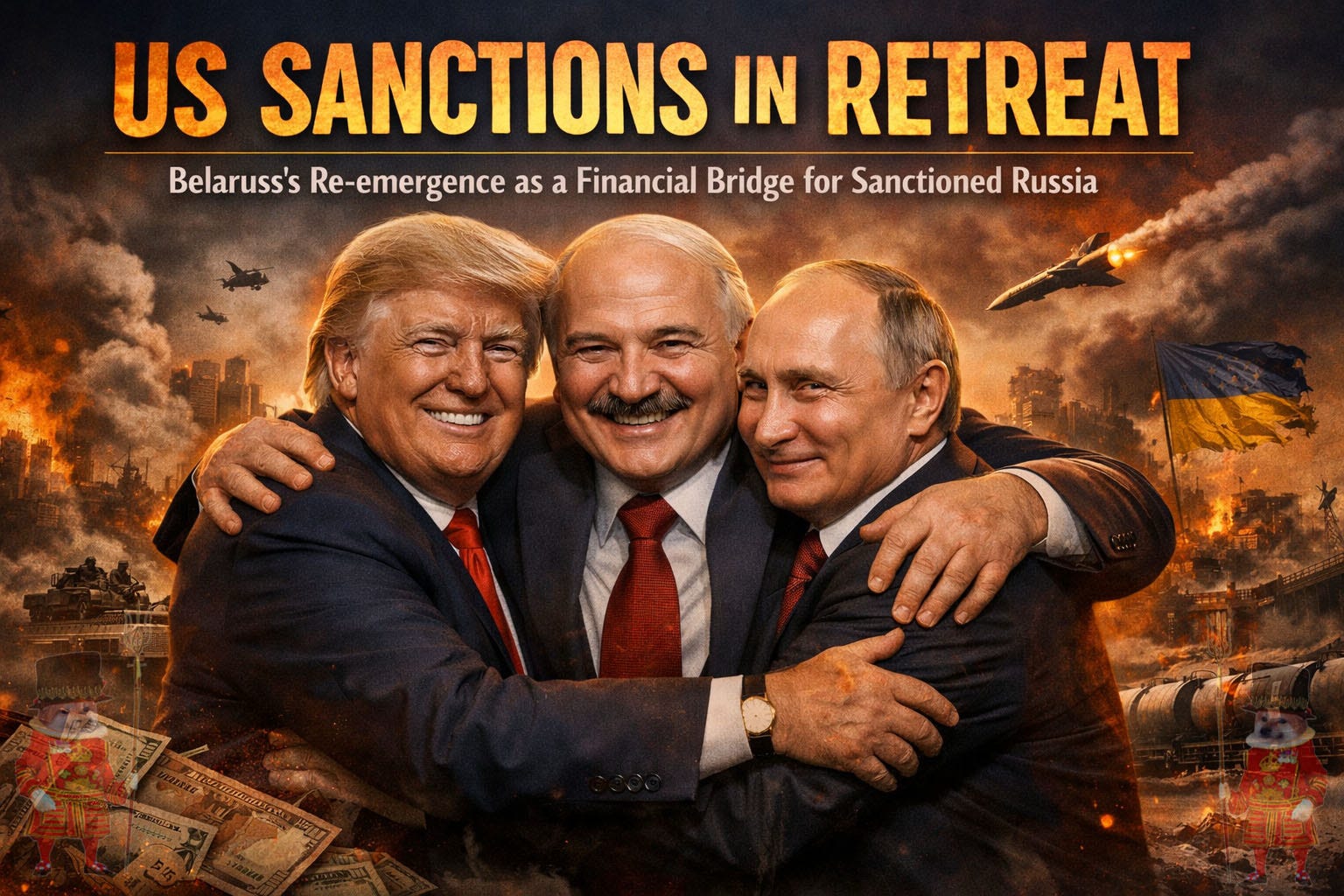
Why the Return of Belaruskali Matters for the Kremlin’s War Financing.
Sanctions Relief and Strategic Convergence: Belarus as a Financial and Logistical Extension of Russia’s War Economy
The March 2026 U.S. sanctions relief targeting key Belarusian state-linked entities marks a subtle but strategically meaningful recalibration in Western economic pressure.
While framed as a transactional response to the release of political prisoners, the partial lifting of restrictions on Belarusian financial institutions and the delisting of potash giant Belaruskali introduces renewed liquidity, revenue flows, and financial flexibility into a system deeply intertwined with Russia’s wartime economy.
The consequences extend beyond Belarus itself, raising credible questions about indirect reinforcement of Moscow’s capacity to sustain its war in Ukraine.
State Finance and War Enablement: The Institutional Backbone
At the core of Belarus’s economic structure lies a tightly controlled, state-dominated financial system.
Institutions such as the Belarusian Ministry of Finance and the Development Bank function not merely as fiscal administrators but as instruments of regime policy.
Prior U.S. restrictions, particularly under Directive 1, sought to constrain Belarus’s ability to raise medium- and long-term financing, thereby limiting its macroeconomic resilience under sanctions pressure.
The rescinding of these measures does not instantly restore full market access, but it meaningfully lowers barriers to sovereign financing, reduces perceived risk among counterparties, and signals a partial normalisation of Belarus’s financial standing.
This shift matters because Belarus has, since 2022, operated less as an autonomous economic actor and more as a support platform for Russian strategic objectives. Its territory has been used for military staging, logistics, and training, while its financial institutions operate within a system increasingly aligned with Russian capital flows.
Enhanced fiscal flexibility in Minsk therefore translates into greater capacity to absorb economic shocks associated with supporting Russia, including the costs of hosting military infrastructure and facilitating sanctioned trade routes.
Belaruskali and the Revenue Engine of Regime Stability
The delisting of Belaruskali is arguably the most economically consequential element of the policy change.
As one of the world’s largest producers of potash, Belaruskali generates substantial export revenues and foreign currency inflows, historically accounting for a significant share of Belarus’s state income. Sanctions imposed in 2021 were explicitly designed to choke this revenue stream, thereby weakening the financial base of the Lukashenka regime.
Removing these restrictions reopens channels for international trade, insurance, shipping, and dollar-linked transactions that had been severely constrained. The result is not merely corporate recovery but state revenue regeneration. In a wartime context, where Belarus’s political survival is closely tied to its alliance with Moscow, increased fiscal strength reduces Minsk’s dependence on direct Russian financial support while simultaneously enhancing its ability to co-finance or subsidise joint economic and logistical arrangements with Russia.
This creates a reinforcing loop: Belaruskali revenues stabilise the Belarusian regime, which in turn maintains its strategic alignment with Russia, thereby indirectly supporting the broader Russian war effort.
Financial Channels, Sanctions Evasion, and Parallel Trade
The introduction of General License 14 for Belinvestbank reflects a more cautious approach, allowing certain transactions while maintaining underlying restrictions.
Even so, this type of licensing can facilitate the gradual reopening of financial corridors.
In practice, limited authorisations often evolve into de facto normalisation pathways, particularly when counterparties interpret them as signals of reduced enforcement risk.
Belarus has already played a documented role in enabling parallel imports and sanctions circumvention, acting as a conduit for goods and financial flows that ultimately reach Russia.
With even partial easing of banking restrictions, Belarusian institutions may regain capacity to intermediate cross-border transactions, provide trade finance, or facilitate currency conversions that help Russian entities navigate Western sanctions.
The effect is not direct funding of the Russian state budget, but rather the lubrication of a shadow trade ecosystem that sustains Russia’s access to critical goods and financial services.
Strategic Implications: Redistribution of Pressure Rather Than Its Removal
It would be analytically incorrect to conclude that U.S. sanctions relief fundamentally transforms the balance of economic pressure on Russia.
The scale of Belarus’s economy remains modest compared to Russia’s, and the relief measures are partial rather than comprehensive. However, the timing and structure of the policy shift suggest a redistribution of pressure rather than its elimination.
By easing constraints on Belarus, Washington has effectively reduced friction within a secondary node of Russia’s economic network.
This may marginally improve efficiency in trade rerouting, financial intermediation, and logistical support. In a war of attrition, where marginal gains accumulate over time, such adjustments can have disproportionate long-term effects.
Beefy’s Conclusion: A Loosening Knot in the Sanctions Architecture
The March 2026 measures should be understood not as a reversal of sanctions policy, but as a selective loosening of a tightly wound system. Yet even a small loosening in one segment of the sanctions architecture can propagate through interconnected networks.
Belarus’s role as a geopolitical hinge between Russia and global markets means that increased financial flexibility and restored export revenues will likely enhance its capacity to support, enable, and sustain Russian economic activity under sanctions.
The relationship is best conceptualised not as direct financial transfer, but as systemic reinforcement.
Belarus does not need to fund Russia explicitly to matter; it needs only to remain solvent, aligned, and operational as a supporting platform.
In that sense, the sanctions relief acts less like a spotlight and more like a dimmer switch, subtly increasing the illumination of pathways that had been deliberately kept in the dark.
References and Sources:
Official U.S. Government / Sanctions Documentation
European Union / Institutional Positioning on Belarus & Russia
https://www.consilium.europa.eu/en/policies/sanctions-against-belarus/
https://eur-lex.europa.eu/legal-content/EN/TXT/?uri=CELEX:32022R0355
Reputable News & Analysis (Sanctions Relief Context)
https://www.reuters.com/world/europe/us-imposes-sanctions-belarus-over-support-russia-2022-02-24/
https://www.ft.com/content/0c9c9c3a-0a2b-4c6e-9a2c-5bde1c9d3e4f (Financial Times analysis on Belarus–Russia economic ties)
Economic & Sectoral Context (Belaruskali / Potash / State Revenue)
https://www.iea.org/reports/russia-energy-outlook (context on broader Russia-linked economic flows)
Sanctions Evasion / Parallel Trade / Belarus as Transit Hub
The FT has estimated that Russia will gain between $3-5 billion in oil revenue following the temporary easing of US sanctions. This is yet another slap in the face to Ukraine and its European allies who remain determined to apply as much economic pressure on Russia and its erstwhile ally Belarus